Best Gut Health Supplements Australia: How to Evaluate
, 18 min reading time
Learn how to judge the best gut health supplements Australia offers: TGA codes, probiotic strains, fibre types and label checks before you buy.
In a 2025 survey of more than 1,000 Australians, 68% said they had proactively changed their diet to improve gut health, according to research reported by Warner Bros. Discovery and published by Mirage News. That number should reset how you read any ranking of the best gut health supplements Australia shoppers are offered. Anyone looking at these products has likely already changed what they eat. A powder or capsule is a narrow add-on, not a replacement for that change.
Colony-forming units, a familiar brand, and the words "multi-strain" do not tell you whether a product fits the symptom you have. Regulatory status, the named strain or fibre, and the pattern of your symptoms do. The sections below turn those three checks into a buying order.
In a 2025 Australian consumer snapshot, 28% of respondents reported using probiotics, while 74% had taken supplements during the previous year, according to Complementary Medicines Australia industry data reported by NutraIngredients. Most readers of a "best of" list are already buyers. What they lack is a sorting method, not another winner.
No single product is best for every gut. The right category follows the symptom you are trialling it for.
| Category | Usually trialled for | Evidence strength | Main caution |
|---|---|---|---|
| Single-strain probiotic with human trials | Diarrhoea linked to antibiotics or a defined condition | Strongest where the exact strain was tested | Benefit applies only to the strain named on the label |
| Multi-strain probiotic blend | General bloating or wellbeing | Mixed; many blends lack condition-specific trials | Strain count does not predict benefit |
| Soluble fibre (psyllium husk) | Constipation and stool consistency | Reasonable for regularity | Needs plenty of water; start with a small dose |
| Prebiotic fibre (inulin, GOS) | Regularity and feeding gut bacteria | Mixed in IBS | Can increase gas and bloating |
| Digestive enzymes | Fullness after meals | Limited for general gut health | See a GP if symptoms persist |
| Other gut-marketed extracts (NAC, nattokinase, TUDCA) | Gut support claims, main evidence for other uses | Little gut-specific human evidence in healthy adults | Not a first choice for gut symptoms |
Read the middle two columns together. A single strain with a human trial for antibiotic-linked diarrhoea is a different purchase from a nine-strain blend sold for "wellbeing". Soluble fibre has a clearer job, stool form, than a prebiotic that mainly feeds bacteria and can add gas. Enzymes and extracts such as NAC, nattokinase or TUDCA often arrive in the gut aisle because the marketing fits, not because gut trials in healthy adults are the main evidence base.
If you are comparing powders, start with named strains and a viable count, not the largest number on the tub. A plain way to compare probiotic powder strains and CFUs is to line the microorganism code up against the symptom, then ignore any brand that will not show both.
Practical rule: Name the symptom, pick one category from the table, then check the specific product. Do not start with the brand.
People also reach for kitchen remedies when bloating shows up after meals. A separate look at apple cider vinegar for bloating and other natural remedies is fine as background, but vinegar is not a row in this table and it does not replace a fibre or strain match. Shortlist one or two categories before you compare packs. Two categories is the ceiling. A third usually means the symptom is still unnamed.
Australia sorts these products by presentation and claims, not by how "natural" the front of the pack looks. The Therapeutic Goods Administration guidance on listed and registered complementary medicines states that nutritional supplements may be foods or therapeutic goods, while many vitamin, mineral and probiotic products presented as complementary medicines generally need to meet therapeutic-goods requirements. Unless an exemption applies, those goods must be on the Australian Register of Therapeutic Goods (ARTG) before they can legally be imported, manufactured or supplied here.
For medicines, the TGA defines a probiotic as a live microorganism that, when administered in adequate amounts, is proposed to provide a health benefit to the host. Guidance published in 2024 covers microorganisms used as active ingredients, including probiotics and postbiotics. Quality guidance for listed probiotic medicines carrying an AUST L or L(A) number says the species name must appear on the label when the organism is identified at species level in the Australian Approved Name list and the ARTG entry.
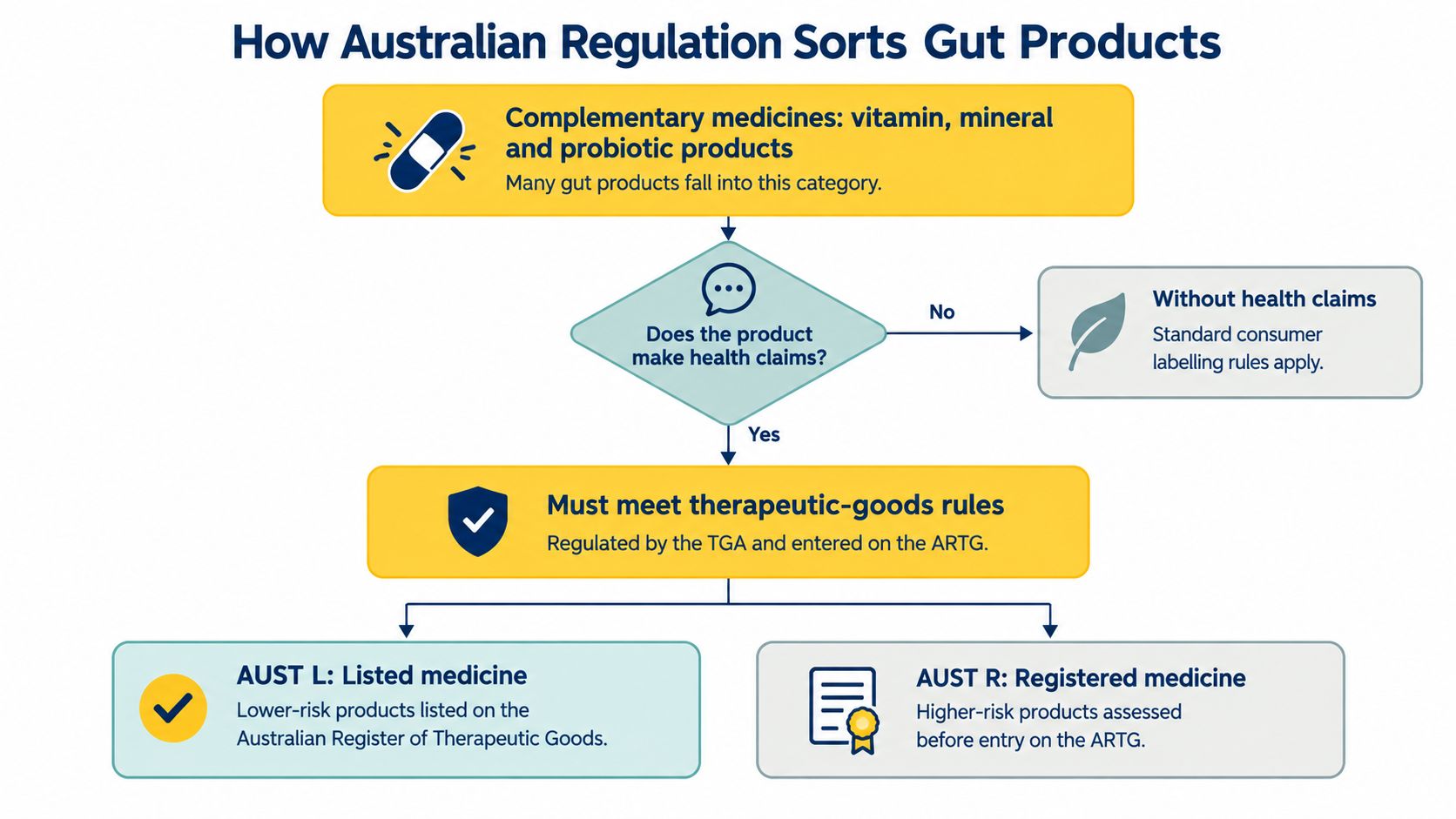
| Code or status | What it means | What it tells you | What it does not prove |
|---|---|---|---|
| AUST R | Registered medicine | Full TGA pre-market check of safety, quality and efficacy | Does not guarantee benefit for every person |
| AUST L | Listed medicine | Ingredients and quality assessed for the intended purpose | Efficacy claims are not individually pre-approved |
| AUST L(A) | Listed medicine, variant listing | Listed probiotic medicine subject to TGA quality guidance | Same limit as AUST L on efficacy |
| No AUST number | Food or unlisted product | Product sits outside the listed or registered medicine route | Health claims on it are a warning sign |
| ARTG number | Entry on the TGA register | Lets you confirm the product is on the public database | Does not confirm the claim matches the strain |
AUST R is the only code in that list with a full pre-market evaluation of safety, quality and efficacy. Listed products follow a different pathway. Copy the ARTG number from the pack and search the TGA public database before you pay. Confirm the entry names the same strain or species as the label. A matching number with a different organism is not a match.
Put two labels side by side. One reads Lactobacillus rhamnosus plus a strain code. The other says only "probiotic blend" or "multi-strain". The first can be checked against a trial. The second cannot.
Better Health Channel guidance from Victoria is blunt on this point. Probiotic effects depend on the species and strain, and in-vitro activity has not consistently translated into demonstrated human efficacy. The evidence has also been judged insufficient to establish a general probiotic combination as effective for preventing or treating diarrhoea from any cause. The same guidance says healthy people generally do not need probiotic supplements for routine gut health, and that whole foods and lifestyle come first. A clinician-defined use is the rational case for a supplement. Immunocompromised people, those who are seriously ill, and people with complex medical conditions should get medical advice before use.
Viable count has to survive the shelf. A colony-forming unit figure stated only at manufacture describes the day the batch was made. Live cells decline over time, so the number that matters is the count guaranteed at the expiry date, read alongside a storage line that says refrigerate or keep at room temperature. A missing storage line means you cannot know which applies.
A qualified line about occasional digestive comfort, next to an ARTG or AUST number, is a different document from "heals leaky gut" or "detoxes the bowel". Those phrases signal weak evidence rather than a stronger product. Fibre labels should state grams of fibre per serve. A proprietary blend with no amounts hides the dose you are paying for.
| Label element | What good looks like | Red flag |
|---|---|---|
| Strain identity | Genus, species and strain code, for example Lactobacillus rhamnosus with its strain code | Only multi-strain or probiotic blend |
| Dose | Colony-forming units stated at expiry date | Units stated only at manufacture |
| Storage | Clear instruction for refrigeration or room temperature | No storage information |
| Expiry and batch | Batch number and expiry date visible on pack | Missing or illegible dates |
| Health claim | Qualified wording tied to a named use, with ARTG or AUST number | Words such as cures, detoxes or heals leaky gut |
| Fibre content | Grams of fibre per serve stated | Fibre described only as gut-friendly |
| Ingredients and allergens | Full ingredient list including milk, gluten or soy | Proprietary blend with no amounts |
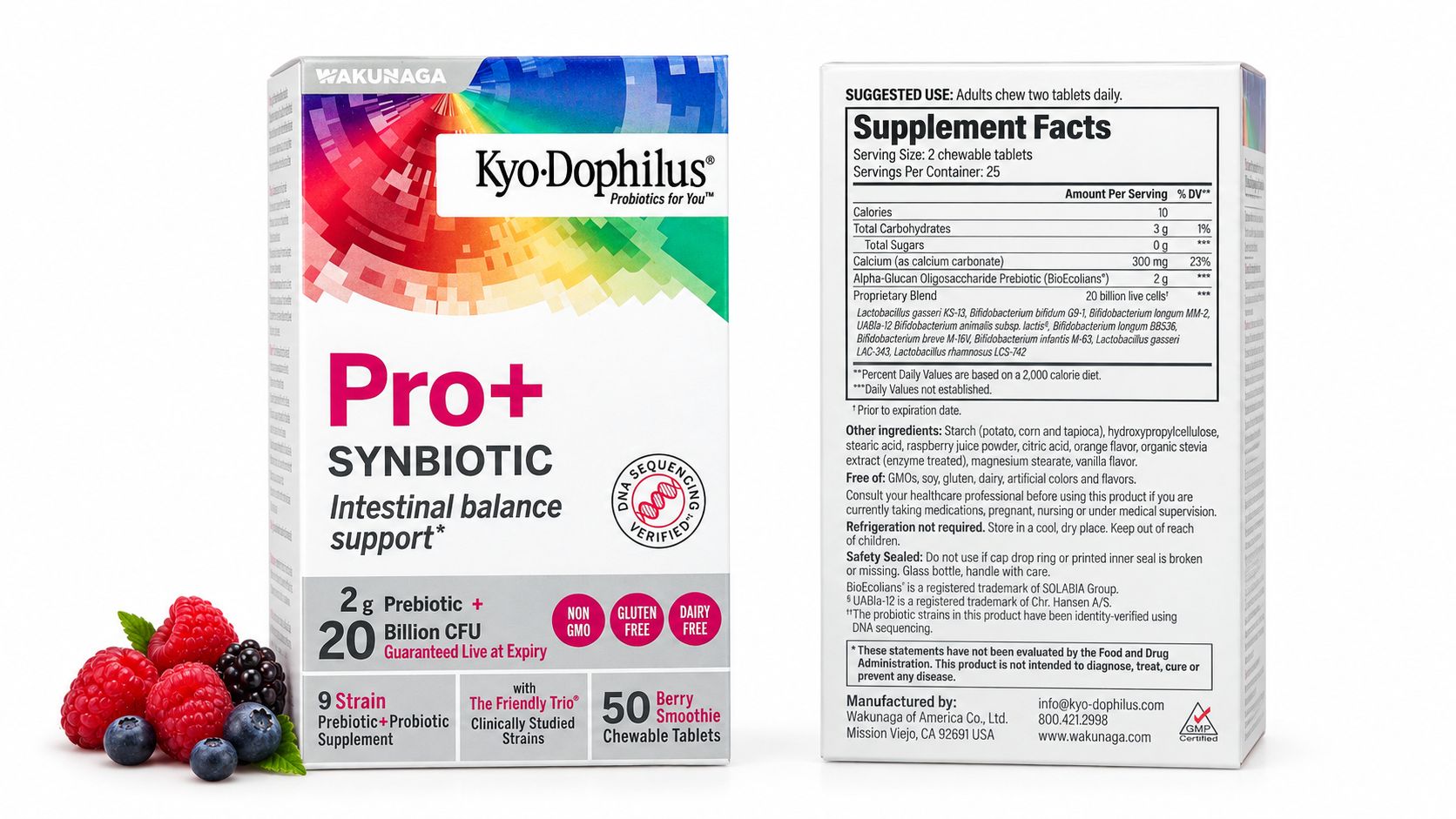
Kyolic Kyo-Dophilus® Pro+ Synbiotic, Berry Smoothie, Chewable Tablets shows this checklist applied to a real pack. The label lists its organisms at strain level rather than behind a blend name, states the live cell count as guaranteed through expiry, and combines a prebiotic fibre with the probiotic strains, which is what "synbiotic" on the front signals. One check still fails. The organisms sit inside a proprietary blend, so the panel gives a combined count rather than the dose of each strain, and you cannot tell how much of any single organism lands in a serve. That is a partial pass. A named-strain label with an expiry-dated count clears more of this list than most products on the shelf, and the pack still cannot prove a benefit for your symptom.
Reject any product that fails the strain, the expiry dose or the storage line, whatever the price. A cheap label you can verify beats an expensive one you cannot.
The Australian Dietary Guidelines set practical fibre targets of at least 25 g a day for adult women and 30 g a day for adult men, and the Australian Bureau of Statistics reports that the guidelines direct Australians to obtain at least two-thirds of grain and cereal foods from wholegrain or high-fibre varieties. A supplement dose exists to close the gap those targets leave, because a single serve of a few grams cannot supply a whole day's fibre.
Fibre that resists digestion in the small intestine reaches the colon, where microbiota ferment it into metabolites including short-chain fatty acids that can support the colonic lining and influence motility. The outcome depends on fibre type, dose, fluid, baseline diet and tolerance, so the useful question is which fibre matches your symptom pattern. A high CFU number on the same shelf proves none of that.
Soluble fibres thicken in water, while fermentable fibres feed bacteria, which is why the dose that relieves one person can bloat another. The defensible supplement is a clearly quantified soluble or prebiotic fibre used to close a gap you have counted, introduced gradually with water. Marked bloating or irritable bowel symptoms call for a slower increase, because rapid fermentation can worsen gas and distension.
| Fibre type | Typical source | What it tends to do | Watch for |
|---|---|---|---|
| Psyllium husk | Plantago ovata seed husk | Adds bulk and eases constipation | Needs fluid; can cause gas early on |
| Inulin and FOS | Chicory root | Feeds bifidobacteria | Gas and bloating, especially at higher doses |
| Galacto-oligosaccharides (GOS) | Milk-derived | Prebiotic effect on bifidobacteria | Bloating; not suitable for dairy-avoiders |
| Partially hydrolysed guar gum (PHGG) | Guar bean | Soluble fibre studied for regularity and IBS symptoms | Tolerance varies between people |
| Beta-glucan | Oats or yeast | Soluble fibre mainly studied for cholesterol | Check the source for gluten if avoiding it |
Psyllium is the blunt instrument for hard, infrequent stools, provided you drink with it, and it is the row aimed squarely at constipation rather than bacterial feeding or cholesterol. Inulin, FOS and GOS feed bifidobacteria, and they are also the types most likely to balloon someone who already feels gassy. PHGG is the softer soluble option many people trial when a husk feels too bulky. Beta-glucan belongs in a cholesterol conversation more than a constipation one, and oat sources need a gluten check if you avoid gluten.
Write yesterday's fibre in grams from food, then subtract it from 25 g or 30 g. A 6 g gap is a different product decision from a 1 g gap, and a bar or serve that states its grams lets you close that gap on purpose. Our guide to Fibre Boost bars shows how a stated fibre serve fits a normal day alongside oats, legumes and whole grains.
If you cannot name the gram gap, you are not ready to pick a tub.
Probiotics and fibre fail in different ways, and irritable bowel syndrome makes that obvious. IBS affects nearly 11% of Australians, as set out by ECU's National Health Innovation and Research Institute. A product that helps a constipated gut can worsen a bloated one, and regulatory listing only shows a product may be supplied, not that it matches diarrhoea-, constipation- or bloating-dominant IBS.
Judge the category by symptom pattern and strain-level evidence, not by colony-forming units, brand reputation or the phrase “multi-strain”. Fermentable prebiotic fibres are the usual failure point when bloating leads. Defined strains only make sense when the label names the strain and the dose matches the course that strain was tested for. A low-FODMAP phase can calm symptoms while narrowing the diet, so treat it as time-limited and pair any probiotic decision with dietitian-led counselling rather than adding a blend because the front panel promises “balance”.
Run this label drill before buying an IBS-marketed product: if it says “gut friendly” or “low FODMAP” but gives no strain IDs, no expiry-dated count, no fibre grams and no review point, the trade-off is unstated. Clinics that treat IBS as a condition, including Sunridge Medical's approach to IBS, start from the symptom pattern rather than a favourite ingredient.
Three mismatches cause most of the harm.
Judge a fibre product at a four-week review, and a defined-strain probiotic over the course that strain was tested for. Our IBS Awareness Month notes make the same point: symptoms deserve a plan, not a bigger tub. See a doctor before any supplement if you have unexplained weight loss, blood in the stool, a persistent change in bowel habit, anaemia, or a family history of bowel cancer.
Some people should not start from a product page. Immunocompromised people, anyone seriously ill, people with a central venous catheter, and people with complex medical conditions need advice from a GP or pharmacist first. The same applies in pregnancy and while breastfeeding. A live organism or a fermentable fibre is a small risk for many adults and a different risk in those groups.
Fibre can change how and when some medicines are absorbed. Many pharmacists separate a fibre dose from other medicines by at least two hours. Ask before you combine, especially with narrow-therapeutic-index drugs. Do not guess the gap from a blog.
Milk-derived fibres: GOS from milk is a problem if you avoid dairy, even when the front panel says "gut friendly".
Gluten in grain fibres: Oat beta-glucan and some bran products need a gluten-free statement if coeliac disease or a gluten-free diet is the constraint.
High-FODMAP prebiotics: Inulin and GOS are the wrong first trial when IBS bloating is the complaint.
Keep the product inside its storage conditions and inside the expiry date. Skip unlisted imports that carry gut claims and no AUST or ARTG number.
Say bloating is the complaint and soluble fibre is the category you shortlisted. Start at about a quarter of the label dose, drink a full glass of water with it, and keep a two-week symptom diary with stool form, pain and distension. Stop if pain or swelling increases. Do not "push through" a clear worsening on the theory that more fibre is always progress.
A diary with dates beats a memory of "I think it helped".
Our support team can answer ingredient and label questions on products we sell. We cannot judge whether a product is medically suitable for you. That decision stays with your GP, pharmacist or dietitian.
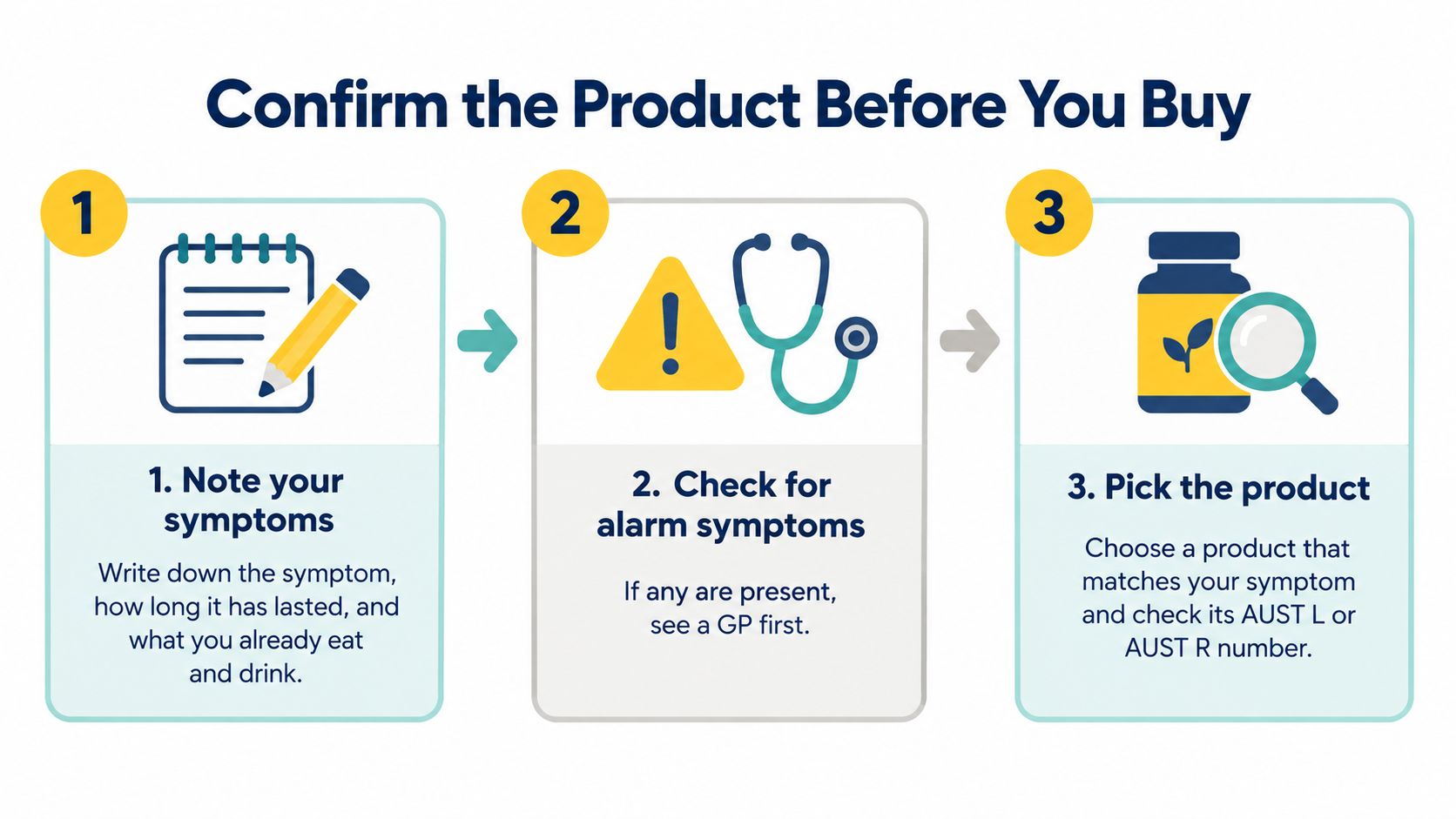
Work in this order. Skipping ahead is how a CFU claim becomes the decision.
A short walk-through of how to think about supplement choice, without treating any one brand as the answer, sits in the video below.
We sell probiotics and gut health supplements, and we also sell NAC, nattokinase and TUDCA. Those three sit in the extract row of the category table. They are not the first pick for constipation, diarrhoea or bloating. Buy only after the eight steps above still point at a product you can verify.
Wallaby Wellness stocks probiotics, gut health supplements and everyday fibre-friendly foods so you can match a verified label to the symptom you wrote down, rather than to a CFU claim. If a pack fails the strain, expiry dose or ARTG check, leave it. When you are ready to compare products that pass those checks, visit Wallaby Wellness and read the label before you add it to the cart.