Best Protein Powder for Women Australia (2026)
, 20 min reading time
Find the best protein powder for women Australia by diet, goals and label checks, with 2026 picks for whey, plant and lactose-free needs.
About 99% of Australians get enough protein from food, according to the Victorian Government's Better Health Channel. That changes the shopping question: the best protein powder for women in Australia isn't automatically the biggest scoop or the tub labelled for women. It's the one that fills a genuine gap without adding ingredients, expense or digestive trouble you don't need.
For a straightforward dairy-based top-up, whey isolate is a sensible starting point. For vegan eating or avoiding milk, a well-labelled pea and rice blend is worth comparing. First establish what's missing from your meals, then choose the source, protein density, batch testing and cost that suit that job.
No single tub is best for every Australian woman. Someone who needs a portable breakfast has a different shopping job from someone managing food allergies or a small appetite.
Use the situation that describes your week, not the goal printed beside a fitness model on the label.
Best-fit protein powder by situation
| Situation | Best-fit type | Protein per serve | Watch-out |
|---|---|---|---|
| Everyday top-up | Whey isolate | A complete serve that closes your food gap | Keep the ingredient list short |
| Lactose sensitivity | Low-lactose isolate or pea-rice | Enough to meet the identified shortfall | Concentrate often has more lactose |
| Vegan or dairy-free | Pea plus rice blend | Compare grams, not scoop weight | More fibre and carbohydrate is common |
| Strength training | Complete isolate or tested plant blend | A serve matched to your training nutrition plan | Trial in training, not on race day |
| Age over 70 or low appetite | Any tolerated complete protein | A serve you'll finish | Use the older-adult daily requirement |
| Pregnancy, breastfeeding, kidney disease or medicines | Food first; powder only if advised | Whatever a clinician sets | Avoid caffeine, fat burners and hormone blends |
For everyday convenience, whey isolate offers a practical balance of concentrated protein and easy preparation. A short ingredient list makes it easier to understand what you're buying, although flavouring or a thickener doesn't automatically make a product unsuitable.
For lactose sensitivity, look for an explicit low-lactose statement rather than assuming every isolate is lactose-free. If you're avoiding milk altogether, choose a suitable plant blend. Milk allergy is a different issue from lactose intolerance, so low lactose doesn't make a dairy powder safe for someone with a milk allergy.
For vegan eating, compare the nutrition panel before judging the scoop. A larger serving can contain more carbohydrate, fibre and flavouring without delivering more protein.
The chart offers a visual comparison of the main shopping situations.
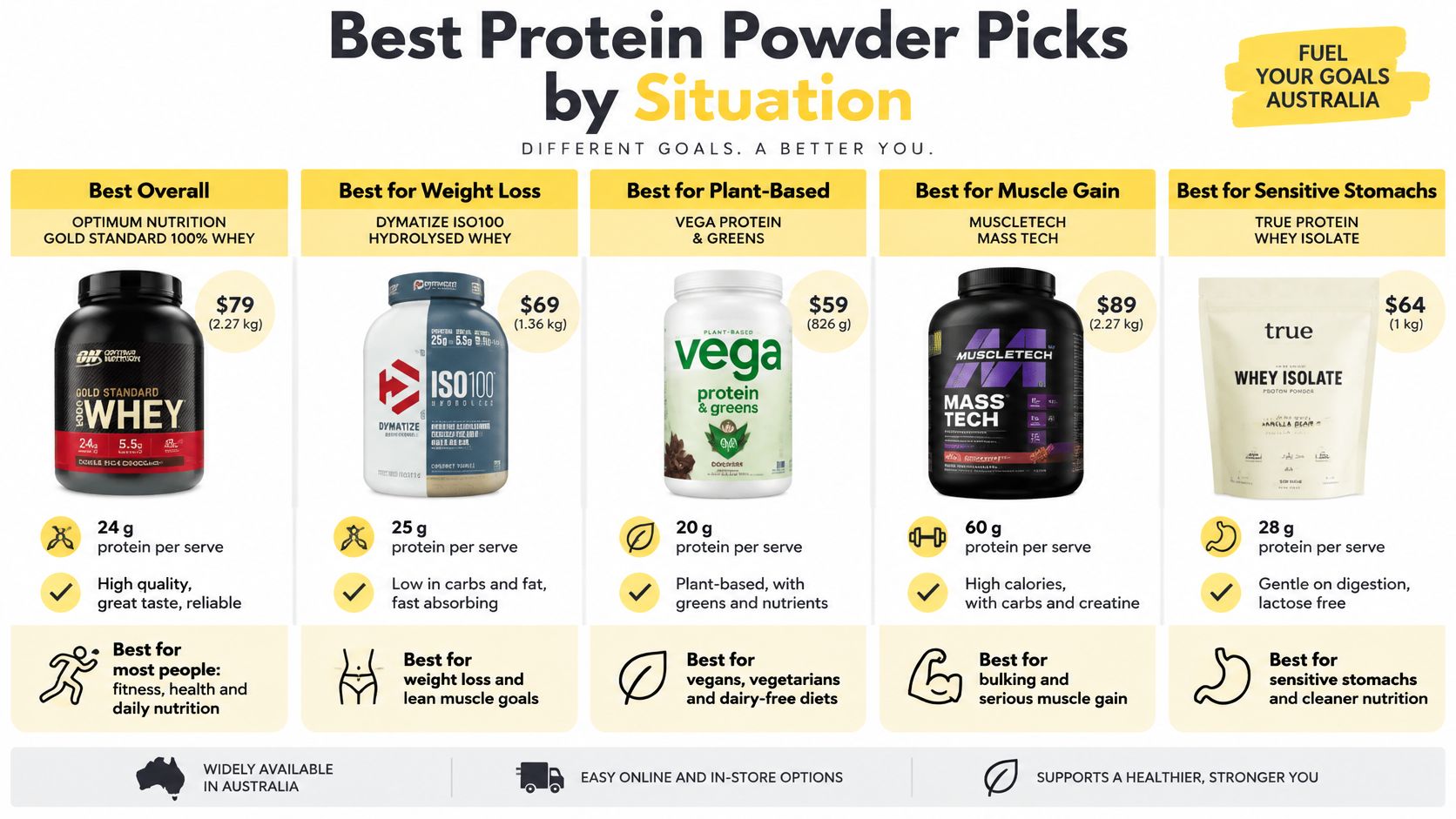
Training doesn't automatically justify a complicated sports blend. A complete protein that you tolerate is usually a more useful starting point than protein bundled with stimulants or botanical ingredients.
With a small appetite, practicality matters more than an impressive serving size. A powder that stirs into food you already enjoy may be more useful than a large shake you leave unfinished. Keep meals in place rather than allowing the drink to crowd them out.
Pregnancy, breastfeeding, kidney disease and regular medicines change the decision. Get individual advice before buying, and don't treat a plain-looking label as medical clearance.
Buying rule: Pick your situation before you read flavour claims. If you can't explain what the powder will add to your normal meals, leave it out of the basket.
Collagen belongs in a separate comparison. It isn't interchangeable with a complete protein chosen to support overall protein intake.
The Australian Government's Nutrient Reference Values set the RDI for women aged 19–70 at 46 g daily, or 0.75 g/kg, and 57 g daily for women older than 70. The same guidance gives estimated average requirements of 37 g daily, or 0.60 g/kg, for women aged 19–70, and 46 g daily after 70.
These measures aren't interchangeable. The estimated average requirement describes a population assessment benchmark, while the recommended dietary intake is designed to cover the needs of nearly all healthy people in the relevant group. Neither is a prescribed powder dose or an individual sports nutrition plan.
The Australian Bureau of Statistics' 2023 usual nutrient intake estimates found 98.5% of Australians had adequate protein intake and a female median intake of 75 g daily. Its age-specific estimates and intake spread provide the context below.
Protein intake adequacy for Australian women
| Group | Benchmark | What the figure means |
|---|---|---|
| Women 19–70 | RDI 46 g/day, or 0.75 g/kg | Baseline target, not a powder dose |
| Women over 70 | RDI 57 g/day | A higher baseline to consider when planning meals |
| All Australians, 2023 | 98.5% adequate | Powders aren't a population-wide fix |
| Women 19–64 | Inadequate intake about 0.3–0.5% | Very few miss the basic requirement |
| Women 65–74 | 1.7% inadequate | Meal intake deserves a closer look |
| Women 75 and over | 6.2% inadequate | The clearest higher-risk age group |
| Female intake spread | Median 75 g; 95th percentile at least 110 g | Many women already eat above the baseline RDI |
Write down what you eat, including breakfast, snacks and drinks. Use food labels and a protein intake calculator as planning aids, rather than guessing from whether a meal feels healthy.
Check for these everyday contributors:
A powder may be convenient when breakfast keeps getting skipped or a restrictive eating pattern leaves meals difficult to organise. It isn't automatically better than adding food you already like.
The supplied visual below concerns cosmetic face powder, not dietary protein, so it shouldn't be used as evidence of protein intake or supplement need.
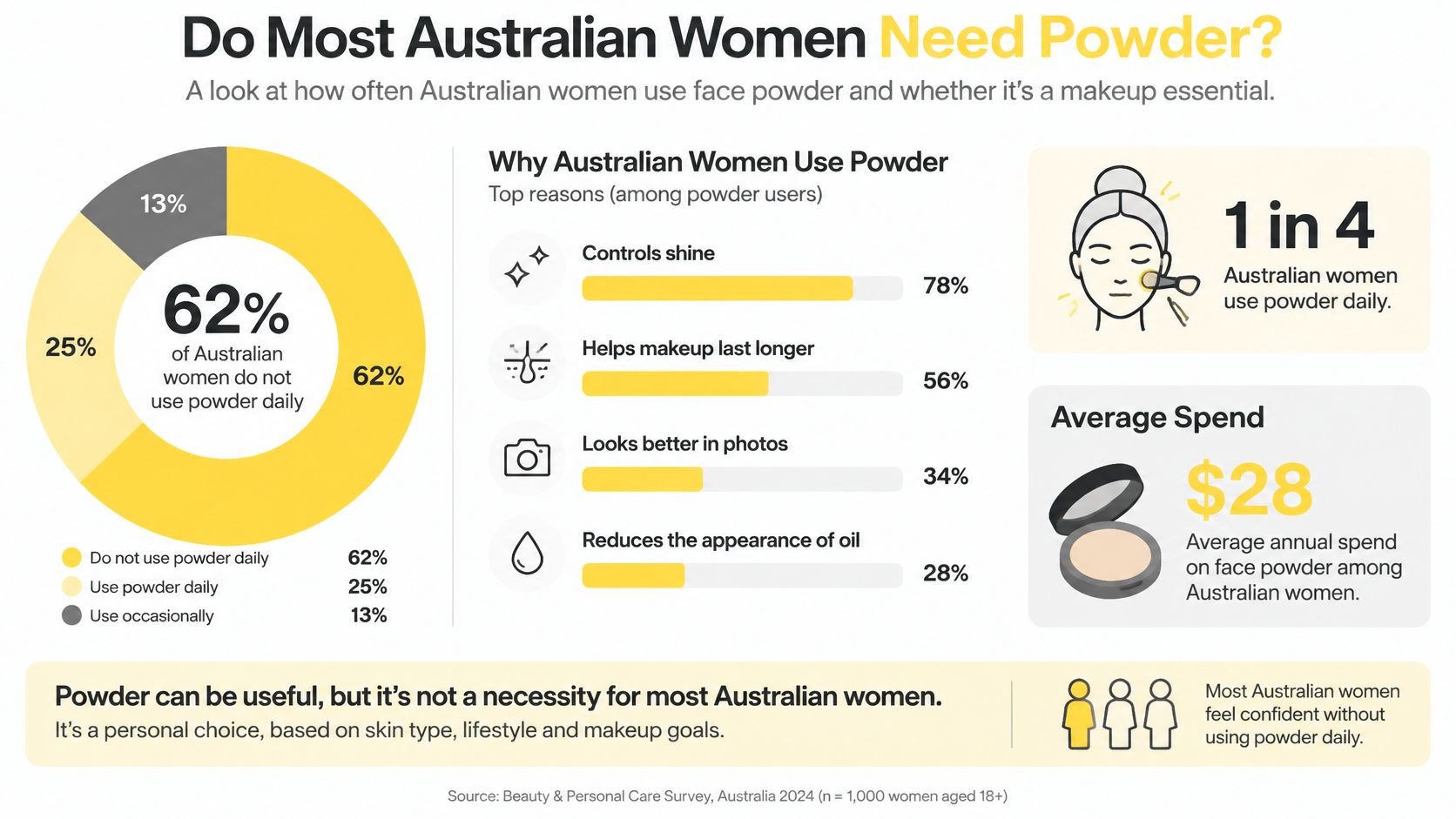
If perimenopause has prompted you to start lifting, separate the training plan from the supplement purchase. Strive Workout Log's perimenopause training guide provides a resource for organising that training discussion without assuming you need a women-specific powder.
The accompanying video is available below as additional viewing, not a substitute for an individual dietary assessment.
Add a powder only if your food check still leaves a useful job for it to do.
The right powder depends on the gap you're trying to fill. A complete protein provides all the essential amino acids, while protein density shows how much of each scoop is protein. Choose the source first, then compare serving size, ingredients and cost.
The Australian Institute of Sport's supplement guidance recommends assessing nutrition before supplementation and trialling products during training rather than first using them in competition. A practical comparison is a complete source delivering around 20–30 g protein per serving, with a density near or above 70–80% when concentrated protein is the aim.
Protein powder types side by side
| Type | Typical role | Protein density cue | Best when | Skip when |
|---|---|---|---|---|
| Whey concentrate | Budget dairy shake | Compare directly with isolate | Taste and cost matter most | Lactose causes trouble |
| Whey isolate | Rapidly digested complete protein | Look for a high protein share of the serve | Everyday or training top-up | Vegan eating or milk allergy |
| Micellar casein | Slower-digesting dairy protein | Read the panel, not the thickness | A filling option between meals | You want a light pre-workout drink |
| Egg white | Dairy-free complete protein | Check a plain formula's protein share | Milk is the issue, not animal foods | Egg allergy |
| Pea and rice | Complementary vegan blend | Calculate protein against serving weight | Plant-based eating | You're judging only scoop size |
| Bone broth protein | Savoury cooking option | Read the panel and amino-acid information | Soups and savoury meals | You expect a sweet shake |
| Collagen | Separate beauty-oriented supplement | Protein grams don't make it complete | Considering it alongside an adequate diet | You need a complete primary protein |
Whey concentrate can be an economical choice if you digest it comfortably. Compare lactose information and protein concentration before paying extra for isolate.
Whey isolate suits people seeking concentrated, rapidly digested dairy protein. It still contains milk protein, so it isn't suitable for a milk allergy. For more detail, see this Australian whey protein isolate comparison.
Micellar casein is a thicker, slower-digesting dairy option. Egg white protein provides a complete source without dairy, provided you don't have an egg allergy.
Pea and rice can complement each other's amino-acid profiles. Plant blends vary, so check the protein amount against the serving weight rather than judging by scoop size alone.
Protein density = protein grams per serve ÷ total serving grams × 100.
For a hypothetical label, a 30 g serve containing 24 g protein has a density of 80%. Use the same calculation to compare powders with different scoop sizes.
Switch Nutrition WPI Premium Whey Protein Isolate Vanilla Creme is one product to compare. Check its current nutrition panel for the serving weight and protein amount before calculating density.
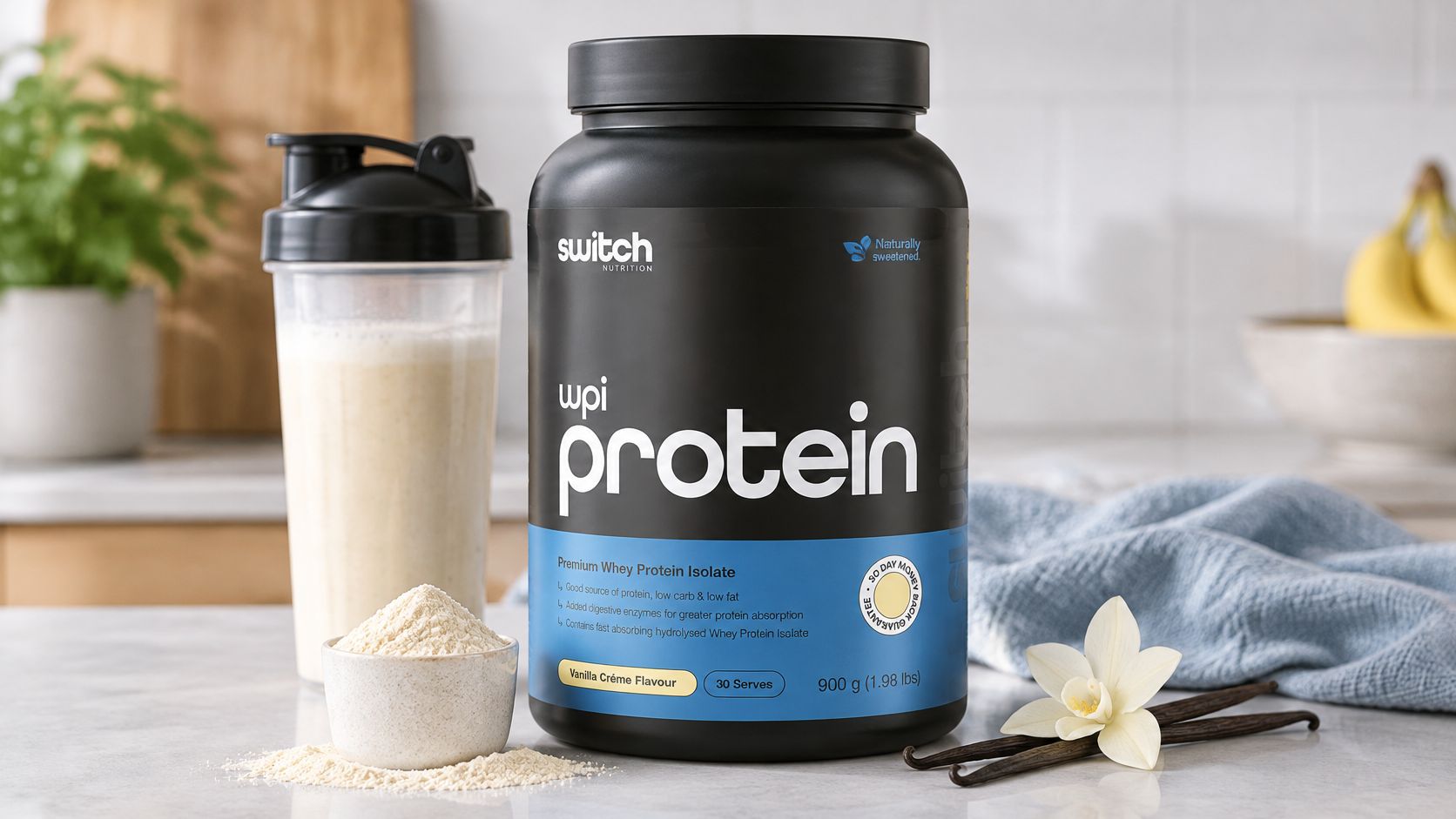
A savoury format doesn't establish that bone broth powder is complete, so check its amino-acid information if you're considering it as your main supplementary protein. Collagen also lacks a complete essential amino-acid profile; its listed protein grams don't make it a substitute for a complete protein.
Wallaby Wellness sells whey isolate, micellar casein, egg white, bone broth and vegan protein options, as well as amino acid supplements. Match the category to your diet and intended use, then compare the individual product panels.
Turn the tub around before you decide whether the front looks convincing. A transparent nutrition panel and traceable batch are more useful than clean or natural marketing language.
Read the label in the same order each time. That makes it easier to compare products without getting distracted by a long list of added ingredients.
Label and batch checks
| Check | What to look for | Pass rule |
|---|---|---|
| Serving size | Powder grams and protein grams per serve | The serve meaningfully fills your identified gap |
| Protein source | Named source and milk, soy and egg allergen information | Source named and relevant allergens clear |
| Carbs, fibre and sweeteners | Carbohydrate, fibre, sugars and sweetener type | Composition matches your intended use |
| Stimulants | Added caffeine or other stimulants | None in a basic top-up |
| Claims | Ordinary food claim or therapeutic claim | No distracting hormone, weight-loss or disease promises |
| Batch and testing | Batch number, country and recognised certification | Exact batch matches a traceable testing record |
The checklist visual summarises the safety steps to use while comparing tubs.
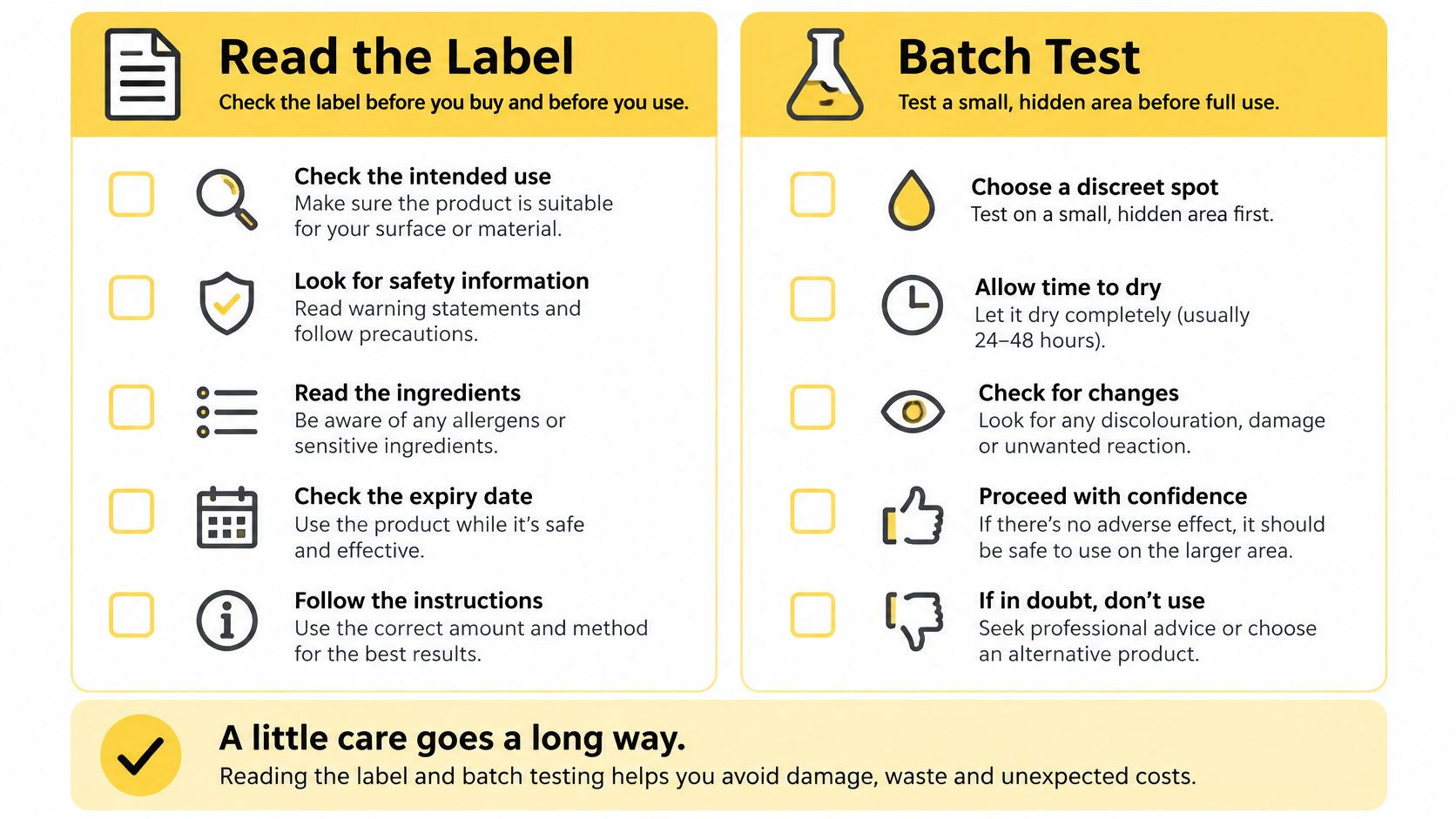
The Therapeutic Goods Administration's sports supplement guidance explains that products may be regulated as foods or therapeutic goods according to their composition and claims, with Standard 2.9.4 covering formulated supplementary sports foods. Conventional protein powders aren't automatically medicines, so the absence of an AUST number doesn't by itself establish that a tub is improperly regulated.
Regulatory classification and independent contamination testing answer different questions. A food label tells you how the product is presented and formulated; batch testing helps you assess a particular production run.
The Australian Institute of Sport's athlete resources warn that no supplement is completely risk-free and recommend batch-tested products when supplementation is justified. Those resources describe HASTA screening for more than 200 prohibited substances and Australian evidence in which more than one in 20 of 112 supplements bought over the counter or online contained undeclared anabolic steroids.
That finding concerns supplements broadly, not a measured contamination rate for every protein powder. It still gives buyers a reason to prefer verifiable testing over a manufacturer's unsupported reassurance.
Look for HASTA, Informed Sport or Certified for Sport, then verify the exact batch through the testing program's records. A logo alone isn't the end of the check, and Australian manufacture isn't equivalent to independent batch testing.
Safety boundary: Batch testing reduces a particular contamination risk. It doesn't establish that a product is suitable during pregnancy, compatible with your medicines or appropriate for kidney disease.
If the manufacturer can't identify the batch or substantiate the testing claim, choose another product. For a non-essential purchase, there's little reason to accept avoidable uncertainty.
The shelf price tells you what you'll pay for the tub, not how much useful protein you'll receive. Serving sizes and added ingredients can make apparently similar packs poor comparisons.
Use a calculator and the current label. Don't rely solely on the retailer's serving count if the pack size or formula has changed.
For a hypothetical worked example, a 1 kg tub with 30 g serves contains about 33.3 serves. If each serve supplies 25 g protein, the tub contains about 833 g protein, so divide its actual shelf price by 833 and multiply by 10 for the comparable protein cost.
That final multiplication matters. Dividing price by total protein alone gives the cost per gram, not the cost per comparison portion.
A cheaper tub isn't necessarily cheaper protein, and cheaper protein isn't good value if you won't use it.
Compare only products that already pass your dietary and safety checks. Then account for delivery charges, discounts and whether a smaller pack or sample is available.
Flavour and texture matter financially because an abandoned tub is wasted money. Trial a manageable amount before committing to bulk, especially if the formula contains sweeteners or thickeners you haven't used before.
Don't add unrelated supplements just to qualify for a shipping offer. A slightly higher delivery cost may still leave you spending less overall.
A useful purchase fits an ordinary week, not just an ambitious training plan. These situations show how the same buying principles lead to different decisions without inventing a special women's formula.
A woman who regularly lifts and eats dairy, meat, or fish begins by evaluating her meals during busy sessions. If dinner already supplies a substantial protein source, she may find that breakfast before work, rather than the period immediately after exercise, is the main inconvenience.
For broader meal-planning context, Navilo Health's nutrition guidance for building muscle is a useful companion to organising training and food. A supplement purchase should follow the dietary plan, not substitute for making one.
A salad can be a satisfying lunch, but leaves and dressing don't replace a deliberate protein food. A vegan worker might find that packed lunches need tofu, beans or lentils before they need a shaker bottle.
When food storage or appetite makes that awkward, a pea and rice blend can provide a convenient addition. Keep the rest of the meal varied rather than using the shake as permission to skip lunch.
Someone who feels bloated after whey concentrate shouldn't assume all protein powders cause the same response. Lactose, flavouring, sweeteners, gums and the size of the drink are separate variables.
If milk allergy isn't the issue, try an explicitly low-lactose isolate while keeping preparation and serving size consistent. Stop if symptoms persist, and seek advice rather than repeatedly buying different tubs to diagnose the problem yourself.
An older woman with a small appetite may prefer powder mixed into porridge or a savoury dish rather than another drink. Introduce a manageable amount and watch whether it improves intake or reduces interest in the next meal.
For readers navigating midlife changes, our perimenopause diet and nutrition guide provides related meal-planning context. Protein, iron, calcium and symptom management are different questions, so don't expect a single powder to answer all of them.
Pregnancy, breastfeeding, kidney disease or medicine use warrants individual clearance before any of these shopping decisions. Once meals cover the agreed target, extra powder isn't automatically an improvement.
Make the final decision with your meal notes, the product label and a calculator open together. The best order is the smallest sensible purchase that solves the problem you identified.
Final check: If you can't name the meal or intake problem the powder fixes, don't place the order yet.
Keep the label information so you can judge whether the product earns a repeat purchase. If your meals already cover the target, don't add a second scoop.
We offer whey isolate, micellar casein, egg white, bone broth and vegan protein options, so you can compare sources against your diet rather than women-specific marketing. Visit Wallaby Wellness to check product ingredients and serving information before choosing; free shipping on orders over $150 AUD is available year-round with code FREE150.