Can You Get Gluten Free Oats? the Australian Answer
, 12 min reading time
Can you get gluten free oats in Australia? Learn how cross-contamination works, what labels really mean, and who should avoid oats entirely.
Yes, you can get oats produced to avoid wheat, rye and barley contamination, but in Australia oat products can't legally carry a “gluten free” claim, even when testing finds no detectable gluten. Look for evidence of controlled production and testing, and remember that some people with coeliac disease may react to oats themselves.
Can you get gluten-free oats if you're standing in an Australian cereal aisle, looking at a packet that says “oats” but not “gluten free”? The answer depends on two separate questions: whether wheat, barley or rye has contaminated the oats, and whether your body tolerates avenin, the protein naturally found in oats.
Those questions matter because one kind of testing can help identify cereal cross-contact, but it doesn't establish that every person with coeliac disease will tolerate avenin. This guide explains what happens from farm to packet, what Australian label rules mean, and how to check a product before buying it. With the right information and clinical advice where needed, many people can make a more confident choice.
Yes, specially produced oats can be made with controls to reduce contamination from wheat, barley and rye. But in Australia, even oats tested with no detectable gluten can't legally be labelled “gluten free” if they contain oats. That means you can't use the familiar claim on the front of a packet to assess oat products in the same way you might assess other foods.
This can make shopping confusing. A packet may describe oats as “pure” or say they're produced under controlled conditions, but those words don't automatically tell you what testing the manufacturer performs or whether people with coeliac disease will tolerate the oats.
There are two distinct safety questions:
The first question is about cross-contact with other cereals. The second is about how an individual responds to a protein found in oats themselves. A product's testing may provide information about the first, but it can't by itself answer the second.
So, don't assume ordinary supermarket oats are suitable if you have coeliac disease. Look for evidence that the oats were produced under gluten-controlled conditions, and ask the manufacturer about its testing policy. If you have coeliac disease, talk with your GP or gastroenterologist before introducing oats. Specially produced oats may suit many people, but they're not a universal option.
Oats aren't the same as wheat, rye or barley. They contain avenin, an oat storage protein related to gluten but distinct from the proteins found in those other grains. That difference helps explain why oat products need special consideration for people with coeliac disease.
Think of the immune system as recognising a particular key. Wheat, rye and barley proteins may match the key that triggers a response in someone with coeliac disease. Avenin is more like a similar-looking key: it doesn't provoke a reaction in everyone, but some people's immune systems respond to it. This analogy isn't a diagnosis or a prediction for any individual. It's a way to understand why tolerance can vary.
Standard gluten tests can detect cereal contamination from wheat, barley and rye, but they don't reliably measure oat avenin. Coeliac Australia explains this testing limitation and the distinction between cereal cross-contact and reactions to avenin in its guidance on oats and the gluten-free diet. As a result, a test finding no detectable gluten doesn't prove that every person with coeliac disease will tolerate the oats.
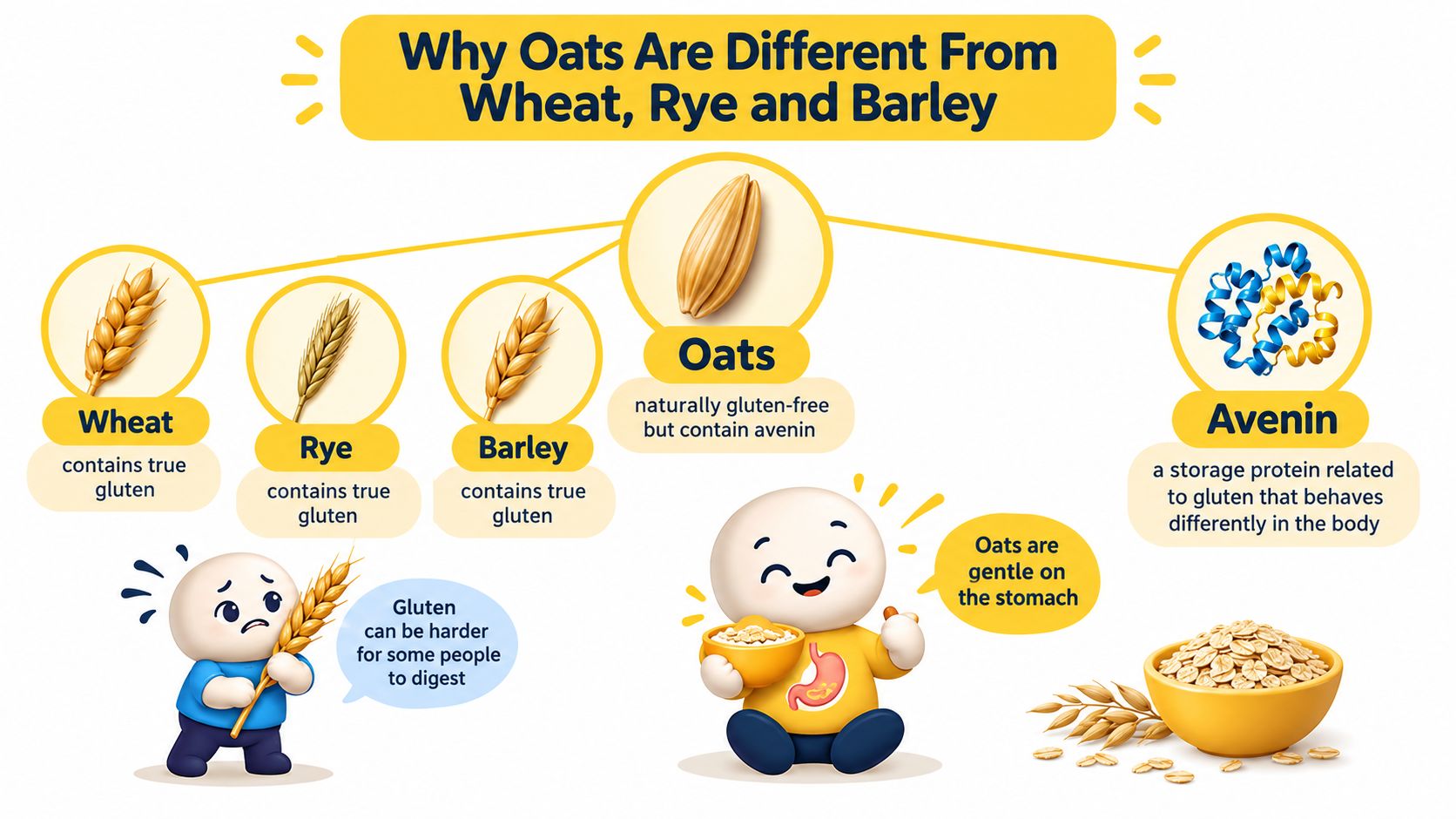
That's why “buy uncontaminated oats” is incomplete advice. Controlled production can address cross-contact with other cereals, but it can't remove avenin from oats or tell you how your body will respond to it. Oats are treated differently in Australian food rules, too. Buckwheat groats can be another grain-style pantry option to consider, but they're a different food, not a type of oat.
The practical decision comes down to two questions: Is this product protected from cereal contamination, and will I tolerate avenin? The first calls for evidence from the producer. The second may require medical advice and careful follow-up.
A single harvester can cut wheat in the morning and oats in the afternoon. Whatever grain dust stays inside that machine travels with the next crop. That is the basic mechanism behind oat contamination, and it repeats at every stage of the supply chain.
Cross-contact can begin on the farm, where oats may grow beside wheat, barley or rye, or in a paddock where those cereals grew the season before. The odd wheat plant left over from an earlier crop can be harvested right alongside the oats. Shared trucks, storage silos, mills and packaging lines then each add another chance for traces of one grain to mix into another.
None of this means every packet of oats is contaminated. It means "oats" on an ingredient list tells you what is in the packet, not how it was handled.
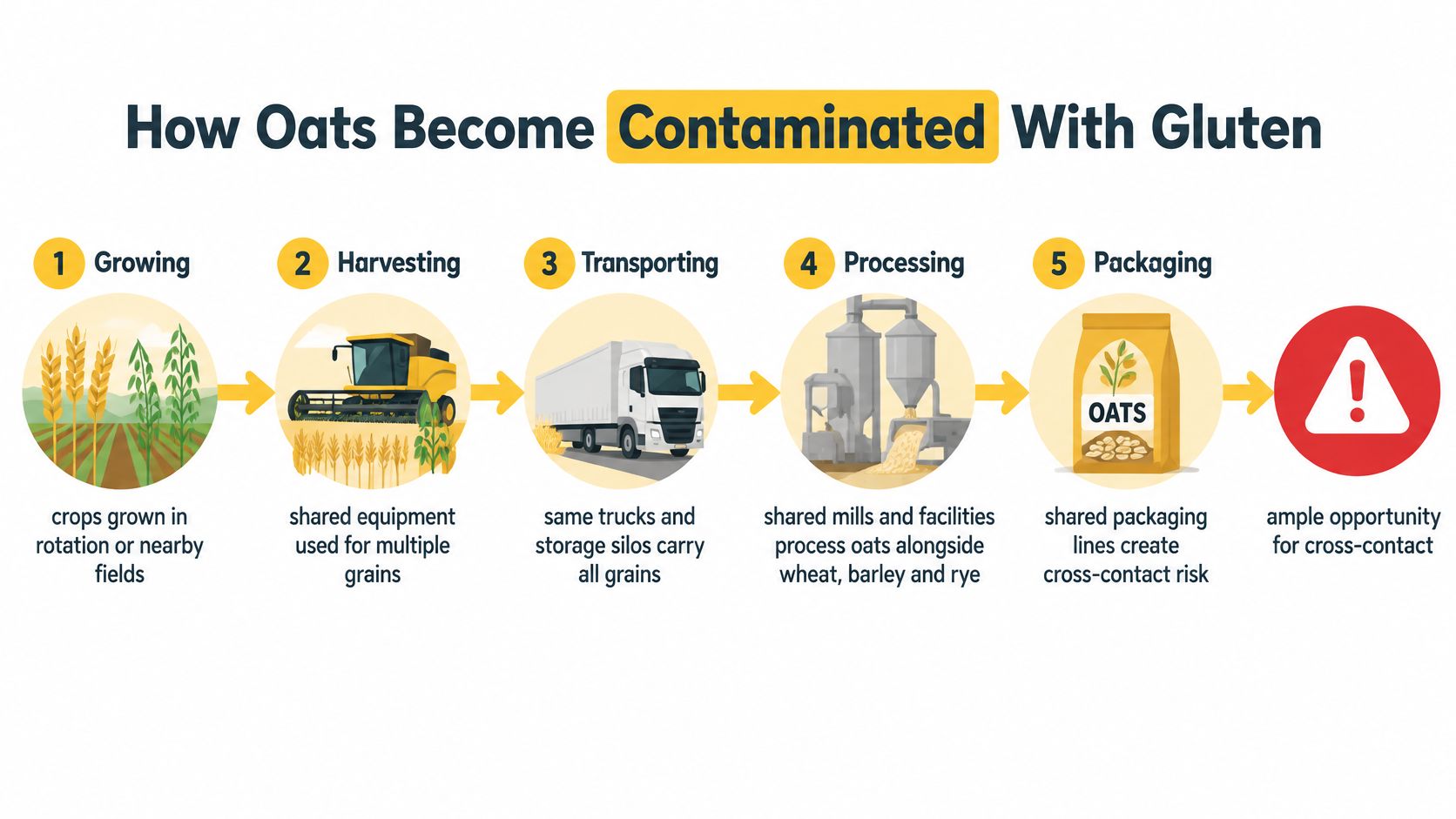
How much gluten can this add? As the Coeliac Australia guidance cited earlier explains, conventionally produced oats can carry detectable gluten ranging from around 23 parts per million (ppm) up to several thousand ppm, depending on the batch and the production method. The spread is wide because contamination is uneven. One paddock may sit beside a wheat crop while another is well isolated. That variability is the reason an ordinary packet should not be assumed suitable for someone who needs to avoid gluten.
One common point of confusion: this is a supply chain problem, separate from how your own body responds to the oats themselves. Careful production can address the first issue. It cannot settle the second.
Some producers work to break this chain. Dedicated or audited fields, separate or thoroughly cleaned equipment, and testing of finished batches all reduce the chance that wheat, barley or rye reaches the final product. For a shopper, the useful step is to check what the manufacturer does and how it verifies the result, rather than trusting a vague description on the front of the pack.
Practical rule: "Oats" on an ingredient list tells you what is in the packet. It does not establish how the oats were grown, handled or tested.
For another example of how product-level information shapes gluten-free choices, see this Rice Chex gluten-free guide. The general lesson holds across products: check the specific item rather than assuming one label or ingredient answers every question.
Pick up a packet of oat muesli in an Australian supermarket and you may notice something odd: no "gluten free" claim anywhere, even on products where the manufacturer tests each batch. That gap between what testing shows and what a label may say confuses many shoppers, and it comes down to how food law treats oats specifically.
Two regulated claims matter here. A food containing oats or oat products cannot use "gluten free", even when laboratory testing finds no detectable gluten. The "low gluten" claim has its own ceiling: no more than 20 mg of gluten per 100 g, and only for foods that contain no oats or malt. Coeliac Australia's guidance on oats sets out both requirements.
So an oat product can be made under carefully controlled conditions and still be barred from the words "gluten free". A missing claim can reflect labelling law rather than careless production. Terms such as "pure oats" are descriptive, so the shopper still needs to check what production and testing took place.
| Label phrase | What it legally means | What it does not guarantee |
|---|---|---|
| "Gluten free" | On eligible foods, that testing detected no gluten in the product | It says nothing about whether a particular person tolerates each ingredient, including avenin |
| "Low gluten" | No more than 20 mg of gluten per 100 g, and only for foods containing no oats or malt | It is not a label option for oat products |
| "Pure oats" or "controlled production" | Descriptive language that should prompt you to check the producer's own explanation | It does not confirm a testing method or individual tolerance |
One more wrinkle: oats must be declared when present, but a declaration is not the same as a statement about cross-contact controls or test results. Ask the manufacturer what the wording on its packet means in practice, and check whether it explains how contamination is managed.
A label speaks to contamination, not to your own reaction. A packet can report no detectable gluten while still containing avenin, which suits some people with coeliac disease and not others. Read the ingredient and allergen information, then ask about production and testing where those details matter for you.
The right approach depends on why you're avoiding gluten. A person with diagnosed coeliac disease has different considerations from someone choosing gluten-free foods by preference, and a wheat allergy is not the same condition as coeliac disease.
Oat reactions can also be hard to interpret because gut symptoms have many possible causes. If you're tracking digestive symptoms, this guide to gut health and IBS offers further context, but it can't replace an individual medical assessment.
If symptoms reliably return after eating oats, stop consuming them and seek clinical advice. Don't rely only on a standard coeliac blood test to decide whether oats are suitable for you. A clinician can help consider your symptoms, history and next steps.
Start by asking why you need to avoid gluten. If you have coeliac disease or another diagnosed condition, get medical advice before introducing oats. If you're choosing them by preference, you can still check the producer's controls rather than relying on a product name or a reassuring-looking packet.
People with coeliac disease should make any introduction with clinical advice, then pay attention to how they feel. Stop eating the oats and contact your clinician if symptoms recur. A negative conventional gluten test can help address one concern, but it doesn't prove you'll tolerate avenin.
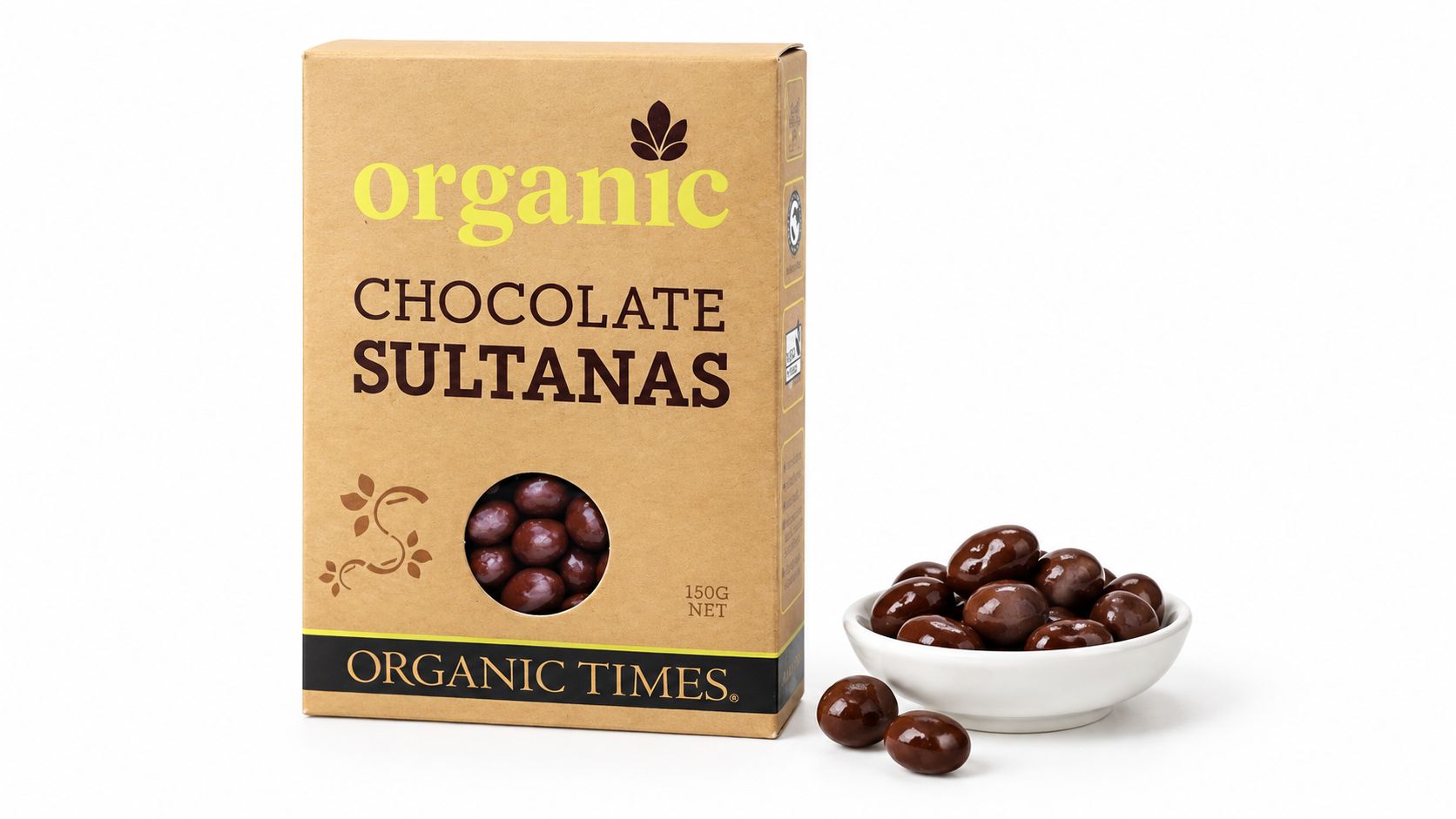
For other pantry foods, these protein granola label reading tips can help you think carefully about product information, and this guide to gluten-free protein bars in Australia offers another category to explore. For a different kind of snack, Organic Times Organic Milk Chocolate Coated Sultanas, 150 g is described as Australian-grown sultanas coated in organic, fair-trade certified milk couverture chocolate. That product description doesn't establish whether it meets your individual dietary needs, so check its current ingredient and allergen information.
Wallaby Wellness offers pantry foods alongside supplements and other wellness products, with options organised by product type and dietary needs. Visit Wallaby Wellness to browse the range and check product details as you plan your shopping.