Is Dried Fruit Healthy? What Australians Need to Know
, 12 min reading time
Is Dried Fruit Healthy? Yes, in 30 g serves. Learn the portion size, sugar labels and dental risks Australians should know.
Yes, unsweetened dried fruit is a real fruit serve, but the standard serve is 30 g rather than a handful, and it is energy- and sugar-dense. That single fact changes the answer from a simple yes to a question of portion.
What if the packet in your drawer isn't the problem, but the way you measure it is? Is dried fruit healthy when you eat a full fresh-fruit weight of it, or only when you treat it as the concentrated food it is?
Unsweetened dried fruit is a legitimate fruit food, but it's a small-portion food. Drying removes water, so energy and sugars concentrate into a much smaller volume than fresh fruit.
In Australia, Food Standards Australia New Zealand sets the standard serve for dried fruit at 30 g, compared with 150 g for fresh, frozen or canned fruit and 125 mL for 100% fruit juice. Australian guidance also places dried fruit and juice in the only occasionally category, preferably without added sugar.
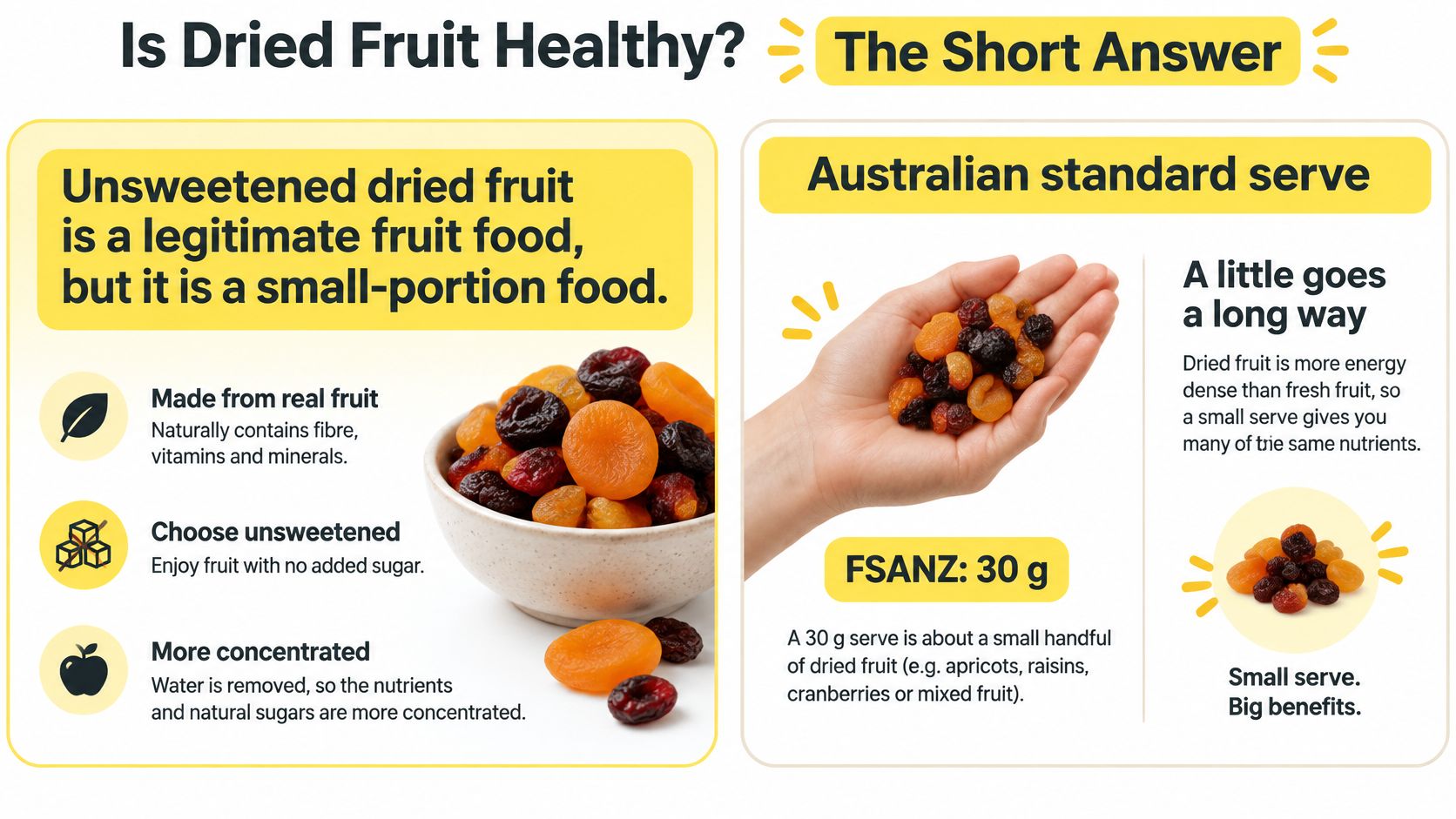
About four dried apricot halves or 1½ tablespoons of sultanas make one serve. That's easy to picture once you've weighed it, and surprisingly small next to a fresh apple or a cup of canned fruit.
| Fruit form | Standard serve |
|---|---|
| Dried fruit | 30 g |
| Fresh, frozen or canned fruit | 150 g |
| 100% fruit juice | 125 mL |
Eating straight from a large packet removes that visual check. A few extra handfuls can become two or three serves.
Dried fruit still contributes dietary fibre and fruit-derived nutrients. What it won't give you is the volume or satiety of whole fresh fruit, because most of the water that fills you up is gone.
Weigh 30 g once. Your eyes will recalibrate faster than your habits will.
So the short answer isn't about banning dried fruit. It's about using it deliberately, checking the label, and keeping fresh, frozen and canned fruit as your everyday base.
Dried apple makes the trade-off concrete. It's plain, unsweetened and easy to compare, so it shows what concentration does without added ingredients confusing the picture.
FSANZ's Australian Food Composition Database lists dried apple at 1,010 kJ of energy per 100 g, 8.5 g of dietary fibre and 59.4 g of total sugars per 100 g. The same entry records 0 g of added sugars and 0 g of free sugars, because the sugar occurs naturally in the fruit.
| Nutrient | Per 100 g dried apple | Per 30 g serve |
|---|---|---|
| Energy | 1,010 kJ | About 303 kJ |
| Dietary fibre | 8.5 g | About 2.6 g |
| Total sugars | 59.4 g | About 17.8 g |
| Added sugars | 0 g | 0 g |
Read the serve column slowly. About 303 kJ is a modest snack, and 2.6 g of fibre is a meaningful contribution from something so compact. You can put that fibre in context with a fibre calculator if you're tracking your daily intake.
Then look at 17.8 g of total sugars in that same small serve. Healthy doesn't mean low in sugar or low in kilojoules. It means the nutrients arrive in a minimally processed fruit, but concentrated enough that portion decides the outcome.
Double the serve and you've doubled the energy without feeling twice as full. That's the practical risk, not the fruit itself.
Dried apple doesn't predict dates, raisins, apricots or berries. Each fruit starts with a different sugar, water and fibre profile, and sweetened products change the picture again.
For example, Dried Cranberries Organic are made from organic cranberries sweetened with organic apple juice concentrate and contain organic sunflower oil. That's a different formulation from plain dried apple, so its panel, not the dried apple figures, is the one to use.
The defensible conclusion is narrow but useful. Unsweetened dried fruit can fit a healthy diet when you measure the portion and don't treat it as unlimited fresh fruit.
The front of the pack is marketing. The answer to the added-sugar question sits on the back, so read the pack in the order you'll meet the information: ingredients list first, then the Nutrition Information Panel.
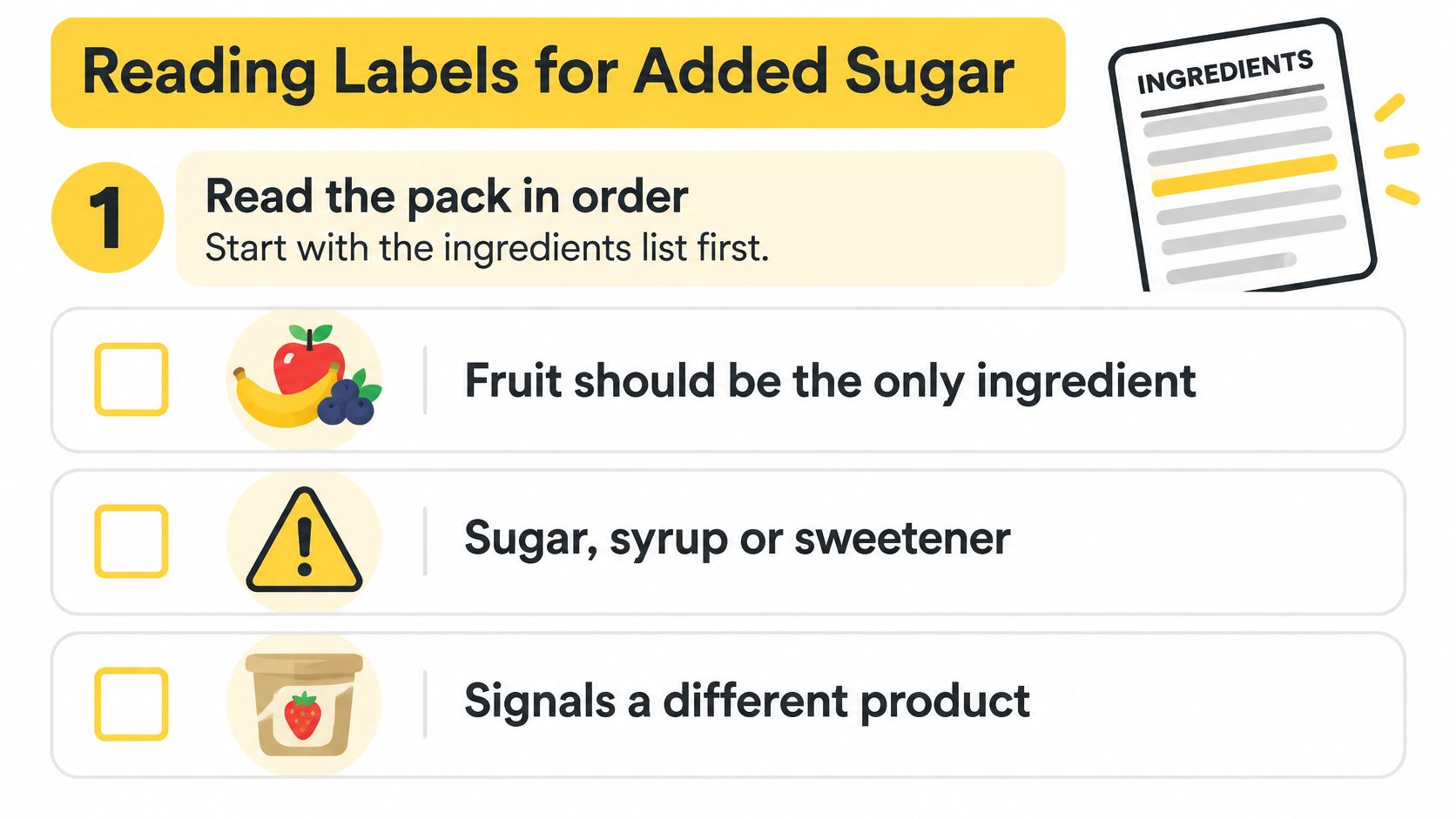
Fruit should be the only ingredient if you want plain dried fruit. Sugar, syrup, juice concentrate used as a sweetener, or any other sweetener signals a different product, even when the front shows a single fruit and nothing else.
| Label check | Where to find it | What to choose |
|---|---|---|
| Ingredients | Ingredients list | Fruit as the only ingredient |
| Added sugar | Ingredients list and sugars line of the Nutrition Information Panel | No sugar or syrup added |
| Sweeteners | Ingredients list | Treat sweeteners as added ingredients, not fruit |
| Serve size | Nutrition Information Panel | 30 g, weighed rather than estimated by handful |
The Nutrition Information Panel comes second, and it has a limit worth knowing. Its sugars line reports total sugars only, so a plain dried fruit and a sweetened one can show similar numbers there. The panel alone can't tell you whether those sugars were added or arrived with the fruit. That answer lives in the ingredients list, which is why the two have to be read together rather than in isolation.
The short video below shows how that two-step check plays out on a real pack.
Sweeteners deserve the same scrutiny as sugar. Dried Strawberries Organic, for instance, is made with organic strawberries, xylitol and organic sunflower oil. Xylitol is an added sweetener rather than part of the fruit itself, so that product sits in a different category from a one-ingredient dried fruit, even though strawberries come first on its list.
One last check turns the label into a portion. Find the net weight on the front of the pack and divide it by the 30 g serve from the panel. A pouch small enough to finish in one sitting often holds several serves, which is how a modest-looking snack becomes a large one. When two products both list fruit first, the per 100 g column on the panel lets you compare their sugar density side by side.
A good everyday label stays simple: one ingredient, no added sugar or sweetener, and a serve size you weigh rather than guess.
When dried fruit and juice were limited to one serve per day, Australian Bureau of Statistics data show Australians aged two and over averaged 0.9 fruit serves daily in 2023, compared with 1.2 when all reported serves were counted. That gap shows dried fruit and juice can lift reported fruit intake, while Australian guidance still treats fresh fruit as the standard they supplement.
Portability cuts both ways here. Dried fruit keeps well, travels easily and slots into breakfasts, salads and lunchboxes without preparation. The same traits remove every natural cue to stop eating.
The choice that matters is what the serve replaces.
Neither choice is automatically wrong. The second just needs to be deliberate, since a single small serve already carries roughly 300 kJ in the dried apple example.
Formulations vary too. Dried Raspberries Organic are a different formulation from plain dried apple, so you count them by their own panel and serve size. Texture is another variable, and our guide to freeze-dried strawberries covers a style that behaves differently at snack time.
Serving control outweighs any single claim about natural sugar or antioxidants. Dried fruit works best as a measured inclusion within your fruit total, not as a snack eaten without limits.
Nutrition comparisons usually stop at fibre and sugar. Your teeth experience dried fruit differently.
The Australian Dietary Guidelines specifically caution that dried fruit can stick to teeth and increase the risk of dental decay, placing it in the "only occasionally and in small amounts" category. That's distinct from acidic dental erosion, the concern associated mainly with fruit juice.
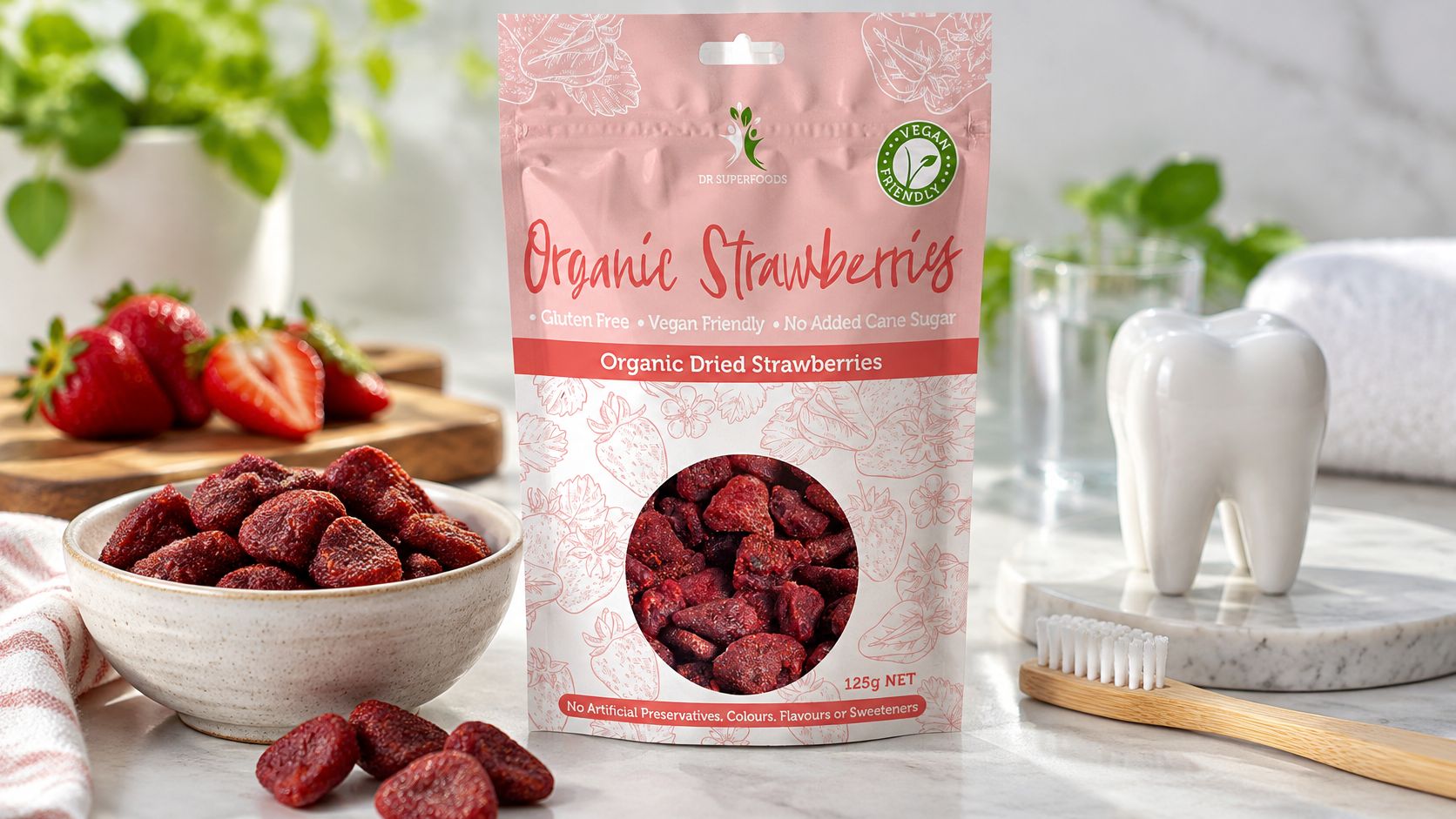
Decay and erosion aren't the same thing. Decay involves sugars feeding plaque bacteria over time, while erosion is acid directly softening enamel.
The sticky texture is the mechanism. Sugars can stay in contact with teeth longer than they do when you eat juicy fresh fruit, which is cleared more easily.
Frequency matters as much as the amount. Eating dried fruit with a meal keeps exposure to one defined occasion, while desk, school, hiking and training snacks often invite repeated nibbling over hours.
No added sugar doesn't mean zero dental risk. Natural fruit sugars still count once they're concentrated and stuck to a tooth.
Practical rule: Give dried fruit a start and a finish. Don't let one serve become an afternoon-long exposure.
For broader habits that support oral health, nutrition and hygiene for healthier teeth is a useful companion read. Dried fruit can fit your diet, but for oral health it isn't equivalent to fresh fruit.
The general answer works for most healthy adults eating measured serves occasionally. Four groups need a tighter approach.
People with diabetes need to count dried fruit as concentrated carbohydrate, not as a free fruit choice. A 30 g serve belongs in your carbohydrate plan, ideally discussed with your diabetes care team or a dietitian. Pair it with protein or fat, such as unsalted nuts or plain yoghurt, and avoid eating it alone when you're trying to blunt a glucose rise.
Young children face two separate issues. The sticky texture raises tooth-decay risk, and small, firm pieces can be a choking hazard. Serve small amounts with meals, cut larger pieces appropriately, and supervise while they're eating.
People managing weight or energy intake should treat dried fruit as a planned snack. Compact foods are easy to underestimate, and a serve eaten while preparing dinner still counts toward the day.
People who find sweet foods hard to stop may find dried fruit keeps the habit going. It can work as a bridge away from confectionery, but an open packet undermines that purpose. Pre-portion it, put the packet away, and decide in advance when it's finished.
Gut comfort is another reason some people prefer smaller serves, particularly when they're increasing fibre quickly. If digestive symptoms are part of your decision, our article on IBS awareness and gut feelings gives useful background, though personal medical advice should come from your own clinician.
None of these cases automatically means elimination. They mean measured portions, planned timing and professional advice where a medical condition is involved.
Use this routine until the portion looks familiar. After that, spot-check with scales whenever you change fruit type or brand.
Apply the same checks before any pack goes in your cart. We sell pantry items including dressings, ghees, oils, vinegars, nuts, dried fruits, seeds, granola, cereals, muesli, drinks, healthy snacks, pasta, grains, rice, baking supplies, baby products, herbs, spices, spreads, and sugar replacements, so you can compare options in one place.
Repeat the label check whenever you switch brands. Recipes, sweeteners and stated serve sizes can change between products, and yesterday's plain fruit may not be today's formulation.
Ready to stock a snack you can portion? Visit Wallaby Wellness to browse dried fruits alongside nuts, seeds and other pantry staples, then check each product's ingredients and Nutrition Information Panel before you buy. Start with one pack, weigh your first 30 g serve, and make that measured portion your new normal.