Maple Syrup vs Honey: Nutrition, Taste and Best Uses
, 17 min reading time
Maple syrup vs honey compared: nutrition, GI, baking ratios and baby safety, plus which to choose for vegan, keto and everyday Australian kitchens.
The advice you'll hear most often is that honey is the smarter sweetener because it's natural, raw and full of antioxidants, and that maple syrup is just expensive sugar for pancakes. That framing fails on three counts. Both products are concentrated free sugars, so neither earns a place as a health food. Some Australian honeys test at a glycaemic index as high as 72, which is not a gentler number than pure maple syrup's 54. And the question that matters most in a house with a baby, whether either product is safe before twelve months, almost never makes it into these comparisons at all.
What a pantry advisor would tell you instead is to stop shopping for a winner and start matching the bottle to the job. Maple brings caramel depth, a plant-based label and a slightly lighter sugar load per 100 g. Honey brings a domestic supply chain, a lower price and a varietal range no single syrup can imitate. Keep one of each if you cook, and measure both.
Neither sweetener wins outright, and any page that hands you a single champion is selling you something. Pure maple syrup is the plant-based pick and the lighter of the two on sugars per 100 g. Honey is cheaper, produced here in Australia, and far more useful across dressings, marinades, tea and baking. Buy honey for the everyday jobs and maple for the finishing jobs, and the argument mostly dissolves.
Here's the side-by-side worth screenshotting before you shop.
| Feature | Pure maple syrup | Honey |
|---|---|---|
| Flavour | Caramel, toffee and woodsy; consistent by grade | Floral and varietal, from mild yellow box to bold leatherwood |
| Energy per 100 g | about 1,082 kJ | about 1,162 kJ (1,662 kJ per 100 mL in the AFCD) |
| Total sugars per 100 g | 60.4 g | 72.3 g (103.4 g per 100 mL in the AFCD) |
| Glycaemic index | 54 | 35-72 depending on floral source |
| Vegan | Yes | No |
| Babies under 12 months | No, it is an added sugar | No, added sugar plus botulism risk |
| Best for | Vegan baking, granola, glazes, coffee | Tea, dressings, marinades, quick breads |
| Australian supply | Imported niche product | Domestic industry with many varietals |
| Typical cost | Higher per 100 mL and import-dependent | Generally cheaper, varies by varietal and season |
Two rows deserve an argument. The sugars line makes maple look like the restrained choice, but both are still free sugars and neither belongs in a "healthy swap" column. The supply line is the reason for the price gap, and it has nothing to do with quality.
What changes the decision is the job, then the diet, then the household. A vegan kitchen rules honey out before flavour gets a vote. A household with a nine-month-old rules both out as routine sweeteners, honey for a safety reason and maple for a boring nutritional one. A cook who wants a glaze to caramelise reaches for maple; someone dressing a slaw reaches for honey, because its acidity does half the work.
The verdict: treat both as free sugars to be measured, not health foods to be ranked. Choose the flavour that suits the dish, the diet that suits the person and the price that suits the week.
Numbers first, because most comparisons muddle the units and then argue about the answer. The Australian Food Composition Database lists honey at 1,662 kJ and 103.4 g total sugars per 100 mL, including 57.2 g fructose and 44.3 g glucose. A University of Sydney-reported comparison used for Australian retail foods puts pure maple syrup at about 1,082 kJ and 60.4 g sugar per 100 g, against honey at about 1,162 kJ and 72.3 g sugar per 100 g.
Read those two sentences again and notice the trap. One set is per 100 mL, the other per 100 g. Honey is denser than water, so 100 mL holds more honey than 100 g does, which is why the millilitre figure looks so much heavier. Compare equal mass or equal household volume, never a millilitre figure against a gram figure. That single error makes honey look far worse than it is, and it's the same error that lets a café smoothie claim a lighter sugar load than a teaspoon of the same stuff.
| Sweetener | Energy | Total sugars | Sugar profile | Glycaemic index |
|---|---|---|---|---|
| Pure maple syrup, per 100 g | 1,082 kJ | 60.4 g | mostly sucrose | 54 |
| Honey, per 100 g retail comparison | 1,162 kJ | 72.3 g | fructose- and glucose-rich | 35-72 by variety |
| Honey, AFCD per 100 mL | 1,662 kJ | 103.4 g | 57.2 g fructose plus 44.3 g glucose | not stated for this entry |
The gap comes down to concentration. Maple syrup is roughly 60 percent sugar by weight with the rest mostly water, which is why it pours thin and coats a spoon without clinging. Honey carries less water and more sugar per gram, so it tastes sweeter off the same teaspoon and you use less of it to hit the same sweetness. That's the practical trade: maple is easier to portion as a measured drizzle, honey is easier to overdo because your tongue reads it as a stronger ingredient.
Glycaemic index is where the product type stops being the useful question. A University of Sydney-reported dataset covering eight Australian honeys found a range from 35 for yellow box honey up to 62-72 for some commercial blends, with pure maple syrup reported at 54, at the upper end of the low-GI band (maple syrup and honey glycaemic comparison). So a mild, single-source honey can sit well below maple, and a blended commercial honey can sit well above it. The variety and its test data matter, and the label rarely tells you.
Practical rule: read the Nutrition Information Panel per 100 g and per serving, then measure your spoon at 15 mL to a tablespoon. A measured tablespoon is a fraction of any 100 g figure above, and measurement is the only lever that reliably changes your sugar intake.
The two products are graded on completely different logic, and that logic tells you which bottle to reach for when you're cooking to a result rather than a craving.
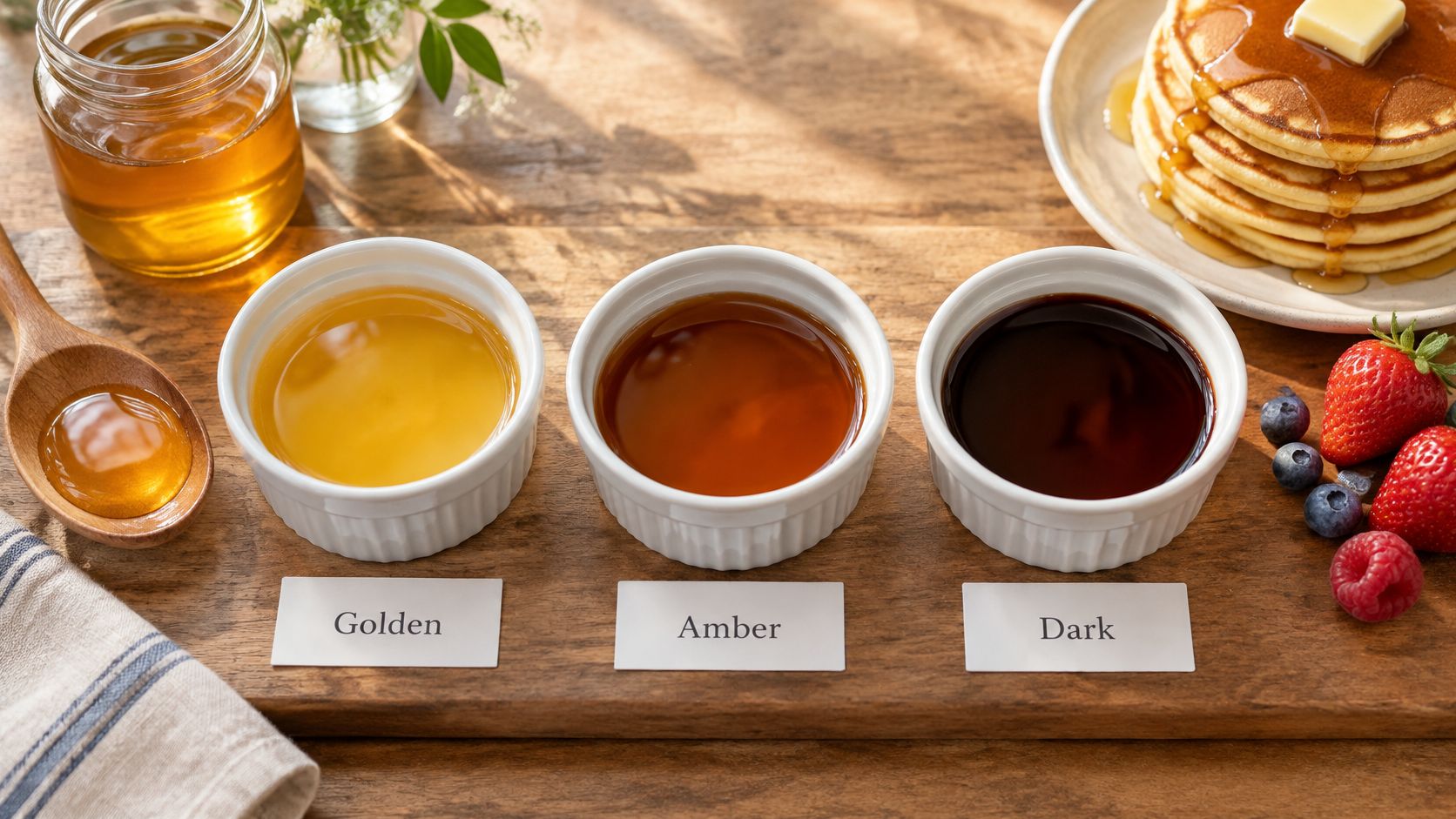
Maple syrup is classified by colour and taste, and the classes move in a straight line. Golden is delicate and light, best poured over yoghurt, fresh fruit or into coffee where you want sweetness without a takeover. Amber is the balanced all-rounder with the classic caramel note, and it's the one to buy if you only keep one bottle for pancakes, porridge and baking. Dark brings rich toffee that survives heat, so it suits sauces, glazes and barbecue. Very Dark is the strongest and holds its own in marinades and heavy batters.
"Grade A" on an Australian shelf refers to that colour and flavour classification, not a premium tier. It isn't a quality ranking, and a Golden isn't better than a Dark, it's just a different tool.
Honey runs the other way entirely, because the nectar source sets everything. Yellow box is mild and clean, which is why it disappears into tea without complaint. Leatherwood, from Tasmania, is pungent and distinctive, and it's wasted stirred into a drink; use it with strong cheese or in a small amount where the flavour is the point. Macadamia and other native varietals sit between those poles. Manuka carries earthy, herbal notes and is priced on its UMF or MGO rating rather than on sweetness, which is a different buying decision altogether. If you want to go deeper on that one, our guide to Australian manuka honey covers what the rating numbers mean.
Raw versus heat-treated matters too. Raw honey crystallises over time and keeps more aroma; gently heat-treated honey stays clear and pourable for longer. Crystallisation isn't spoilage, it's a sign the honey hasn't been over-processed. Darker colour is not a guide to sugar behaviour either, so don't buy on shade.
For a sense of what a floral honey does in a cold dessert, this honey parfait recipe shows the technique better than any description.
Matching rule: delicate grades and mild honeys go on at the end, off the heat. Dark grades and punchy honeys go in at the start, where the flavour has to cut through fat, acid and spice.
Ratios work best as a routine rather than a lookup, because the order of operations is what stops a cake going flat or a glaze turning to water. Work through these five steps and you can convert almost any recipe on the first attempt.
| Task | Use maple syrup | Use honey |
|---|---|---|
| Sweeten drinks and porridge | 1-2 tsp stirred in; caramel notes suit coffee and oats | 1 tsp is enough; floral notes suit tea and yoghurt |
| Glazes and marinades | Caramelises well on salmon, pumpkin and bacon | Brighter finish for chicken, carrots and salad dressings |
| Granola and bliss balls | Binds at low oven temperatures with toffee depth | Stickier bind with a stronger flavour per gram |
Texture decides the rest. Maple is thinner, so it brushes onto a tray of pumpkin or a side of salmon evenly and caramelises without burning at moderate heat. Honey is viscous and acidic, which is why it clings to leaves in a dressing and why it keeps quick breads and muffins soft for days. If you want the technique for a glaze that balances that acidity against a roasted vegetable, this sweet-savory carrot glaze method walks through the heat and timing.
One warning that saves a lot of disappointment. Maple-flavoured pancake syrup is not pure maple syrup. It's typically a glucose-based formulation with colour and flavour added, so it behaves differently in baking and carries different carbohydrate. Read the ingredient list: pure maple syrup has one ingredient. If you want maple flavour in a lower-sugar format, our maple flavoured syrup with monkfruit sweetener is built on monk fruit extract instead, and it's a different product from the pure syrup in every ratio above.
Natural does not mean suitable for everyone, and this is the section where that phrase earns its keep. Three diet rules are useful and one safety rule is essential.
Vegans exclude honey because bees produce it, which makes pure maple syrup the only option of the two. Both are naturally gluten-free, though shared processing lines are worth checking if you're coeliac rather than avoiding gluten by preference. For low-FODMAP cooking, maple syrup is generally the safer choice at normal serves, while many honeys carry excess fructose that can trigger symptoms; check current Monash University guidance for the specific product rather than trusting a general rule. Keto and low-carb readers should treat both as off-plan, and should read the ingredient list of any sugar-free maple-flavoured syrup before assuming it fits.
Australian infant-feeding guidance advises against foods with added sugar for children under twelve months, and honey carries an additional botulism risk for infants on top of that (Maternal & Child Nutrition). Maple syrup avoids the honey-specific spore concern but remains an added sugar and is not a nutritionally appropriate infant staple. The spore risk is the part people get wrong, because maple is sometimes promoted as the safer "natural" alternative to honey for babies. It isn't safer. It's just a different added sugar.
Say it plainly: honey is never safe before twelve months. Maple syrup isn't a workaround, and no "organic" or "raw" label changes either answer.
For toddlers and older children, use either sparingly and put whole foods first. Recent Australian research found that sweet snack foods marketed to infants and toddlers can be more likely to meet some compositional thresholds while still contributing to a broader pattern of highly processed, sweet foods. That's the useful lesson for a shopper: a product clearing one compositional benchmark tells you very little about whether it belongs in a child's daily diet.
The distinction worth carrying into the supermarket is that food-safety suitability, added-sugar guidance and adult nutrition are three separate tests. A product can pass one and fail the others. Honey fails infant safety outright and passes as a fine adult sweetener. Maple passes the spore test and fails as an infant staple anyway, because it's still sugar.
The price gap between the two bottles is structural, not a markup someone invented. Honey sits on top of an established domestic agricultural industry. Maple syrup depends on a tree and a climate Australia doesn't have at scale.
Start with the production base. Australian Government data count 1,868 commercial beekeepers, 668,672 hives and 24,600 apiary sites on public land across the reported states and territories, averaging 22.5 hives per beekeeper, with state patterns ranging from 13.4 in Victoria to 86.1 in Tasmania (Australian Beekeeping Survey data tables). That's thousands of businesses tied to forest access, flowering and rainfall. Maple requires maple trees with freeze-thaw conditions for sap flow, which is why Australia has no equivalent domestic production base at all.
The volume and value numbers explain both the price and the variability. National honey production averaged 18,000 tonnes a year between 2016-17 and 2020-21, down about 5 percent from 19,000 tonnes a year in the previous five-year period, yet the average gross value of production rose 74.5 percent from AUD 91 million to AUD 159 million, which points to stronger value per tonne rather than weaker demand (ABARES non-wood products report). Australia exports around 10 percent of production, averaging 3,900 tonnes a year worth AUD 31.9 million. Recorded maple-syrup exports, by contrast, run to 80 kilograms valued at AUD 3,235 in one reported period. Kilograms against thousands of tonnes.
Seasonality is the other half of the honey story, and it's why your favourite varietal vanishes for a year. Annual output has swung from 36,416 tonnes in 2001-02 down to 16,133 tonnes in 2003-04 as drought, fire and flowering moved. Imported honey fills that gap: Australia brought in 9,015 tonnes of honey in 2024, valued at about US$34.05 million (HoneyHQ trade data).
Two buying implications follow. First, compare unit price per 100 g or 100 mL on the shelf rather than pack price, since maple is sold in smaller bottles and the pure product costs more per unit because it's imported and exposed to the North American harvest and the exchange rate. Second, if Australian-made matters to you, read the origin line on the honey jar, because a large share of what's on the shelf is imported and blended.
Here's the direct answer by situation, with no hedging.
The shopping step that settles it is to keep one bottle of each, because they do different jobs and a kitchen with only one is always compromising. Choose pure maple by checking for a single ingredient on the label, then compare the two Nutrition Information Panels per 100 g side by side before you commit to a brand.
For the honey side of the pantry, our wild crafted honey tub is the everyday spoonable option, and free shipping applies on orders over $150 AUD year-round with code FREE150 if you're stocking up on more than one jar.
Wallaby Wellness stocks both sides of this comparison, from pure maple syrup and maple-flavoured alternatives to Australian honey and the granola, oats and pantry staples you'll use them in. Every product is listed with its Nutrition Information Panel and origin, so you can compare per 100 g before you buy rather than after. Browse the pantry range at Wallaby Wellness and build a shelf that covers both jobs.