What Is Black Seed Oil? Uses, Evidence and Limits
, 15 min reading time
What is black seed oil? Discover where Nigella sativa comes from, how the oil is used, what thymoquinone does, and how to read Australian labels.
Black seed oil is the oil pressed or extracted from the seeds of Nigella sativa (black cumin), a botanical prized for its thymoquinone content. In Australia it shows up as a food ingredient, a cosmetic oil, and a TGA-listed medicine ingredient.
If the same name sits on a pantry bottle, a skincare dropper, and a listed medicine, are you buying one product or three? Overseas articles often skip that question and jump to a benefits list. The plant is specific. The aisle is not. That gap is where Australian shoppers get confused, and it is the useful place to start.
Black seed oil is a botanical oil pressed or extracted from the seeds of Nigella sativa. In Australia, and in many other countries, the plant is also called black cumin, black caraway, or Love in a Mist. It is not a catch-all “black oil,” and it is not a generic seed oil with a dark colour. The identity is one flowering plant, and the compound that draws most scientific attention is thymoquinone (TQ).
People reach for it because the seed and oil have a long food-and-traditional-use record, including perceived immune-supporting effects, while modern research keeps circling back to TQ. That is the one-sentence reason. It is not the same thing as proof that a teaspoon treats a disease.
Shoppers in Australia usually meet the oil in one of three places.
Same plant, different job. A food label talks about ingredients and use in cooking. A cosmetic label talks about external use. A listed medicine carries an AUST number and directions for a therapeutic purpose. Treating those bottles as interchangeable is the mistake that makes “what is black seed oil” harder than it needs to be.
Practical rule: If you can't name the plant as Nigella sativa, you don't yet know what is in the bottle.
Cold-pressed, organic, and “natural” describe how a product is made or marketed. They don't rename the plant, and they don't turn a kitchen oil into a clinically proven treatment. The next sections cover where the reputation came from, what TQ is, and how to read the label in front of you.
The enthusiasm around this oil is easier to understand once you see how old the plant's story is, and how recent its mainstream Australian retail life is.
CSIRO reports that N. sativa may have been cultivated approximately 3,000 years ago, and that black seeds were reportedly placed in the tomb of the Egyptian pharaoh Tutankhamun. The same CSIRO report describes historical use of the seed and oil as condiments and for perceived immune-supporting effects, while stressing that modern clinical evidence remains mixed and further research is needed.
That is a long memory for a small seed.
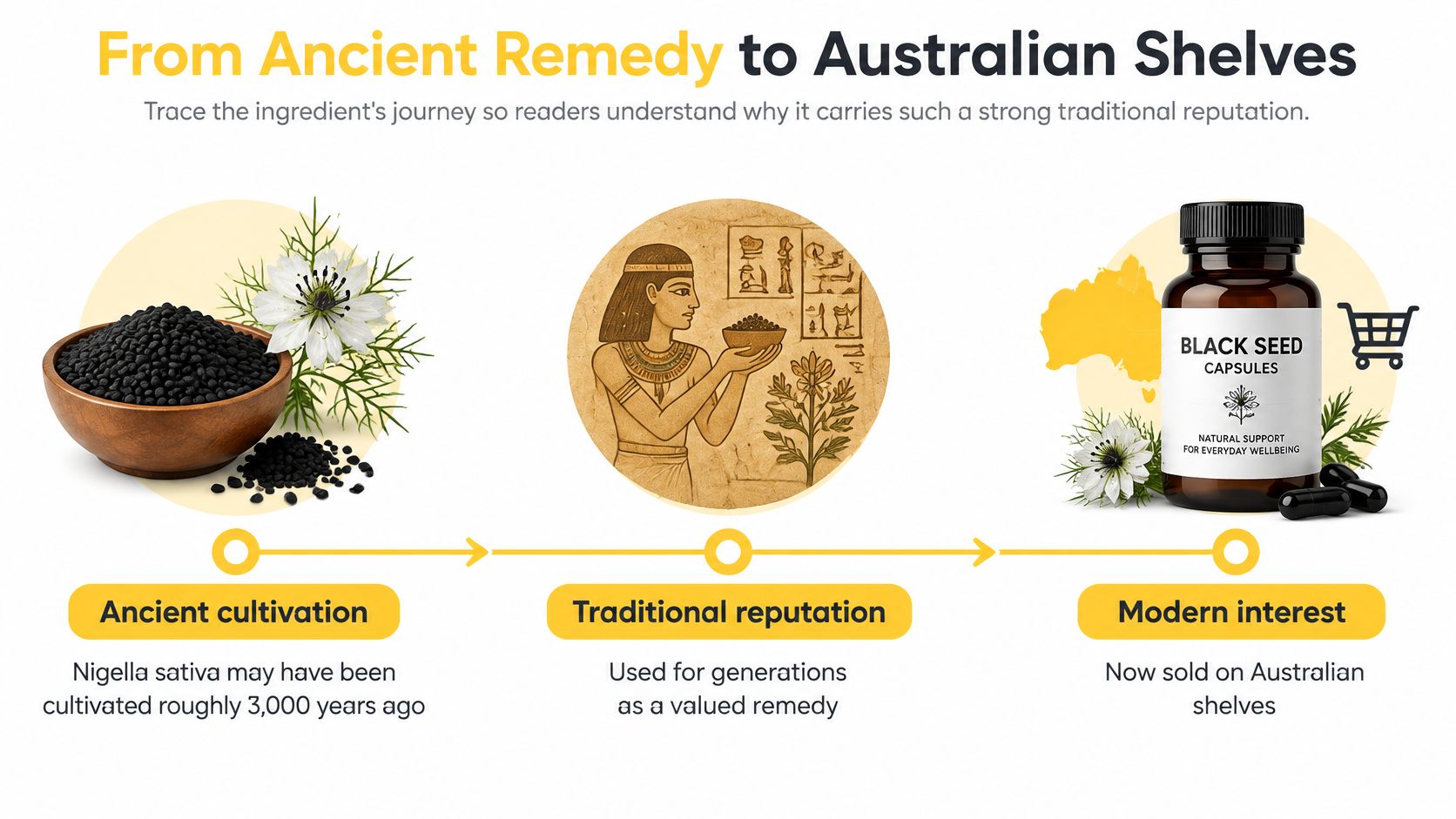
The history runs in three beats rather than a straight line from ancient Egypt to your chemist.
That last beat matters. A plant with an ancient reputation can still be a newcomer on local shelves. Enthusiasm travels faster than clinical trials, which is one reason marketing often sounds more settled than the evidence.
An old kitchen ingredient can be interesting without being a finished medical story.
A short explainer on the seed's traditional place in food and wellness sits well beside that timeline.
The tomb detail tells you the seeds were valued. It says nothing about what a capsule sold today will do for your blood sugar, your skin, or your immune system. That distinction is worth holding whenever a label leans on thousands of years of use.
If the seed is the plant, thymoquinone is the marker researchers keep scoring. A Murdoch University review describes TQ as the main component of black seed volatile oil. Think of it the way caffeine helps define coffee. Coffee has many compounds, but caffeine is the one people track when they want a comparable cup. TQ plays that role for the volatile-oil fraction of Nigella sativa.
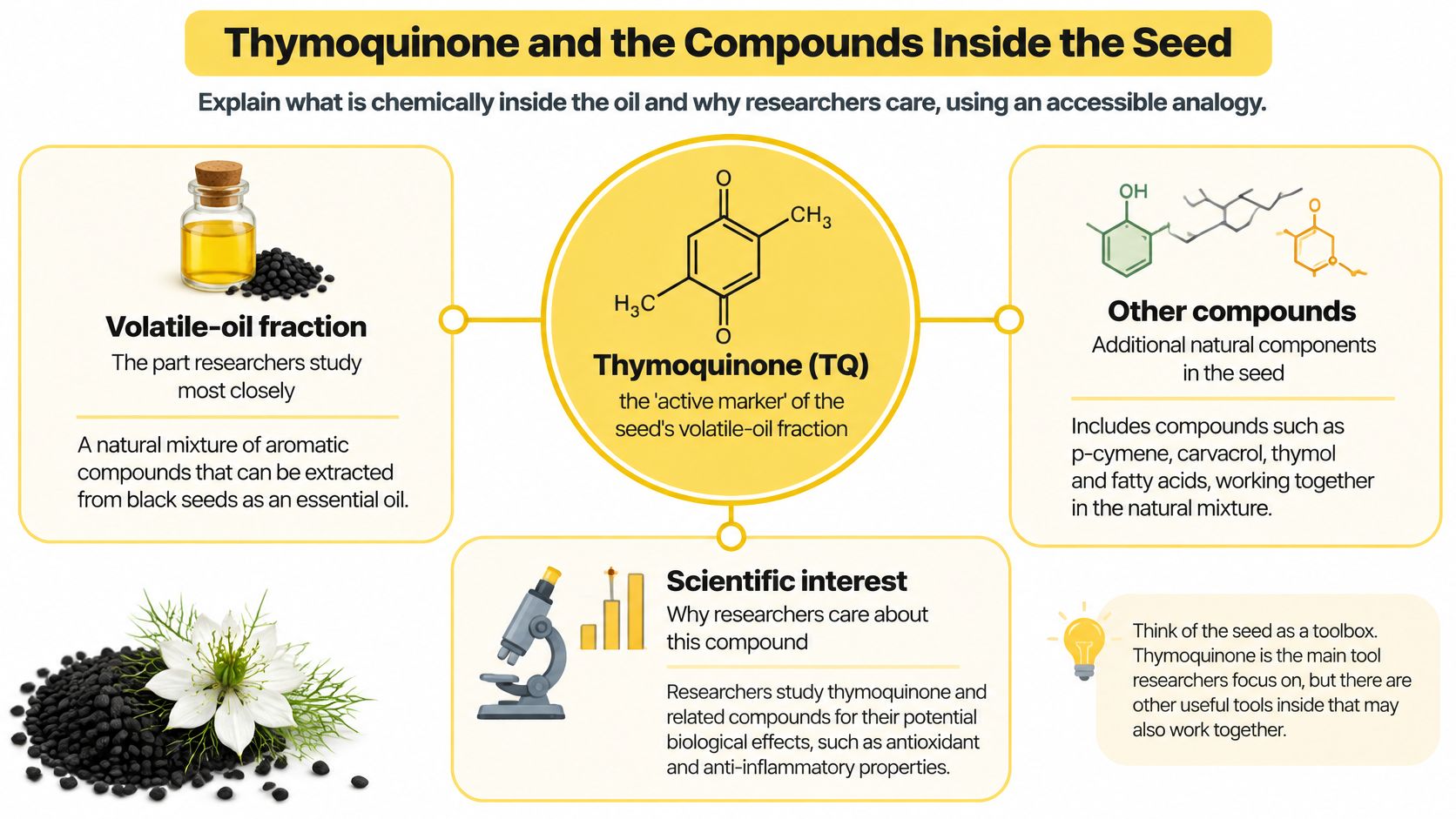
Black seed oil is a lipid-rich extract, and TQ sits in the plant's volatile-oil fraction. Laboratory and animal research associates TQ with antioxidant activity, modulation of inflammatory mediators, and possible effects on cellular proliferation. Those are mechanisms. They help explain why the oil is marketed for broad wellness. They do not establish that an oral oil product treats a specific disease.
The same review reports antioxidant and anti-inflammatory findings, and it notes that further research is needed before advanced TQ preparations can be used as pharmaceutical treatments in humans. A concentrated lab material and a kitchen teaspoon are not the same dose, the same preparation, or the same kind of evidence.
This is the practical problem most benefit lists skip. TQ concentration can vary with cultivar, geography, seed maturity, extraction method, storage, and whether the preparation is a fixed oil, a volatile oil, or a blend. A label that only says “Nigella sativa oil” doesn't give you a reliable TQ amount.
Two bottles can share a botanical name and still differ in the compound people assume they're buying. Follow the labelled dose of the product you hold. Don't scale up because a paper used a purified TQ preparation.
A teaspoon in a dressing, a capsule after breakfast, and a drop warmed between the palms can all start with Nigella sativa. The useful question in Australia is which lane the bottle sits in: food, supplement, or cosmetic. The plant can be identical while the directions, claims and safety wording change.
Culinary black seed oil works more like a strong spice than a neutral cooking oil. The flavour is pungent, peppery and slightly bitter, so small amounts make sense: a few drops through yoghurt dressing, a little over hummus, or the whole seed scattered on flatbread. A large pour in the frypan usually overwhelms the food before it adds anything useful.
Kitchen traditions also show why named-compound talk can be more honest than “superfood” talk. Fermented black garlic is discussed through chemistry such as SAC compounds in black garlic, which is a cleaner way to frame a pantry ingredient than treating folklore as proof.
Supplement use usually means a measured liquid or capsules for people who dislike the taste. In Australia, a black seed oil product may sit in different regulatory categories depending on how it is presented, so read the front label and directions as a set, not as a vibe. A bottle sold for general wellbeing should not be treated like a targeted treatment, and a culinary oil should not be assumed to have supplement-style directions.
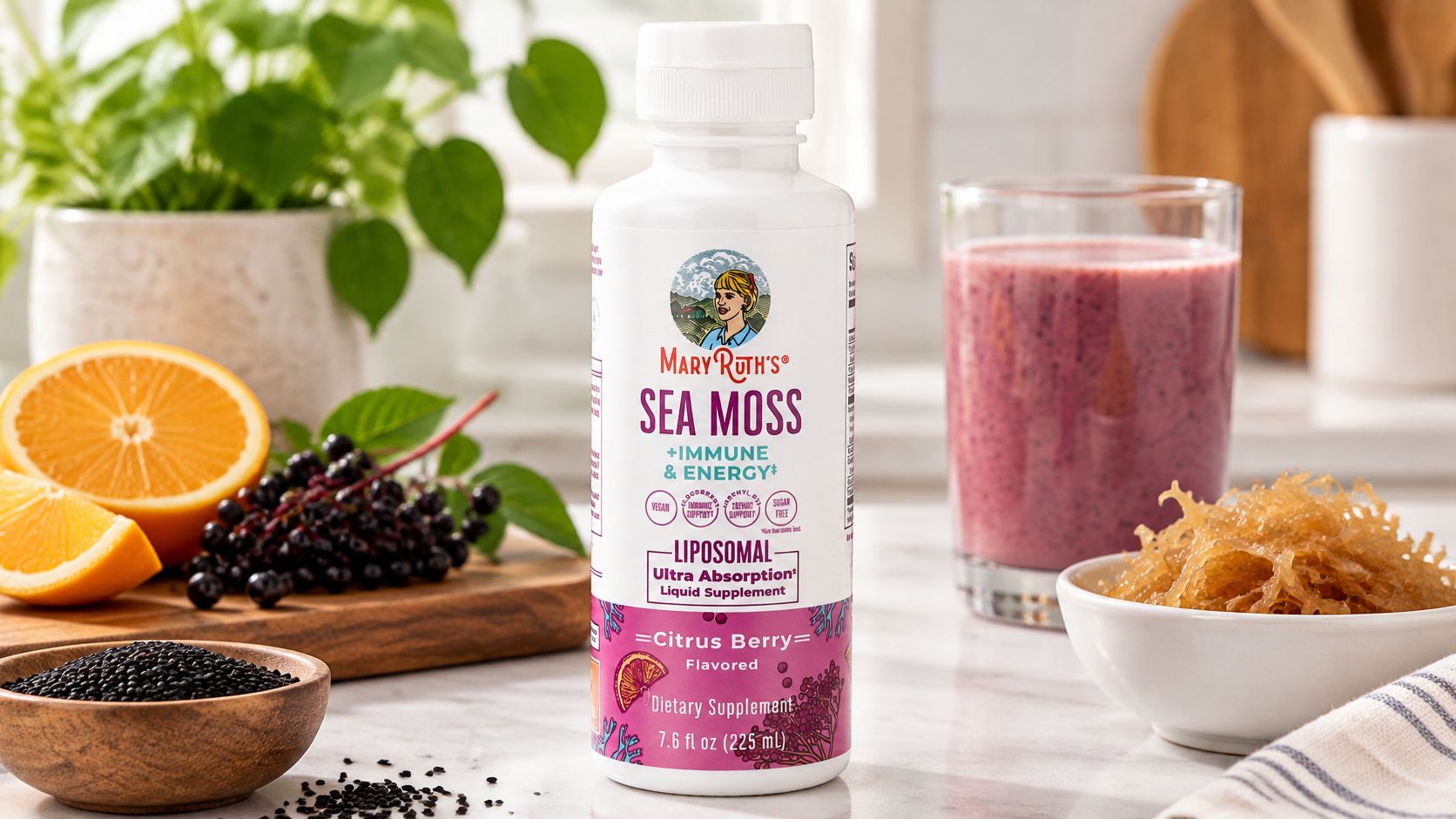
Shoppers comparing immune-support liquids sometimes land on a different botanical entirely: MaryRuth's Sea Moss + Immune & Energy Liposomal, Citrus Berry is one sea moss product in the Wallaby Wellness range. It sits outside black seed oil, and it shows how “immune support” on a shelf can describe several plants, formats and labelled routines.
Topical use is the cosmetic lane: a small amount warmed between the palms, pressed over dry areas, or smoothed through hair ends. Keep it simple. Patch-test first if your skin is reactive, keep it away from eyes, and do not assume a food bottle is formulated or labelled for facial use.
For wider context on how everyday botanicals get folded into Australian energy and immune routines, our guide to simple superfood staples for energy and immunity gives the pantry view without turning one oil into a cure.
A common assumption is that an old remedy plus a named compound plus a government register equals a proven treatment. It doesn't.
Laboratory and animal work, covered above, links TQ with antioxidant and inflammatory signalling and with possible effects on cellular proliferation. Those findings are early-stage mechanisms. Human clinical evidence is a different bar. As the CSIRO account already notes, modern clinical evidence remains mixed, and further research is needed. Mixed means some signals exist and they are not consistent enough to treat the oil as a settled therapy for a named disease.
Regulatory recognition is real, and it is narrower than marketing implies. The Therapeutic Goods Administration lists an ARTG medicine named “Black Seed Oil” containing Nigella sativa, with an ARTG date of 24 January 2025, as shown on the ARTG entry for Black Seed Oil. Earlier Australian entries include “Black Seed Oil” dated 19 June 2020 and cold-pressed Nigella black seed oils dated 12 and 13 October 2022.
Read those dates as milestones, not as verdicts.
The entries identify the ingredient as Nigella sativa and classify the products as medicines under the listed licence category. The register pages do not, by themselves, establish that black seed oil prevents or treats a disease.
Registration tells you a product sits inside the therapeutic-goods system. It doesn't score the clinical trials for you.
Benefit round-ups for other kitchen plants, including pieces on proven health benefits of ginger, show how easy it is to slide from tradition into a numbered promise. For black seed oil, the honest map is tradition plus interesting early research, not a proven treatment. Be sceptical of any line that blurs those.
A label is a legal document before it is a sales pitch. Everything you need to classify a bottle of black seed oil sits on it in small print, and none of it requires a chemistry degree.
Start with the regulatory line. The Therapeutic Goods Administration says complementary medicines sold legally in Australia generally need an ARTG listing and an AUST number on the label, and listed medicines are not evaluated by the TGA for efficacy before sale. That distinction is set out in the TGA's guide to understanding complementary medicines. An AUST number places a product inside the therapeutic-goods system. The number alone cannot tell you whether the oil helps with any condition.
The same checklist travels across the aisle. A clear walk-through on how to choose supplements confidently with AloeCure applies the identical habit to other bottles: name the ingredient, read the dose, and let the facts outweigh the slogan. The habit earns its keep in a crowded market, and our snapshot of Australian supplement industry statistics shows how many similar-sounding products an Australian shopper can meet in a single scroll.
The same dark oil can sit under three different sets of rules depending on what the seller claims it does. That is why the aisle matters as much as the ingredient.
| Product type | How it is regulated | What to check on the label |
|---|---|---|
| Food or pantry oil | Sold as a food rather than a therapeutic good | Botanical name Nigella sativa, ingredients, and culinary directions |
| Cosmetic oil | Sold for external use on skin or hair | Intended use, ingredients, and any warning to patch-test |
| Listed medicine | ARTG-listed complementary medicine with an AUST number | AUST number, directions, and the stated dose. Efficacy is not pre-checked |
Wallaby Wellness organises supplements by product type, ingredient and health goal, which can make broad categories easier to compare. To identify whether a particular bottle is a food, cosmetic or listed medicine, however, read the botanical name, intended use, AUST number and directions on that product's own label. Batch information and dosing still belong to the label in your hand, not to a category name on a website.
Black seed oil is a specific oil from Nigella sativa, not a generic dark seed oil. It carries an old food-and-traditional-use history, a distinctive marker in thymoquinone, and three everyday roles: condiment, supplement, and cosmetic. The evidence around TQ is interesting at the laboratory and animal level, and it is still developing in people. An ARTG entry recognises the ingredient inside Australia's listed-medicine system. It is not a certificate that the oil prevents or treats disease.
The habit that survives all of that is simple. Judge the bottle by botanical identity, intended use, and what the label states. Ignore the slide from “traditional” to “proven.” If you take other medicines, or you have a condition your clinician is already managing, talk with that practitioner before you add a listed medicine or a daily teaspoon.
We sell supplements that include ashwagandha, black seed oil, bone broth, and bone broth protein powder. We also sell sea moss supplements, colostrum supplements, black seed oil, and diatomaceous earth, so the oil sits in a range you can compare by format and by health goal rather than by slogan.
Wallaby Wellness is an Australian retailer of health foods, dietary supplements, and everyday wellness products, including black seed oil alongside sea moss, colostrum, and other botanicals. If you want to compare formats with the label habits from this guide, start with the supplement range and match the bottle to food, cosmetic, or listed-medicine use. Visit Wallaby Wellness to browse the range and choose with the label in front of you.