Why Collagen Supplements Don't Work: What to Check
, 16 min reading time
Collagen not working? Learn why collagen supplements don't work, what the Australian evidence shows, and how to test a product fairly before deciding.
Eight weeks of daily collagen, same lighting, same mirror, and the photos look identical. That outcome is common enough to deserve a better explanation than "buy a stronger tub."
Swallowed collagen is digested into amino acids and small peptides rather than delivered intact to skin or joints. Skin trials using ongoing daily doses report group averages, and an average says little about whether your particular product will produce a change you can see.
The standard advice to take more or wait longer skips the first question: what, exactly, are you testing? A disappointing result is a diagnosis problem. Product identity, dose, duration and the outcome you expected all get checked before collagen itself takes the blame.
Collagen marketing rests on an appealing assumption: swallow the material your skin and joints contain, and the body will replenish them. Plausibility is a starting point; it is not evidence of a visible result.
Commercial success settles nothing either way. Collagen represented 36.07% of Australia's skin-care supplements market revenue in 2024, according to Grand View Research's Australian market analysis. That figure records what shoppers bought. Sales volume says nothing about whether anyone's skin improved.
Take an example: a trial reports a mean improvement of 1 point on a hydration scale. That kind of change is statistically detectable and invisible in a bathroom mirror. Some participants may improve more, some may go backwards, and the published average conceals both.
Your question is narrower than whether researchers detected any change. You want to know whether the change justifies paying for and taking the product every day.
Practical distinction: A measured research outcome can still leave you seeing no difference at all.
When collagen seems to fail, the useful response is diagnosis. Five variables deserve checking before the ingredient itself: the dose against studied amounts, the duration against the trial period, the outcome you chose to measure, the identity of the product you bought, and its regulatory status.
Each failure points to a different fix. A misidentified product needs verification. An unsuitable outcome needs redefining. A fair test with no worthwhile improvement may justify stopping, not escalating the dose indefinitely.
A disappointing mirror check can come from the product, the plan or the measurement rather than from collagen itself. Run through the rows below before deciding the supplement is useless.
| Reason | What the Evidence Shows | Quick Check |
|---|---|---|
| Digestion breaks collagen into amino acids | Amino acids and small peptides enter general circulation rather than following a guaranteed route to skin or joints | Identify the ingredient and its stated collagen amount |
| Dose below the studied range | Trial results apply to the daily collagen amount tested, not to a lower intake | Compare actual collagen grams, not total powder weight |
| Duration too short | Research measures outcomes over a defined period | Find the assessment period for the relevant outcome |
| Effect too small to see | A measured difference may not be personally noticeable | Choose a defined measure before starting |
| Wrong product type | Gelatin, peptide preparations and collagen-builder blends aren't interchangeable | Read the full ingredient list and how the product is regulated |
| Baseline habits complicate interpretation | Nutrition, sun exposure and recovery routines can differ from research conditions | Record your routine and changes to it |
Start with the row that best matches your situation. If you can't identify the ingredient or amount, resolve that before deciding your body needs more.
The Australian Institute of Sport's collagen evidence review explains the potential role of collagen-related amino acids while describing substantial uncertainty about practical benefits.
Digestion makes targeted-delivery claims misleading. However, it doesn't prove supplements can never have an effect: increased availability of relevant amino acids offers a plausible mechanism that still needs convincing clinical testing.
That's the distinction to retain. A plausible mechanism isn't a guaranteed outcome, and digestion alone isn't proof of uselessness.
A scoop describes a serving, not necessarily its collagen content. In a blended powder, some of that serving may be flavouring, fibre or other ingredients.
Hydrolysed collagen peptides should also be distinguished from gelatin and from collagen builders containing vitamins or herbal ingredients. A product name can describe a marketing goal without identifying the substance used in a trial.
Stopping before the relevant assessment period can leave the result uncertain. Continuing indefinitely without a defined endpoint creates the opposite problem: there's always another reason to wait.
Neither approach answers whether the supplement helped. Set the outcome and reassessment point in advance, and don't use a lack of visible change as an automatic instruction to increase the dose.
A 2019 systematic review of 11 studies involving 805 participants found promising improvements in skin elasticity and hydration with 2.5 to 10 g daily, as described in CHOICE's assessment of collagen supplements. But those figures combine studies using different products, doses, designs and outcome measures.
Several preparations also contained vitamin C or other ingredients. That makes it difficult to credit collagen alone for the observed changes, or to assume an unrelated powder will reproduce them.
The headline figures need to be read alongside those limitations.
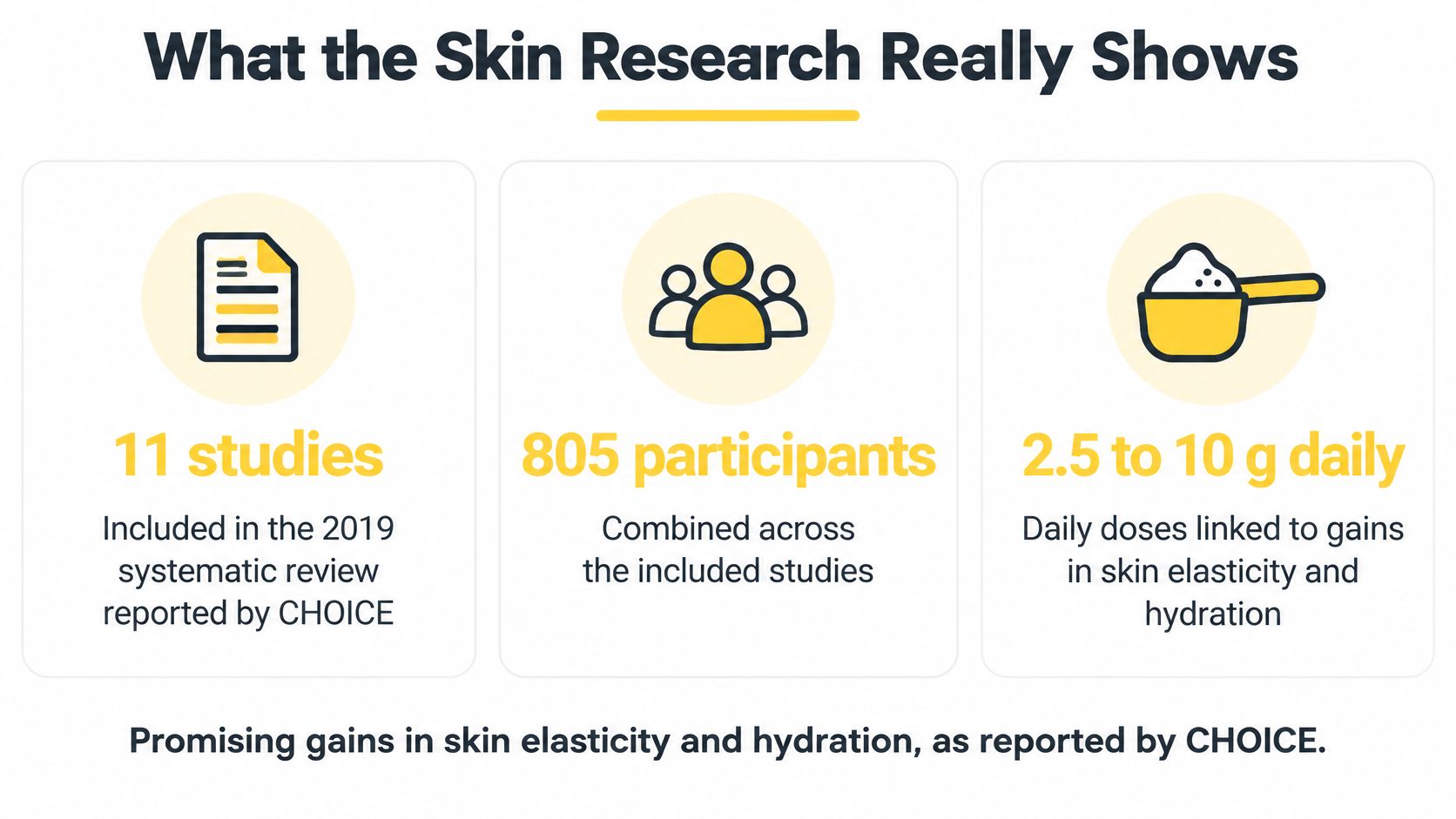
CHOICE also reported an Australian dermatologist's assessment that evidence remained insufficient to conclude supplementation visibly improves skin after use. That's a narrower, more useful conclusion than either declaring collagen proven or dismissing every possible benefit.
A 2025 meta-analysis covering 23 randomised trials and 1,474 participants found that apparent improvements in hydration, elasticity and wrinkles disappeared when analyses were restricted to higher-quality studies or trials without pharmaceutical-industry funding, according to Medscape's discussion of the skin evidence.
| Study comparison | Earlier systematic review | Later meta-analysis |
|---|---|---|
| Headline finding | Promising hydration and elasticity results | Apparent improvements across several skin outcomes |
| Main qualification | Products and methods differed | Improvements disappeared in the specified quality and funding analyses |
| What it establishes for buyers | A reason for further investigation | A reason not to treat pooled positive findings as settled proof |
| Dose interpretation | Applies to the studied preparations | No single daily dose is established by the summary |
The important issue isn't merely how much research exists. It's whether favourable results remain persuasive when weaker studies are removed.
Skin hydration and elasticity measurements aren't identical to a visible reduction in ageing. A research result can therefore sound more compelling in an advertisement than it feels to someone taking the product.
Multi-ingredient formulas add another uncertainty. Browsing vitamin C supplements won't resolve whether a collagen blend's result came from collagen, another ingredient or their combination.
The defensible conclusion is cautious expectations. The evidence doesn't guarantee visible improvement, but uncertainty also doesn't prove that every preparation is ineffective for every person.
Broad promises about joint health reach beyond the condition-specific evidence. Research involving people with knee osteoarthritis cannot automatically answer whether collagen helps hip pain, an athletic injury or general stiffness.
Pain after activity also needs an appropriate assessment, rather than an assumption that more collagen is the missing treatment.

The RACGP's osteoarthritis guideline describes pooled results from six studies suggesting short-term pain improvement over 13 to 26 weeks with very inconsistent findings, and reports that four studies found no effect on function, all concerning knee osteoarthritis rather than hip disease.
The guideline finds insufficient evidence to recommend for or against collagen and insufficient research to recommend a particular dose. It also notes a possible increase in gastrointestinal adverse events that wasn't statistically significant.
Less pain and better function measure different outcomes. An improvement in either one leaves the question of cartilage repair open.
That distinction matters when comparing joint and bone health supplements. A category label doesn't establish which condition a product has been tested for, or whether its claims concern symptoms, movement or tissue changes.
The sports evidence also needs context. The AIS review discussed earlier treats collagen as an adjunct to established rehabilitation or exercise, not a replacement.
An Australian-registered trial planned to compare 15 g of bovine collagen hydrolysate daily for 16 weeks with hydrolysed milk protein and placebo in postmenopausal women with knee pain related to early osteoarthritis. That's a trial design, not a reported demonstration of benefit, and its population doesn't represent every active adult.
Consider a standard physiotherapy plan for knee pain: scheduled strengthening sessions, graded progression and a validated function measure, such as a timed sit-to-stand score, recorded at baseline and again after several months. Collagen added to that programme is one input among several. If the score improves, the supplement's contribution can't be separated from the training effect without a comparison group.
A supplement tested alongside rehabilitation shouldn't receive sole credit for the rehabilitation programme's result.
The same logic applies in reverse. A disappointing result is a diagnosis problem before it's a verdict on collagen: the outcome measured, the dose and the duration all need checking before the product takes the blame.
The video below offers additional context, but individual treatment decisions should follow clinical assessment.
If you're considering collagen for persistent joint pain, ask a clinician to help select an appropriate pain or function measure. Keep prescribed strengthening and rehabilitation central, and don't postpone diagnosis while waiting for a supplement to work.
The TGA's warning about Collagen Slim capsules illustrates why product verification belongs before dose escalation. The regulator found their supply illegal and their manufacturing site unapproved.
A separate warning reported that Natures Valley Collagen Builder tablets contained approximately 199.3 mg of undeclared sildenafil per tablet, as described in Medical Republic's coverage of the regulator's findings. Sildenafil can cause dangerous blood-pressure effects and interact with nitrates.
These cases don't establish that ordinary collagen peptides are unsafe. They show that a collagen-related name doesn't guarantee a product contains only what the buyer expects.
| Label Check | Why It Matters | Red Flag |
|---|---|---|
| AUST L or AUST R number, where required | Therapeutic goods must meet the applicable Australian registration requirements before legal supply | Unclear regulatory status on a product presented as therapeutic |
| Ingredient type | Product identity determines whether research is relevant | A collagen builder that contains vitamins or herbs rather than collagen |
| Collagen amount per serve | Trial comparisons require an identifiable daily amount | A blend without a separately stated collagen amount |
| Supplier | Traceability allows you to identify what you bought | Unclear importer, missing batch details or an incomplete ingredient list |
| Marketing claims | Claims need to match the product and its regulatory status | Guaranteed rebuilding, rapid transformation or dramatic testimonials |
Start by distinguishing a food product from a therapeutic good. An absent AUST number isn't, by itself, proof that a food powder is illegal, and an AUST number shouldn't be treated as a promise of visible results.
Then check ingredients and amounts separately. A clearly named collagen ingredient still leaves an unanswered question if the label gives only the total weight of a multi-ingredient serving.
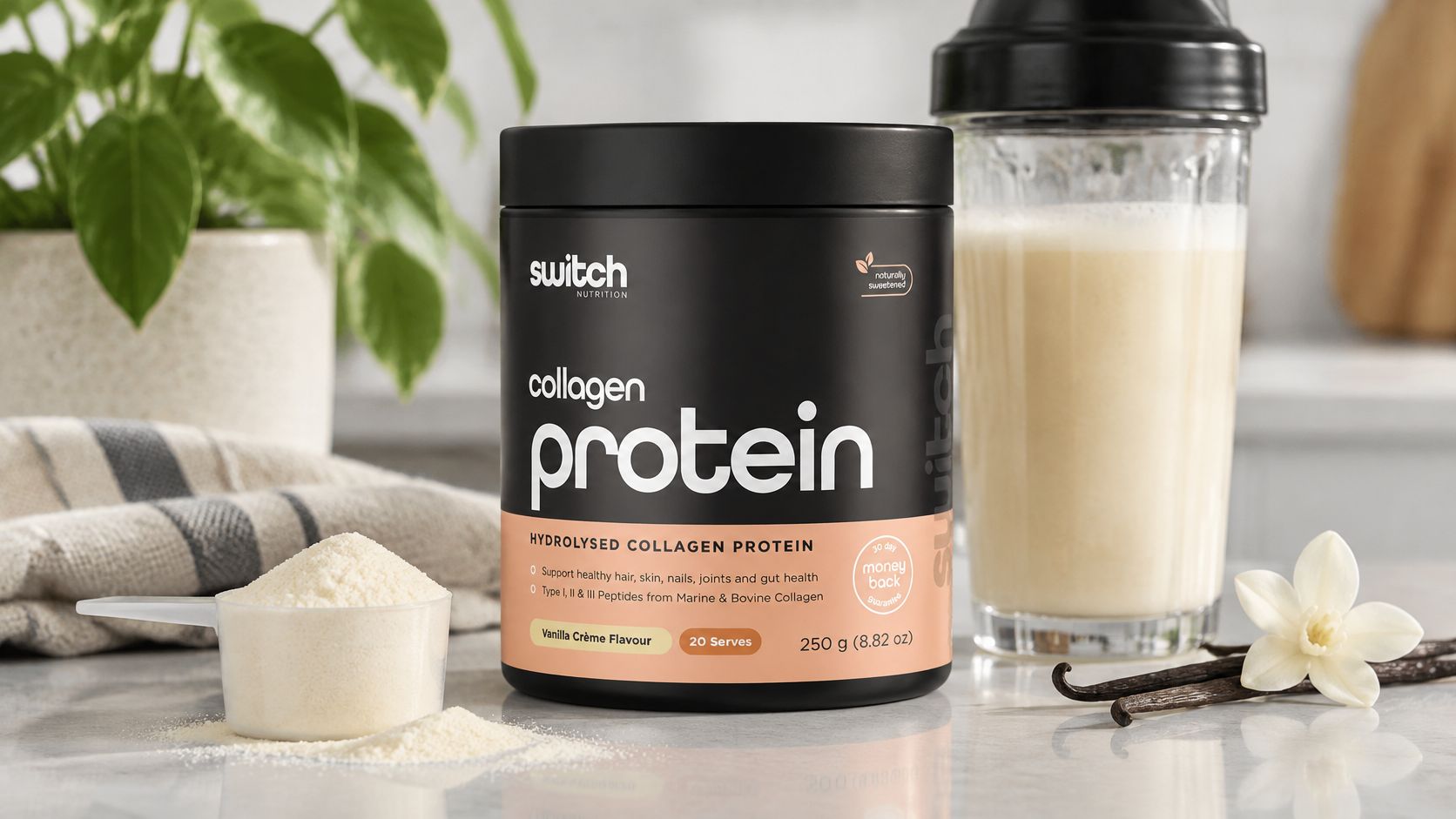
For example, Switch Nutrition Hydrolysed Collagen Protein Vanilla Creme lists bovine and marine collagen peptides alongside other ingredients. That makes the distinction between powder serving weight and collagen content important; it doesn't establish that the finished blend reproduces a clinical trial.
The product image is a label-reading example, not evidence of efficacy or an association with the regulator warnings above.
Don't interpret unexpected symptoms as evidence that a product is powerful or finally working. Stop taking a suspect product and seek medical advice; chest discomfort, marked dizziness or a racing heart warrant prompt assessment.
Testimonials can't verify ingredients, safety or suitability. If the label and supplier checks leave basic questions unanswered, don't solve that uncertainty by taking more.
A personal trial can help answer whether continuing feels worthwhile. It cannot establish that collagen caused a change, because you aren't reproducing a blinded, controlled study.
The useful goal is narrower: decide whether a verified product produces enough observable benefit to justify continuing, without delaying appropriate care.
The process is easier to follow when you write it down before opening the container.
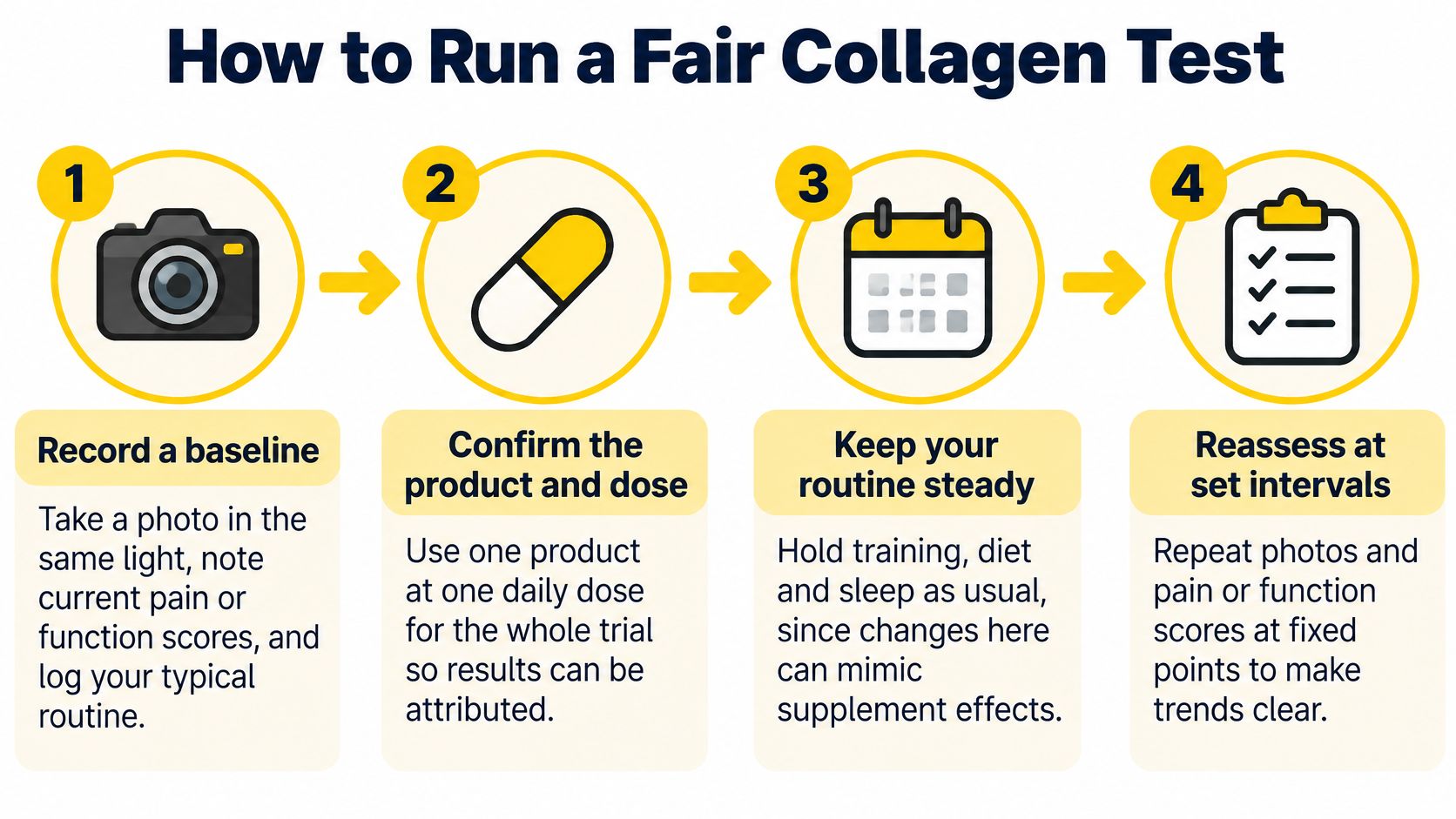
For skin, decide whether your goal is something you can assess consistently in photographs. Avoid changing the goal from visible improvement to an undefined internal benefit when nothing changes.
For joints, separate discomfort from ability. A clinician can help you track a validated measure rather than relying on whether your knee feels generally better.
Stop rule: A disappointing result isn't a reason to keep extending the deadline until something improves.
Don't preserve harmful habits or postpone necessary treatment just to keep the test consistent. Make appropriate health changes, record them, and accept that you may no longer be able to isolate the supplement's contribution.
A flat result after a reasonable test is still useful information. It doesn't mean you lacked discipline or chose the wrong time of day; it may mean this product offers no worthwhile benefit for your chosen outcome.
A flat result narrows the decision. Before collagen itself takes the blame, check the variables that commonly fake a verdict: dose, duration, chosen outcome, product identity and regulatory status. If one of those failed, the trial may have tested the wrong product or the wrong question.
When the test was fair and the defined measure still did not move, continuing is a purchase habit. Stop buying a product that has not met your defined measure, especially when its identity or safety is still unclear.
The next spend is often better aimed at the constraint that actually limits the result: overall nutrition and protein intake, resistance training or clinician-directed rehabilitation for joints, and consistent sun protection for skin.
If a symptom could signal harm, ask a doctor or pharmacist before any restart.
At Wallaby Wellness, we sell collagen beauty supplements, collagen protein bars, probiotic collagen, biotin hair products and hair growth supplements. Visit Wallaby Wellness to review the available options, and use the ingredient, dose and product-status checks above before deciding whether another purchase fits your goal.
If the failed outcome still matters, book the dermatologist or physiotherapy appointment first.