BCAA vs EAA: Which Amino Acids Your Body Needs
, 16 min reading time
BCAA vs EAA compared on amino acid profile, dietary sources and sports evidence, so you can choose what suits your training and diet.
The popular advice to choose EAAs over BCAAs skips the most important question: do you need an amino-acid supplement at all? A broader ingredient list isn't automatically a reason to buy, especially when your meals already supply the amino acids you're looking for.
A better BCAA vs EAA decision starts with total daily protein, then product verification. Only after those checks should you compare formulas, timing and cost. That order separates a genuine nutritional gap from a supplement that merely sounds relevant to your training.
The label split between BCAA and EAA overstates the difference between the two products. BCAAs are leucine, isoleucine and valine, a subset of the essential amino acids; EAA formulas provide the complete essential set that your body must obtain through nutrition. The meaningful difference is composition. Whether that matters depends on what your meals already supply.
BCAA and EAA compared on composition and use
| Criterion | BCAA | EAA |
|---|---|---|
| Amino acids included | Three: leucine, isoleucine, valine | All nine essential: the three BCAAs plus histidine, lysine, methionine, phenylalanine, threonine, tryptophan |
| Supplies all essential amino acids | No | Yes |
| Role in muscle-protein synthesis | Leucine signals; building blocks limited to the BCAA subset | Signals and supplies the full essential set of building blocks |
| Replaces complete dietary protein | No | No |
An EAA product covers a wider amino-acid profile. A free-form amino-acid drink still supplies isolated amino acids, while eggs, tofu, dairy and a balanced meal supply protein along with the other nutrients those foods carry. The supplement addresses a narrower task: delivering specified amino acids when your diet leaves a gap.
BCAAs sit inside the EAA category, so a genuine full-spectrum EAA formula already includes them. A product labelled EAA plus BCAA often describes that overlap rather than an additional category of muscle-building ingredients. Check the panel: when the label says EAA plus BCAA, see whether the BCAA amount sits inside the essential total or appears as a separate addition. That distinction shows whether the wording adds anything.
The useful label question is whether the formula supplies the complete essential profile and discloses meaningful quantities. Prominent wording about leucine alone cannot answer that. Evidence for a complete EAA blend does not automatically carry over to a BCAA-only product with a different amino-acid profile. Compare the amino-acid panel, the amount per serve and the form of each amino acid before accepting a performance claim.
Buying principle: A more complete formula can address an amino-acid gap more logically without being necessary for someone whose diet already addresses it.
Composition answers what you're buying. Your daily protein intake and training circumstances determine whether the purchase makes sense. Start with total daily protein, then verify the product against its label.
Total daily protein is the first filter before any amino-acid product enters the decision. Product verification comes second. In 2023, only 1.5% of Australians aged two years and over took a protein or amino-acid supplement, according to the Australian Bureau of Statistics dietary supplement release. That low figure makes supplements unusual in this dataset, while leaving open the separate question of whether individual diets meet protein needs.
Population averages cannot settle your own intake. Meals, portions, dietary restrictions and training demands all change the answer. A useful audit starts with what you eat on training and rest days, not with a product category.
Common protein sources and essential amino acid completeness
| Source | All nine essential amino acids | Practical note |
|---|---|---|
| Whey protein | Yes | Dairy-based; a protein-powder option |
| Eggs | Yes | A whole-food protein option |
| Chicken or beef | Yes | Animal-protein options for meals |
| Soy, including tofu, tempeh and soy milk | Yes | A complete plant option; compare protein content between products |
| Lentils and legumes | Not in the same balanced proportions as complete proteins | Pair with grains or legumes at the same meal |
| Rice | Not in the same balanced proportions as complete proteins | Relatively low in lysine; pair with legumes |
For plant foods, a limiting amino acid means the proportion is lower relative to nutritional needs. The amino acid can still be present. Mixing foods across the day, such as rice with legumes, strengthens the overall profile without treating any single food as useless.
Write down breakfast, lunch, dinner, snacks and drinks. Use labels and usual portions to estimate protein, including the foods that are easy to overlook.
A concrete daily comparison makes the point better than a broad diet label. A vegan day of tofu, soy milk, lentils with rice, hummus, nuts and a protein bar can contain enough protein when portions are adequate. An omnivorous day of toast and coffee, a small salad lunch, a casual snack and one dinner can fall short despite including animal foods. The structure of the day matters more than the category name.
Food protein comes first because meals supply broader nutrition alongside amino acids. A supplement becomes easier to judge once the daily total and the diet gap are clear. Our comparison of plant protein vs whey can help when the practical choice is between protein sources rather than isolated amino acids.
If intake remains uncertain, a sports dietitian can interpret your meals against your activity and goals. The national supplement figure provides context, not a personal prescription.
Muscle-protein synthesis needs two things at once: a signal to begin building and the materials to continue. Leucine carries much of the signalling role. Signalling alone supplies no building blocks.
The diagram illustrates that distinction.
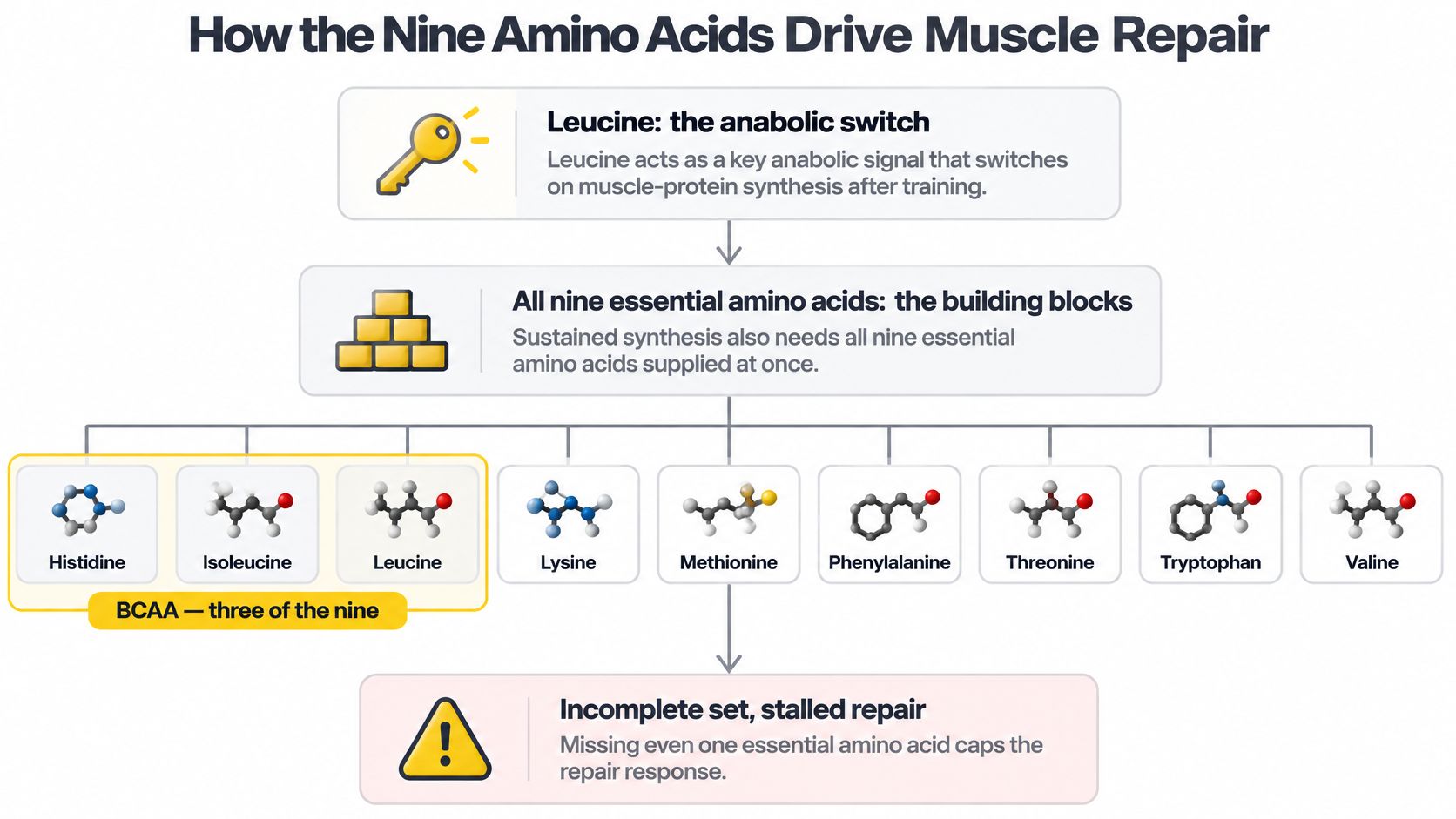
After training, leucine helps activate the processes involved in muscle-protein synthesis. Sustained synthesis then depends on availability of the broader essential-amino-acid pool, and your body cannot manufacture essential amino acids it was never given. Amino acids from meals and existing body pools contribute to that pool as well, so a BCAA drink never operates in isolation from your diet. What the drink itself lacks is the complete essential profile, which is why its usefulness can only be judged against what your meals already supply.
In a controlled resistance-exercise feeding study, a bolus feeding pattern produced higher peak post-exercise amino-acid concentrations than more distributed patterns: EAA concentrations rose 135% above rest at approximately 40 minutes, while BCAA and leucine concentrations rose 37% and 57%, respectively. These are blood-concentration responses to feeding, not equivalent percentage improvements in muscle growth. The trial compared feeding patterns, not products, so the different rises rank nothing on a shelf. Availability sets a ceiling on how much repair can proceed. It does not set the pace.
A rise in circulating amino acids describes availability, and availability alone does not demonstrate greater strength, faster recovery or more muscle over a training programme.
The mechanism becomes practical when you plan around real constraints:
Our protein intake calculator is a starting point for reviewing intake, not a diagnosis or an automatic reason to add supplements.
Video: the same mechanism, explained visually.
The practical priority stays a complete protein serving whenever you can eat or drink one comfortably; an EAA formula is the fallback when dietary protein is unavailable.
The Australian Institute of Sport places BCAAs in Group C, and the evidence summary behind that classification describes an international systematic review of 24 eligible athlete studies drawn from 2,298 records. Its overall finding was negligible effects on athletic performance and body composition.
That result sits awkwardly with the mechanism-led pitch. BCAAs participate in muscle metabolism, which establishes that these amino acids matter to the body. Whether extra amounts change strength, speed or lean mass in an athlete already eating enough protein is a separate question that needs its own trials.
Soreness is the contested endpoint. The same evidence summary records lower perceived soreness in some resistance-training trials, while endurance-exercise findings were inconsistent. Those two results shouldn't be merged into a general recovery claim.
Feeling less sore, producing more force, finishing a session faster and gaining muscle are four separate endpoints, and evidence for one doesn't transfer to the others. Read endpoint by endpoint, the picture separates cleanly:
A BCAA effect is indistinguishable from the correction of a dietary shortfall unless total daily protein intake is known. Where intake goes unmeasured, a trial cannot say whether participants responded to a specific amino-acid dose or ate closer to their requirement. The ambiguity carries into the purchase decision: someone already eating enough complete protein has no established reason to expect added benefit, and swapping in an EAA product doesn't change that on its own.
Evidence boundary: A possible soreness benefit isn't the same as a proven improvement in training adaptation or competition performance.
Group C describes the strength of the evidence, not a claim that BCAAs can never act. For a buyer, the burden of justification stays with the product, and that check comes second. Total daily protein comes first. Equally, this verdict doesn't prove that adding an EAA product to an adequate diet will improve performance.
A Sport Integrity Australia-linked analysis of supplements purchased online in Australia found prohibited substances in 35% of 200 products overall, including 2 of 21 amino-acid products, reported as 10%; the investigation also identified a BCAA powder containing high levels of beta-methylphenethylamine, an amphetamine isomer with stimulant effects.
Those findings describe the tested sample, not the probability that every Australian supplement is contaminated. They nevertheless expose a problem that an ingredient comparison can't solve: choosing EAA over BCAA doesn't verify what's in the container.
Use the checklist as a starting point, then verify the documents behind the packaging.
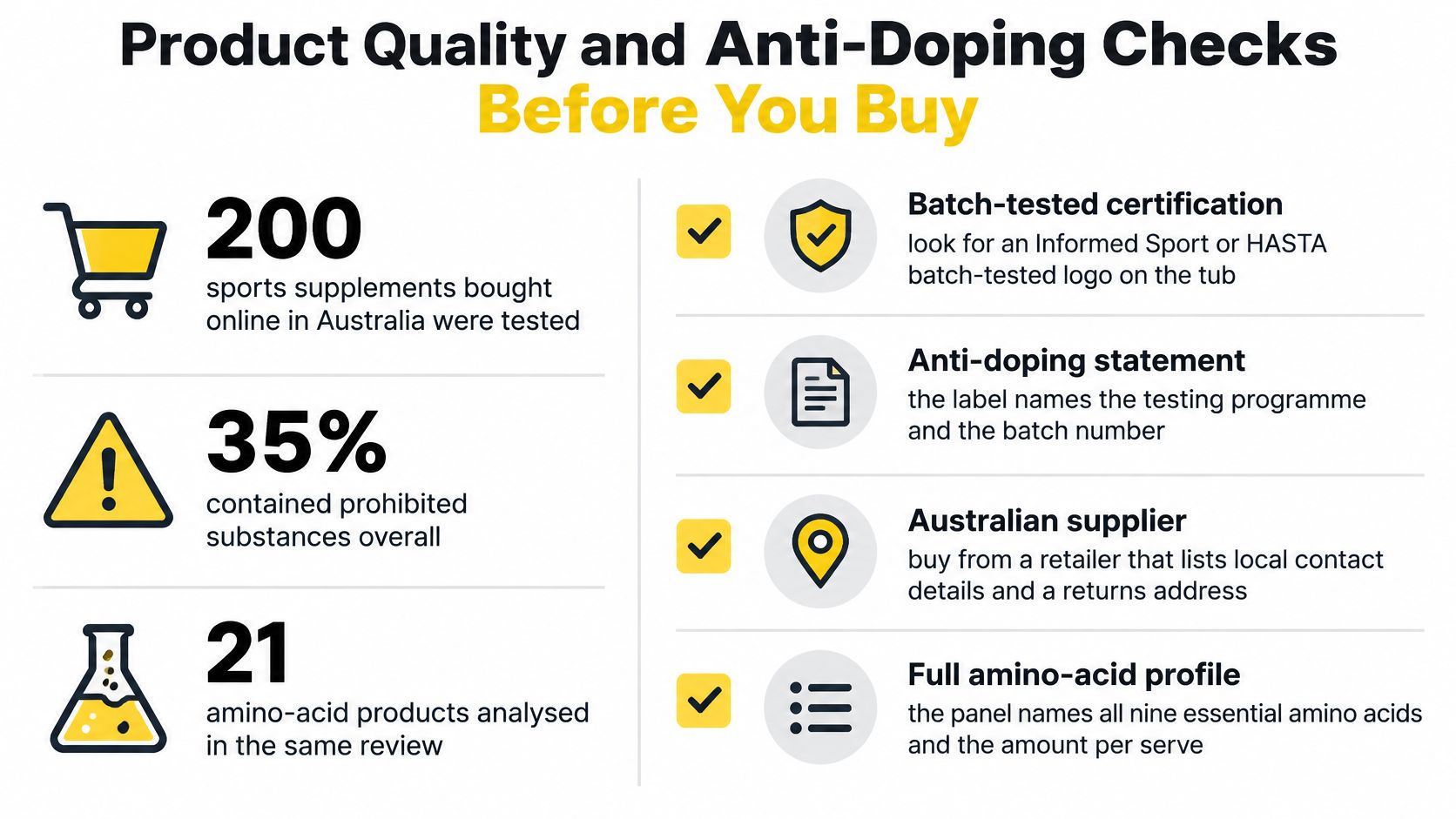
For competitive athletes, unresolved certification questions are a reason to pause the purchase, not an administrative detail to sort out after using it. Coaches and parents of younger athletes should apply the same scrutiny.
Natural positioning, a local supplier and an ingredient list aren't proof of sport safety. Supplier contact details help with accountability, but they can't replace batch-specific verification.
Best fit by training situation and diet
| Situation | Better fit | Why |
|---|---|---|
| Adequate protein from daily meals | No amino-acid product needed | A hard session on its own doesn't create a requirement for a separate amino-acid drink |
| Training fasted or with no protein meal before | EAA if food isn't practical | Supplies the complete essential profile when an amino-acid option is the practical choice |
| Low-protein or vegan diet | EAA or complete plant protein if a shortfall exists | Closes the gap without animal sources; vegan eating alone isn't an indication |
| Energy restriction during a cut | EAA if a convenient bridge is needed | Provides essential building blocks but doesn't replace adequate daily protein |
| Long endurance session, ample protein eaten | No added benefit established | Nothing in that scenario gives either product a clear performance role |
The strongest recommendation remains to identify what your current routine lacks before selecting a product.
Say a resistance trainer skips breakfast, trains early and then starts work without eating. The more useful question is how the schedule came to leave no practical protein option around the session.
A prepared protein breakfast, a suitable shake or a meal carried to work may solve the problem more completely. If those options aren't workable and the person wants an amino-acid drink, EAA is the more coherent choice, because the formula doesn't leave part of the essential profile unprovided.
That doesn't mean everyone who trains before breakfast needs a supplement. Someone who eats a suitable meal afterwards has a different situation from someone who routinely delays food well into the working day.
If whey suits your diet, our guide to the best whey protein isolate options in Australia can help frame that alternative. We also sell vegan protein supplements, egg white protein powder and micellar casein, so the choice needn't be restricted to amino-acid drinks.
For a catalogue example, Switch Nutrition Amino EAA & BCAA Electrolyte Recovery Mango Kiwi is described as supplying the complete essential-amino-acid profile alongside electrolytes. That description identifies the formula's intended role; it doesn't establish independent batch certification or prove an added benefit for your circumstances.
The product image shows the catalogue example, not evidence of effectiveness or anti-doping clearance.
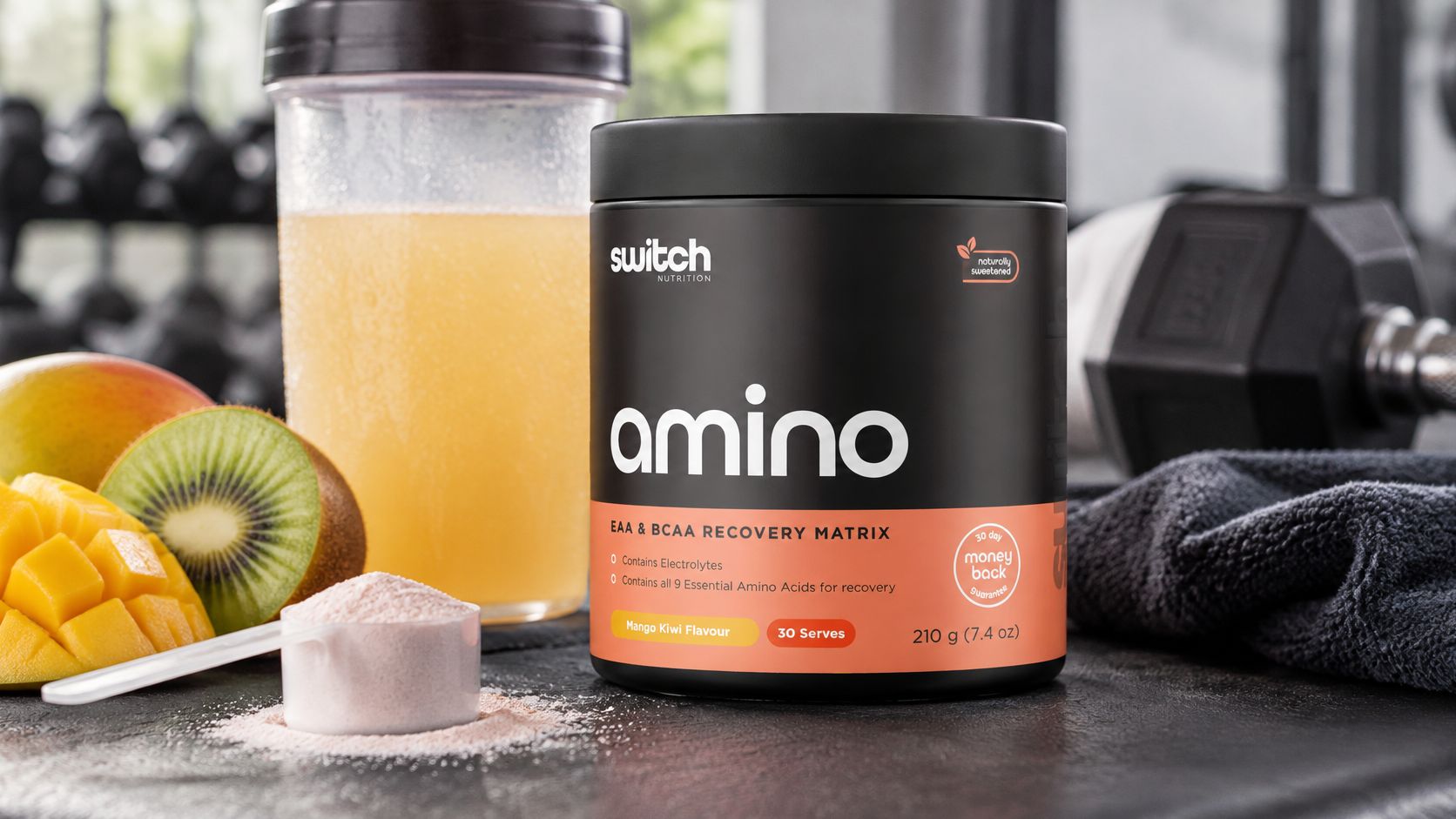
Assess added electrolytes separately from amino acids. Vitamins, botanicals or flavouring shouldn't distract from checking whether the core formulation addresses your identified need.
If you're considering a broader assessment of your health and training, Telomyx health and performance testing is a resource to review with an appropriately qualified practitioner. Personal testing isn't a substitute for a dietary assessment, and it doesn't certify a supplement's contents.
An amino-acid product earns its place when a defined gap exists and the label, batch and certification checks hold up. Where daily protein is already sufficient, that same scrutiny is better spent on food or on a complete protein powder.
We offer whey protein isolate, vegan protein supplements, amino-acid products, electrolytes and muscle-recovery supplements. Visit Wallaby Wellness to compare options against your food-protein needs, then check the label and relevant batch verification before choosing a supplement for a specific gap.