Plant Protein vs Whey: Which Suits Your Goals?
, 15 min reading time
Plant protein vs whey compared on protein per serve, leucine, digestion and diet fit, with clear picks for muscle gain, dairy-free and vegan eaters.
“Choose whey if you want muscle, plant protein if you avoid dairy” is too blunt to be useful. It treats every plant powder as the same product and assumes that a scoop is a meaningful nutritional unit. Neither assumption helps you compare what you're buying.
The more useful plant protein vs whey comparison starts with protein delivered, amino-acid composition and the rest of your diet. Whey offers a concentrated starting point. A well-designed plant product can also work, but its ingredients and serving instructions deserve closer attention than the front-of-pack promise.
Whey and plant powders differ most in how much protein and which amino acids a serving delivers. Both can contribute to daily protein intake; the source affects concentration, amino-acid composition and dietary fit.
The Australian Institute of Sport's isolated protein supplement guide gives a typical whey serving benchmark of 21–27 g protein and 450–580 kJ per 30 g. These are general whey benchmarks, not specifications for every product.
Plant protein vs whey: key specifications per 30 g serve
| Criterion | Whey protein isolate | Plant protein blend (pea, rice or mixed) |
|---|---|---|
| Protein per 30 g serve | Use the product label; general whey benchmark above | Calculate from the label's protein per serve and serve weight |
| Energy per 30 g serve | Use the product label; general whey benchmark above | Read the energy declaration for the equivalent powder weight |
| Lactose | Usually very low; check whether the product is labelled lactose-free | Plant ingredients contain no inherent lactose; check the complete formulation |
| Suitable for vegans | No, it's milk-derived | Yes, provided all added ingredients are vegan |
| Leucine per serve | High and concentrated; check the amino-acid declaration | Often lower; assess blend design, serving size and added leucine |
| Biological value | High | Generally lower for individual sources; complementary blending can improve quality |
| Typical digestion | Rapidly digested | Source and processing affect digestion |
The product label is the best guide to an individual powder's protein and energy content. Plant blends vary, so their values should be compared by label rather than inferred from the ingredient category.
Biological value describes how effectively the body can use absorbed protein. Essential amino acids supply materials the body can't make for itself, while leucine also participates in signalling muscle protein synthesis. Whey provides substantial branched-chain amino acids, including leucine, making it a concentrated option.
Soy is also classified as a high-biological-value protein, although its leucine concentration is generally lower than whey's. Added leucine can address that difference.
Hemp, pea, chickpea and rice proteins generally have lower biological value when assessed individually. That does not make them useless or mean a diet containing them is deficient. It means a concentrated sports supplement needs to be assessed by more than its headline protein total.
A pea product, a soy product and a complementary plant blend are not interchangeable. Their plant origin indicates dietary suitability, but says little by itself about their nutritional performance.
Manufacturers can address plant-protein limitations in several ways:
A formula may combine these approaches. The relevant comparison is between finished products, not just their individual protein sources. A rice-and-pea blend cannot be assessed from rice protein's limitations alone, and a longer ingredient list does not prove that a blend's proportions are optimised.
Australian nutrient-reference guidance on protein recognises that appropriately planned plant-based diets can provide essential amino acids in the required amounts. A supplement comparison asks a narrower question: how conveniently does this product supply the protein and amino acids you want?
That distinction affects what to check. Someone eating a varied diet and adding powder for convenience may prioritise dietary compatibility. Someone relying heavily on a powder around training has more reason to examine its amino-acid information.
You don't need to treat supplement choice as a permanent dietary identity. A plant powder can fit a diet that includes animal foods, while whey may be unsuitable for someone avoiding animal ingredients.
Practical takeaway: Compare the finished formula, not just the plant-or-dairy label. Check the protein source list and look for a declared leucine amount before assuming equal scoops deliver equal nutrition.
Does plant protein necessarily produce a weaker muscle-building response? A controlled trial challenges that assumption, but it doesn't justify claiming that every plant powder equals whey.
In a controlled study in healthy young men, 30 g of a plant blend containing wheat, corn and pea protein in a 50/25/25 ratio produced a myofibrillar muscle-protein-synthesis rate of 0.064 ± 0.016% per hour, compared with 0.053 ± 0.013% per hour after an equivalent milk-protein treatment; the difference wasn't statistically significant (P = 0.08).
That supports a carefully bounded conclusion: this particular plant blend stimulated post-meal muscle protein synthesis similarly to the dairy comparator under the study conditions. The comparator was milk protein, not a direct test against every whey isolate on the market.
An acute muscle-protein-synthesis response isn't the same outcome as long-term muscle gain. The findings also shouldn't be transferred automatically to older adults, different blends or smaller servings.
The numerical result doesn't prove the plant blend was superior, either. A higher average in a non-significant comparison isn't a reliable basis for a superiority claim.
The following visual frames the practical planning question around body weight and eating occasions.
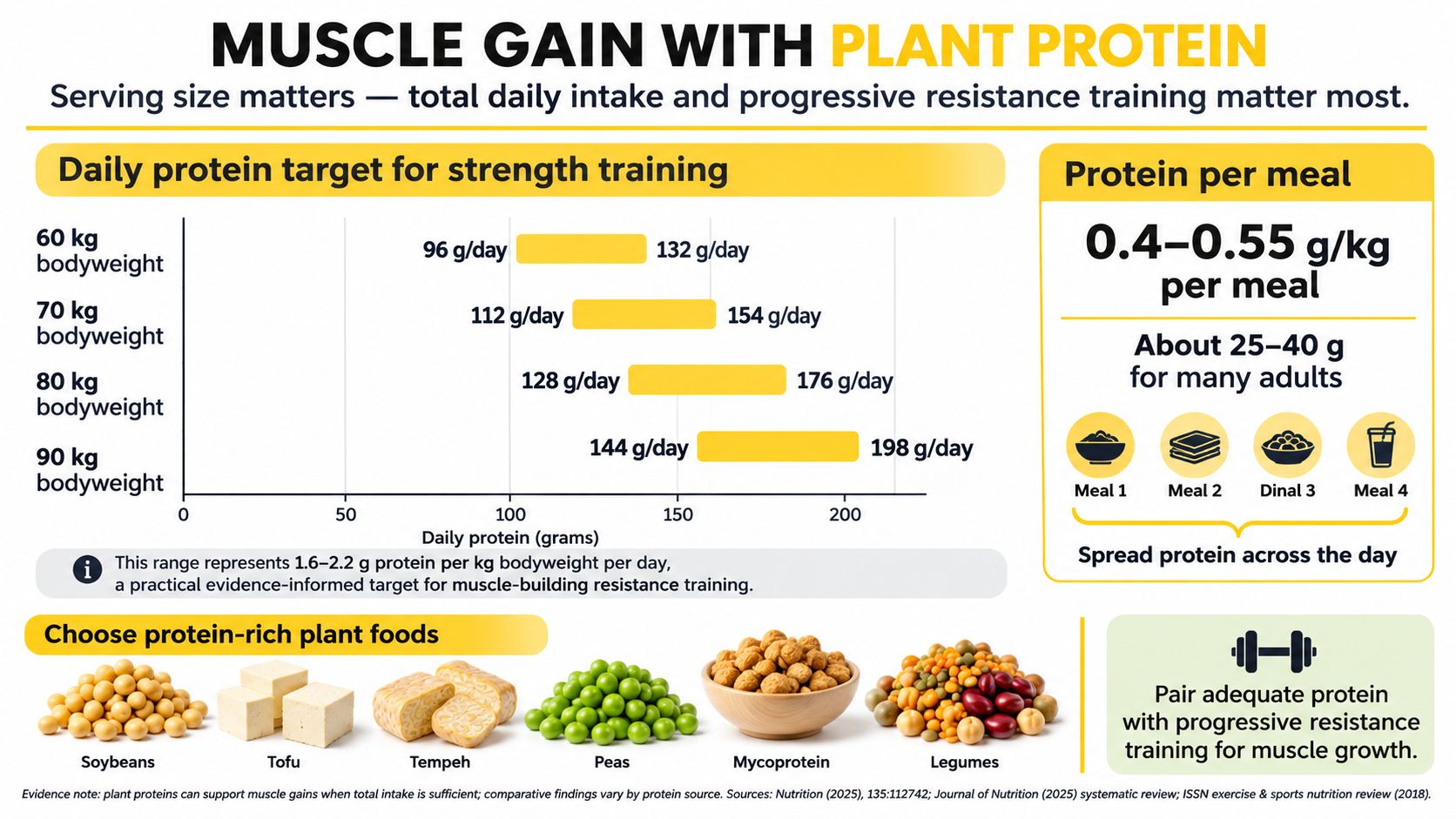
For most sports-nutrition situations, the AIS protein supplement guidance describes supplements delivering roughly 20–40 g protein per serve, protein spread across 3–5 eating occasions, and a heavy-training target of approximately 1.2–1.6 g/kg body mass/day. Using that target, an illustrative 75 kg lifter would calculate approximately 90–120 g daily, including food rather than powder alone.
Use the protein intake calculator to organise that estimate, then compare it with what you already eat. Grams of powder aren't grams of protein, so measure the dietary shortfall against the nutrition panel, not the scoop's weight.
For a single-source plant product, consider whether a serving towards the upper end of the sports-nutrition range is appropriate. Don't assume that increasing powder alone resolves an undisclosed amino-acid profile.
A concrete blend example is Happy Way Vegan Protein Powder Vanilla, which contains pea and rice protein isolates. That ingredient combination identifies its formulation approach, but doesn't establish equivalence to the trial blend.
If you're managing an injury rather than routine training recovery, Aspen Falls Wellness's resource on protein for healing strained muscles provides additional reading. It shouldn't replace assessment of a suspected muscle strain.
Digestive tolerance can rule out an otherwise suitable powder. Whey isolate generally contains very little lactose, while concentrate contains more. If lactose triggers symptoms, that difference may matter.
Milk allergy is different. Removing much of the lactose does not remove whey's identity as milk protein. Anyone with a dairy allergy should not use whey isolate on the assumption that low lactose makes it safe.
Plant formulations contain no inherent lactose, but they can still cause discomfort. Check the full ingredient list, introduce a new product without changing several other dietary factors at once, and stop using it if symptoms persist.
Some brands use fermentation, sprouting or digestive enzymes to support gut-comfort claims. These formulation choices do not establish that every user will tolerate the product or absorb more protein.
Faster or easier digestion also does not prove better training results. Without product-specific evidence, neither benefit follows from the ingredient list alone.
A powder you tolerate is useful. A gut-friendly claim still needs to suit your own digestion.
An Australian dietary analysis published in 2025 involving 7,637 adults found that higher plant-protein intake was associated with better overall diet-quality scores in both men and women. This links plant protein with a dietary pattern, not with proof that replacing whey with a plant shake improves diet quality by itself.
When animal foods are removed, check which nutrients need attention. People following plant-based diets may need to consider vitamin B12, iodine and long-chain omega-3 sources. A protein powder alone does not establish whether the overall diet supplies enough.
A dietitian or other qualified health professional can assess whether testing or supplementation is appropriate.
Choose the essential requirement first: allergy safety, dietary exclusions or a specific training need. Then compare the remaining products on formulation and practicality.
This visual offers a broad comparison of protein categories. Treat any product specifications or prices as prompts to verify, not substitutes for current labels.
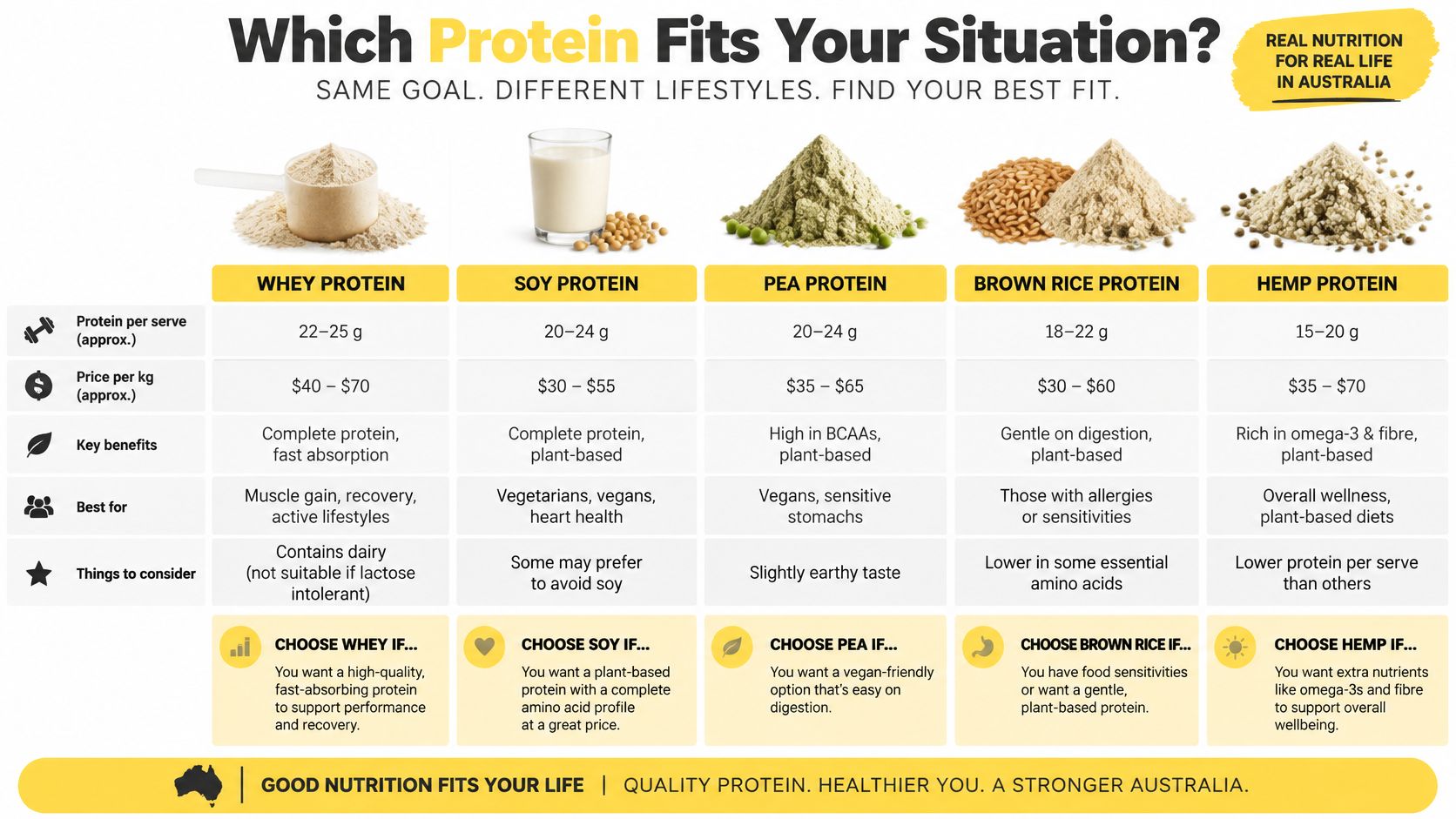
Which protein fits which situation
| Situation | Better fit | Why | Watch for |
|---|---|---|---|
| Building muscle on a heavy training schedule | Whey isolate, or a suitably dosed complementary or leucine-fortified plant blend | Provides a practical way to deliver the intended amino-acid dose | A small serving of a single-source plant powder may underdeliver |
| Vegan or plant-based eating | Plant protein blend with verified vegan ingredients | Avoids animal-derived protein | A vegan claim doesn't establish micronutrient adequacy |
| Dairy allergy | A suitable plant protein with appropriate allergen information | Whey contains milk protein | Check milk ingredients and cross-contact warnings |
| Lactose sensitivity | Whey isolate or plant protein | Offers alternatives to higher-lactose dairy powders | Low lactose isn't a guarantee of individual tolerance |
| Older adults protecting muscle | Whey, or a plant formulation with a clear leucine strategy | Makes amino-acid delivery easier to assess | Seek individual advice rather than extrapolating from young-adult trials |
Dairy allergy is a safety constraint, not a reason to experiment with progressively purer whey. Check allergen statements before comparing flavour, price or amino-acid marketing, and follow your clinician's advice about cross-contact.
Lactose sensitivity allows a different decision process. An isolate may be suitable, but a plant product can be the simpler choice if you'd prefer to avoid dairy entirely.
For shoppers considering isolate, the Australian whey protein isolate comparison can help organise a shortlist. It still needs to be checked against your own dietary restrictions and the current product label.
The young-men trial doesn't establish the optimal product or dose for an older person. Appetite, usual food intake, health conditions and the feasibility of regular meals all deserve attention before choosing a supplement.
A clearly declared amino-acid profile is more useful here than a vague “muscle support” claim. If information is missing, don't score the product as nutritionally equivalent by default.
For another explanation of the category comparison, the video below provides supplementary context. Use the situation table and current labels to make the actual purchase decision.
Cost per gram of protein = container price ÷ total protein in the container.
Calculate total protein by multiplying the container's powder weight by its protein proportion. This prevents favoring a cheap tub due to higher amounts of non-protein ingredients.
The following prices and compositions are hypothetical calculation inputs, not current retail prices or specifications for a named product. Both example tubs contain a kilogram of powder.
Illustrative cost per gram of protein (hypothetical prices)
| Product | Price (AUD) |
|---|---|
| Plant blend, 60% protein | $35 |
| Whey isolate, 80% protein | $45 |
For the hypothetical plant blend, the calculation is 1,000 g × 0.60 = 600 g protein, then $35 ÷ 600 = approximately $0.0583 per gram of protein.
For the hypothetical whey isolate, it's 1,000 g × 0.80 = 800 g protein, then $45 ÷ 800 = approximately $0.0563 per gram of protein. The more expensive tub is slightly cheaper for the protein it delivers.
Value check: A lower checkout price doesn't necessarily mean a lower protein cost.
Protein cost is a useful baseline, but it isn't a complete amino-acid comparison. If you select a larger plant serving to meet your intended nutritional dose, calculate the cost of that serving rather than comparing manufacturers' scoops.
Keep practical constraints visible too. A cheaper whey product isn't good value if you can't use dairy, and an inexpensive plant product isn't a bargain if its formulation doesn't meet your needs.
Repeat the calculation with the current container weight, protein declaration and retailer price. Use the nutrition panel's protein proportion, not a front-of-pack claim about the percentage of a protein ingredient.
Start with the product's ingredients and suitability for your diet. Then check the details that can't be inferred from a category name: the ingredients in the flavour and pack you're buying, allergen statements, and the manufacturer's wording about lactose.
Use the Australian protein powder buying guide to build a shortlist, then check current product pages and label images. Product descriptions can help you find options, while the label provides the specifics for your selection.
For a pea-and-rice blend, note the complementary sources, then check the label for allergen information and any details relevant to your diet. For whey isolate, note its dairy origin and check the same details. Neither category alone confirms that a product suits your needs.
Wallaby Wellness sells whey protein isolate and vegan protein supplements, as well as micellar casein, egg white protein, bone broth protein and amino acid supplements. These categories help narrow the search, but the specific ingredients and label claims determine whether a product fits.
Apply these checks to a shortlisted product before adding it to your basket. Questions involving a health condition, medication or medically restricted diet belong with a qualified health professional.
Wallaby Wellness offers both whey protein isolate and vegan protein supplements for shoppers comparing dairy and plant options. Visit Wallaby Wellness, shortlist a suitable product, and check its current label for ingredients, allergens and dietary fit before you buy.