Beta Alanine Tingling Cause, Feel and Duration
, 17 min reading time
Beta alanine tingling is dose-related paraesthesia, often lasting under 90 minutes. See the dose table, warning signs and how to ease it.
Beta alanine tingling is paraesthesia from a large single dose, often after immediate-release servings above about 800–1,600 mg, commonly on the face, neck, hands or upper trunk, and it usually settles within about 60–90 minutes. The sensation itself doesn't signal an allergy or a better workout.
The popular advice to chase the buzz gets this backwards. A stronger skin sensation isn't a useful measure of supplement quality, muscle readiness or how productive your session will be.
What matters is the amount in each serving, whether the sensation fades, and whether anything falls outside ordinary tingling. That gives you a practical way to judge the drink you've already taken and make a better decision before the next scoop.
Before taking another serve, check whether the feeling is easing rather than trying to overpower it with training. Paraesthesia is a predictable response to a large single hit, not evidence that the powder is burning your skin.
Beta-alanine serving, sensation and how long it lasts
| Serving style | Amount that matters | Typical sensation | How long | Practical read |
|---|---|---|---|---|
| Immediate-release single serve | The amount swallowed at once | Uncomfortable tingling on the face, neck, hands or upper trunk | Temporary, rather than continuous | Expected paraesthesia doesn't mean tissue damage |
| Split immediate-release | Smaller individual portions | Milder tingling, or none | No guaranteed shorter duration | A practical way to reduce the peak |
| Taken with a meal | The same measured amount, taken alongside food | A less pronounced peak may improve comfort | Food doesn't establish a fixed finishing time | Use meals to improve tolerability, not to treat unusual symptoms |
| Sustained-release | Both the release format and the daily total | Tingling can still occur | Don't assume it eliminates symptoms | Consider it when fast-release powder feels too sharp |
| Steady daily use | Daily intake and individual serving size | Large individual servings can still cause paraesthesia | An acute sensation, not an expected all-day feeling | Safety observations don't make every serving style equally comfortable |
A 2023 human-safety review reported no adverse effects through 24 weeks at 3.2 g/day, while noting that paraesthesia can follow a large single dose and may be reduced by splitting doses below 1.6 g. Those are separate observations: tolerating a daily intake doesn't mean swallowing that entire amount together will feel pleasant.
Start with the ingredient panel, not the size of the scoop. Find the beta-alanine amount per serving, then check whether the serving means a level scoop, multiple scoops or a specified weight.
A daily target answers how much you take across the day. A per-serving amount answers how much arrives together, which is more relevant to the immediate skin sensation.
For example, someone might divide their planned daily amount between meals instead of tipping it all into a pre-training drink. They haven't necessarily changed the daily total, but they have changed the size of each exposure.
Practical rule: A tolerable daily total can still make an uncomfortable single drink.
The duration column isn't a countdown that proves a reaction is harmless. Ordinary tingling should fade, and a symptom that remains strong or comes with other changes deserves a different response.
It's also unhelpful to promise that food or sustained-release powder will make every episode shorter. Their practical value is reducing the sharpness of exposure and improving tolerability, not guaranteeing a symptom-free serving.
If the feeling doesn't resemble a temporary skin prickle, don't solve the problem by adjusting the scoop alone.
Say you drink a pre-workout before entering the gym. Your hands and neck begin to prickle, yet your muscles feel much the same as they did before the drink.
That mismatch is useful. A skin sensation and a muscle-training effect aren't the same event.
The Australian Institute of Sport's beta-alanine guidance describes paraesthesia as dose-related, with immediate-release doses above approximately 800–1,600 mg capable of causing uncomfortable tingling, often involving the face, neck, hands or upper trunk, lasting up to about an hour.
The leading explanation involves sensory pathways containing MrgprD, short for Mas-related G-protein-coupled receptor D. In plain language, beta-alanine can activate a pathway involved in reporting sensations from the skin.
Think of a smoke alarm chirping because its sensor has been nudged, rather than because the kitchen is on fire. The signal is real, but the signal alone doesn't establish damage.
That analogy has a limit: it isn't permission to ignore every symptom after a supplement. It explains why an ordinary prickle can happen without injured skin, not why swelling or breathing trouble should be dismissed.
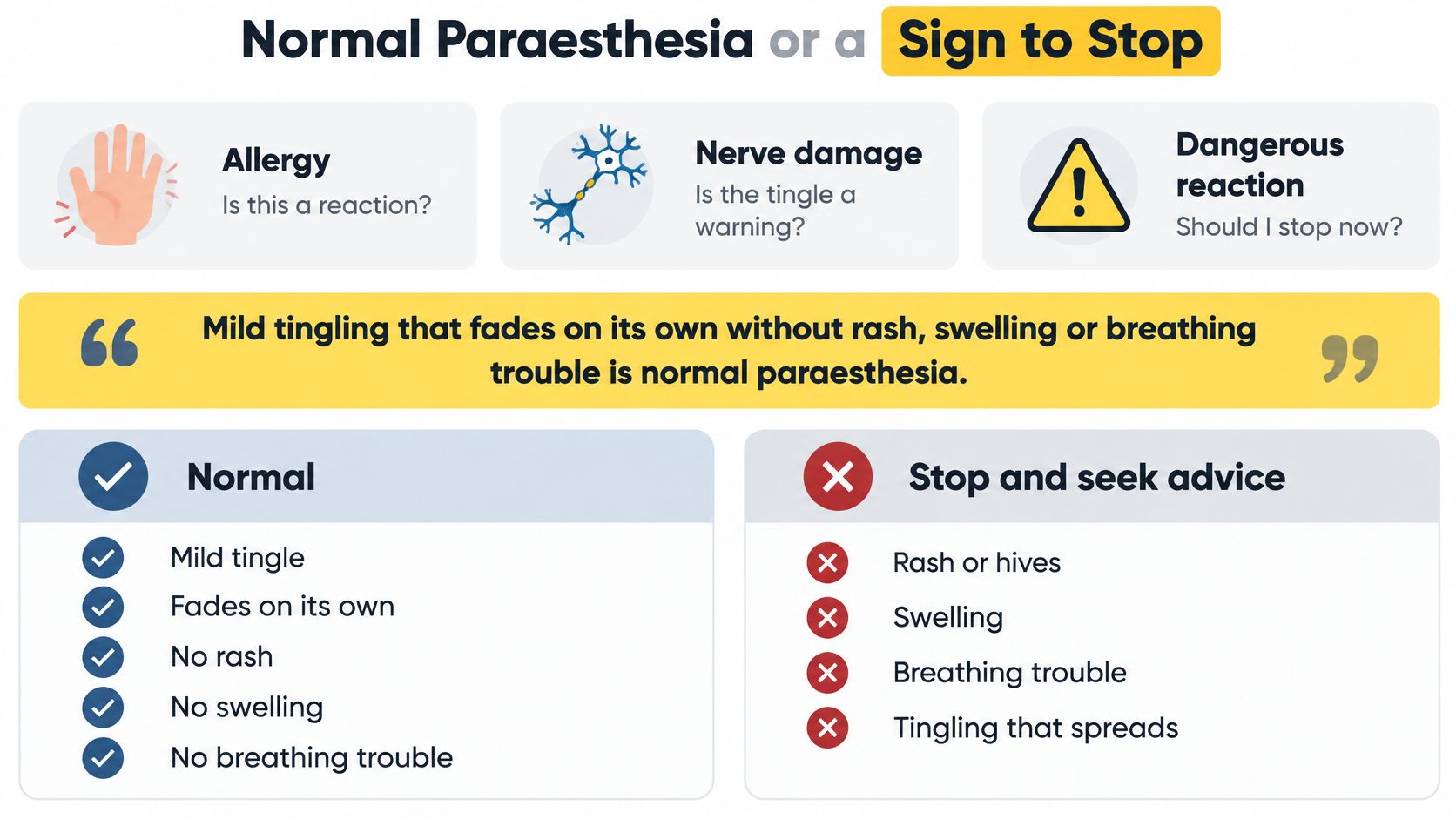
The visual distinction is useful when deciding whether a sensation belongs in the normal category.
Beta-alanine may also interact with strychnine-sensitive glycine-receptor sites in the central nervous system. That's a technical name for another proposed interaction, not a statement that the supplement contains strychnine.
There isn't one fully resolved explanation accounting for every aspect of the sensation. It's more accurate to describe sensory-pathway activation as the leading proposal than to present the biology as completely settled.
Keep the intended training role separate:
You don't feel the muscle buffer filling. A noticeable prickle is therefore a poor substitute for checking what you're taking and whether the routine suits your training.
A temporary, symmetrical skin tingle soon after a serve fits ordinary paraesthesia more closely than an allergy or nerve injury. It's generally not painful, serious or harmful, but the pattern matters more than the ingredient name.
Tingling that follows the dose, affects the usual areas symmetrically and fades on its own fits ordinary paraesthesia. Additional symptoms or an unusual course need a different explanation.
The Australian Institute of Sport's concerns and considerations guidance distinguishes dose-related tingling from safety concerns; broader clinical descriptions put the usual sensation window at 60–90 minutes.
Beta-alanine tingling versus symptoms that need care
| What you notice | Fits ordinary paraesthesia? | What to do |
|---|---|---|
| Symmetrical tingle on the face, neck, hands or upper trunk soon after a serve | Yes, if temporary and otherwise uncomplicated | Monitor whether it fades; don't take more to intensify it |
| Mild itch that tracks the size of an immediate-release scoop | Consistent with it | Judge the next serve by its ingredient amount |
| Feeling still strong many hours later, or appearing without a recent dose | No clear fit | Don't assume it's beta-alanine; seek medical advice |
| Rash, hives, swelling, breathing difficulty or faintness | No | Stop the product and get urgent medical assessment |
| Weakness or persistent neurological symptoms | No | Stop and seek medical assessment |
| Jitters, racing heart or nausea after a multi-ingredient pre-workout | Not diagnostic of beta-alanine | Consider the whole formula and treat red flags urgently |
Breathing difficulty, throat or tongue swelling, or collapse requires emergency help, not a smaller scoop next time. Don't continue exercising while trying to decide whether a severe reaction will pass.
Caffeine and other ingredients can make symptoms harder to interpret. A racing heart or nausea shouldn't automatically be labelled beta-alanine tingling just because beta-alanine appears on the tub.
For context on another ingredient category, NexiHerb LLC's explanation of blood-pressure drops from pump boosters can help you frame questions about a mixed formula. It isn't a way to diagnose faintness or justify training through it.
There's also a performance distinction: the Australian guidance describes competitive cyclists experiencing noticeable sensory effects after acute beta-alanine without a demonstrated improvement in the time trial. Feeling more isn't proof of performing better.
For uncomplicated tingling, these label and serving checks offer a practical adjustment routine.
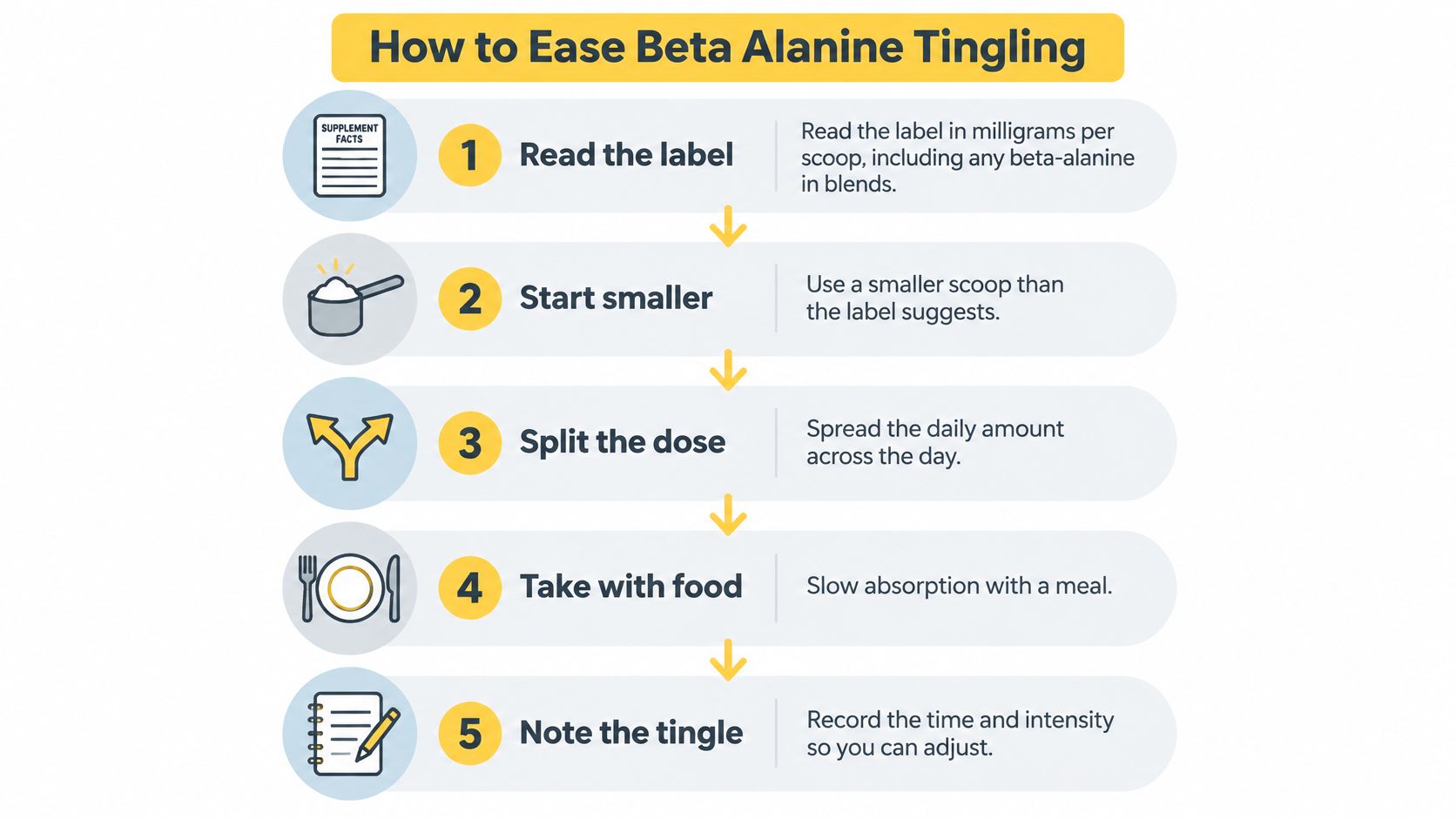
If tonight's sensation is mild and fading, note the serving and don't top it up. If it matches a stop row, put the product aside and seek appropriate care.
The accompanying video offers another format for the topic.
The useful adjustment is usually to change how you take your planned amount, not to search for a remedy after an oversized serving. Make the next drink easier to tolerate before you mix it.
Use this process only for ordinary, temporary paraesthesia. It isn't a treatment plan for a rash, weakness or other warning signs.
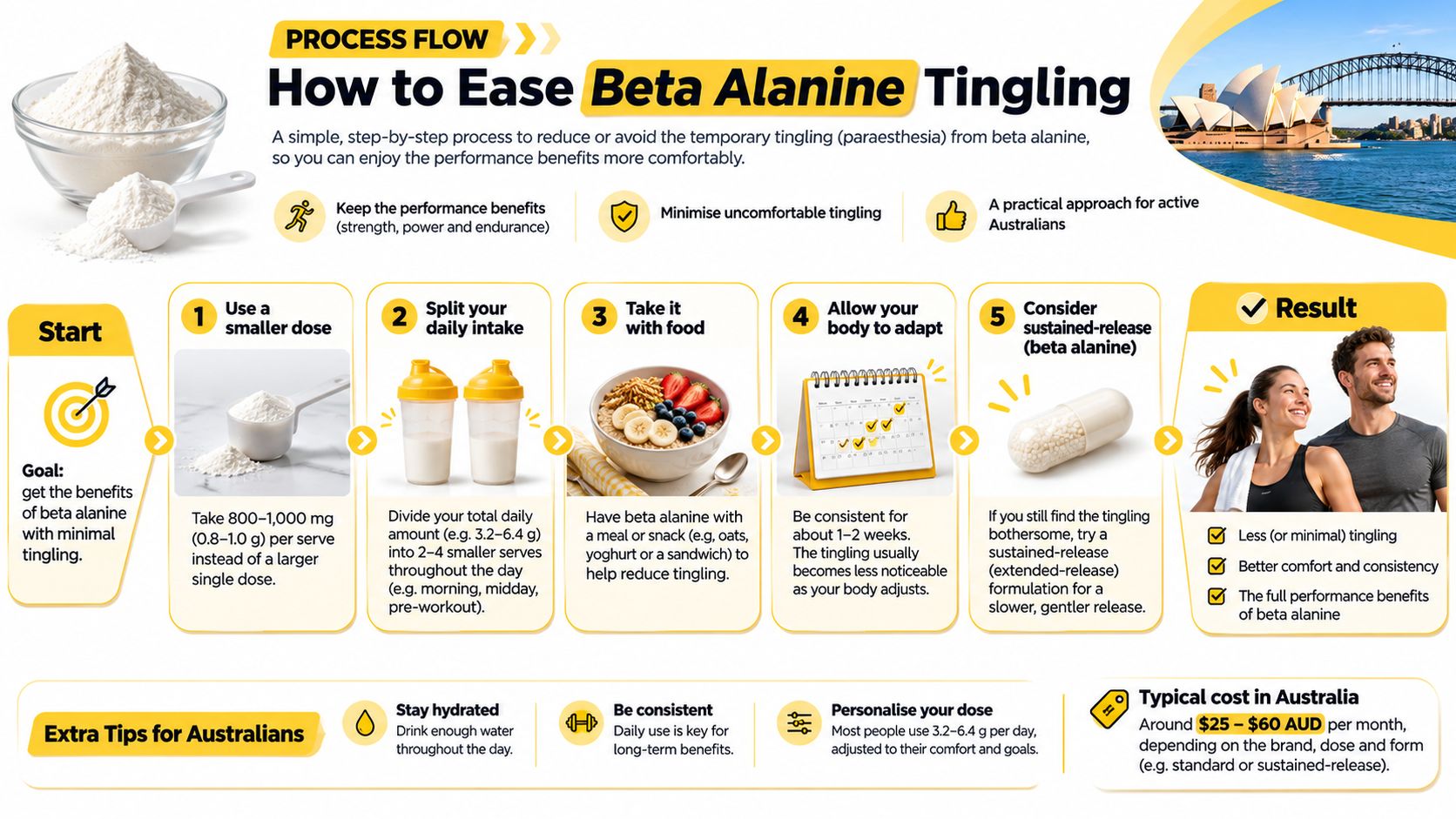
If you change the powder, serving size, meal timing and pre-workout together, you'll struggle to identify what improved comfort. A simple note on your phone is more useful than relying on whether a session felt intense.
Keep the actual packaging or photograph the ingredient panel. That helps a pharmacist, sports dietitian or clinician assess the whole formula if you need advice.
Write on the tub: Keep the planned daily amount separate from the amount in each glass.
Don't increase your daily intake to make up for losing the buzz. The adjustment succeeds when the routine becomes manageable, not when you discover a new way to produce the same uncomfortable sensation.
A lifter drinks a heaped immediate-release scoop in the car park. During the warm-up, their hands and neck develop a fizzy itch, similar to mild pins and needles.
They can still move normally, and there's no rash or swelling. In this example, the useful response is to stop adding powder and notice whether the sensation fades, not to assume the heaped scoop produced a better training stimulus.
On another day, the same person measures their powder and spreads the planned amount between meals. At the gym, they notice little or nothing on their skin.
That's a successful comfort adjustment, not evidence that the tub has become weak. The person has removed a distraction without needing to manufacture a replacement sensation.
When checking a flavoured blend such as the RYSE Loaded pre-workout listing, use the ingredient panel rather than flavour, scoop size or product name to judge what's going into the drink. Don't assume different pre-workouts have interchangeable serving instructions.
Consider a team-sport athlete who changes to a sustained-release format. They still notice a light background tingle, but it no longer dominates their preparation.
That's a plausible experience, not a guarantee for everyone. In a 2023 randomised controlled study in recreationally trained men, tingling was the majority experience after 15 g/day of sustained-release beta-alanine for 30 days, yet almost all participants recorded a visual-analogue tingling score below 3/10.
A low intensity rating describes how noticeable the sensation was. It doesn't replace a symptom check, and that high-dose study protocol isn't a recommendation to copy.
These examples point to different decisions:
The study population also matters. Recreationally trained men taking sustained-release beta-alanine don't automatically represent everyone using an immediate-release stimulant blend.
Likewise, an intensity score can't turn hives or weakness into normal paraesthesia. What the symptom is matters as much as how strong it feels.
Tingling strength is a poor measure of how well beta-alanine suits your routine. The more useful checks are the amount in each serve, how long the sensation lasts, and whether the symptoms fit ordinary paraesthesia.
Beta-alanine is taken repeatedly to support muscle carnosine accumulation. A single serve's prickling is a short-lived sensory response, not a direct readout of that longer-term process. A stronger buzz after an oversized serve does not show that the supplement is working better.
Longer-term safety observations are reassuring within the conditions studied. They do not establish that every dose, product blend or combination is suitable for everyone.
Keep these limits in mind:
A sensation becoming less noticeable does not, by itself, give a reason to increase intake. If discomfort persists, reconsider the plan with a qualified sports dietitian or clinician.
For longer-term use, keep an up-to-date record of your supplements and review whether each still has a clear purpose. Check for duplicated ingredients before adding another product. If you also use amino-acid supplements, this BCAA versus EAA explainer can help distinguish the two categories.
Choose an appropriate routine you can tolerate, rather than trying to maximise a sensation.
Before shopping for another pre-workout, make a serving audit of your current products. Write down the beta-alanine amount per scoop, the scoops you use, and any additional beta-alanine from another formula.
Use the label, not your memory of the front-of-pack claims. If the amount in a single drink has repeatedly caused uncomfortable but otherwise ordinary tingling, consider a smaller portion or a different serving schedule.
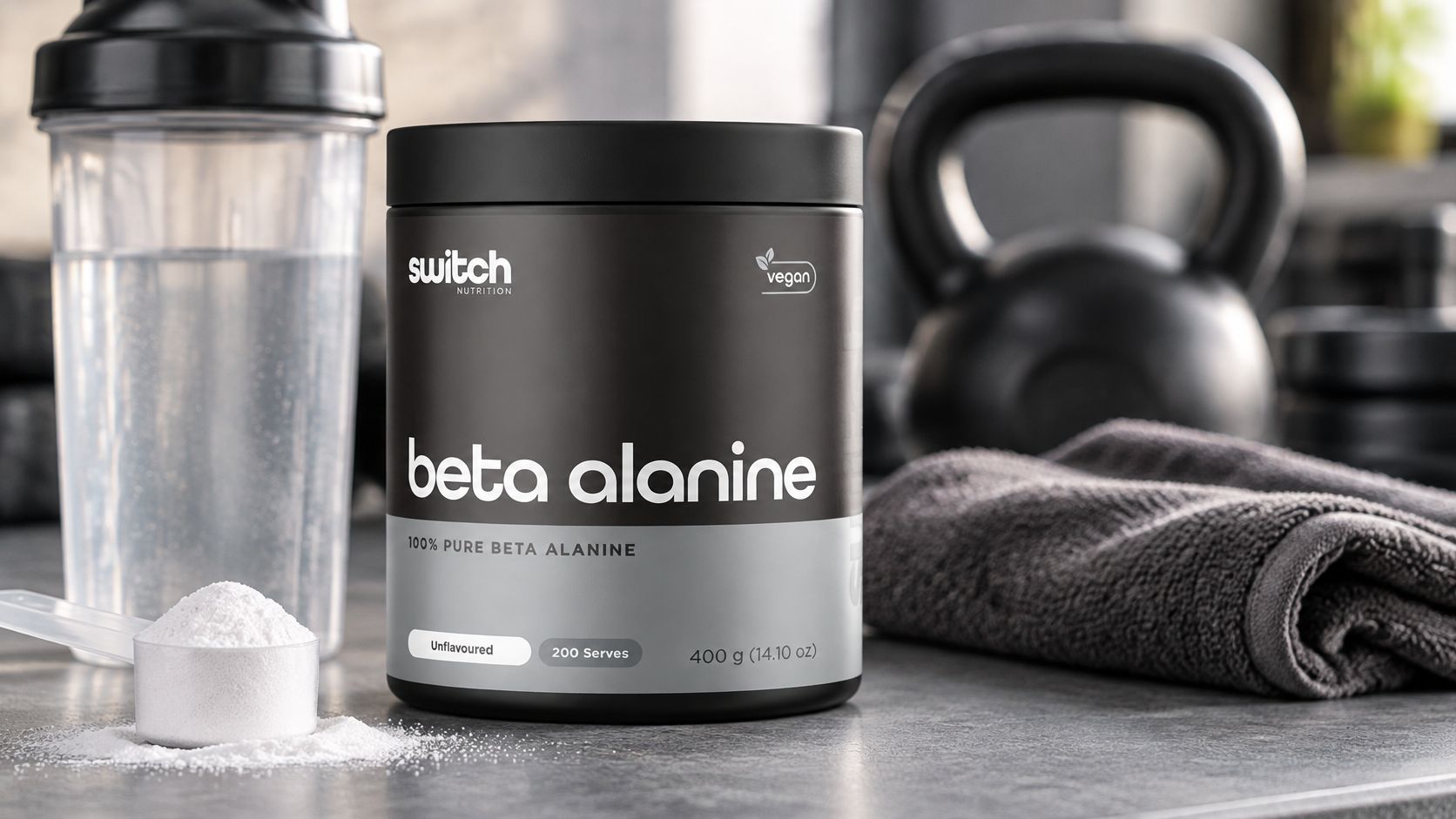
For readers wanting a separate powder they can measure, Switch Nutrition Beta Alanine Powder 100% Pure Unflavoured is an option whose listing describes an approximately 2 g scoop and directions of 2–5 g daily, including training and rest days. It can be mixed into water or another drink, and the listing notes that temporary tingling may occur.
Those are product directions, not personalised dosing advice. The listing's suggestion that tingling indicates effectiveness shouldn't be used as a reason to chase the sensation.
If you're also planning creatine intake, our creatine calculator is a separate planning resource, not a beta-alanine dosing tool. Don't transfer instructions between ingredients because both appear in a training stack.
Before your next serve, make the decision explicit:
Pick a per-serving amount you could take on a rest day without dreading the itch, within an appropriate daily plan. Judge the choice by that repeatability, not by how intensely your skin reacts.
Wallaby Wellness offers sports-nutrition products alongside electrolytes, muscle recovery supplements and tart cherry supplement. Visit Wallaby Wellness to compare ingredient labels and serving directions, and choose products that fit a tolerable routine rather than a stronger beta-alanine buzz.