L Theanine vs Ashwagandha: Which Suits You Best?
, 17 min reading time
L Theanine vs Ashwagandha compared for stress, sleep and safety in Australia. See the evidence and when to ask a healthcare professional.
The advice you'll find most often on L-theanine vs ashwagandha is a tidy division of labour. L-theanine is the fast one, taken an hour before a presentation. Ashwagandha is the slow one, taken daily for weeks to rebuild your stress response. Buy both, the argument runs, and you've covered every timeline.
That advice isn't wrong about timing. It's just not the part that decides whether a product suits you. For an Australian buyer, two other things matter more. One is what the label can prove, because a listing on the Australian Register of Therapeutic Goods confirms a product met listing requirements, not that anyone checked whether it works. The other is safety, and on that measure the two ingredients are nowhere near each other. Australia's regulator has issued a specific liver warning for ashwagandha that has no equivalent for L-theanine in the material reviewed here.
That asymmetry, not onset speed, is where a sensible decision starts. Both ingredients carry real human trial data. Both have gaps wide enough to fall through if you're expecting a treatment.
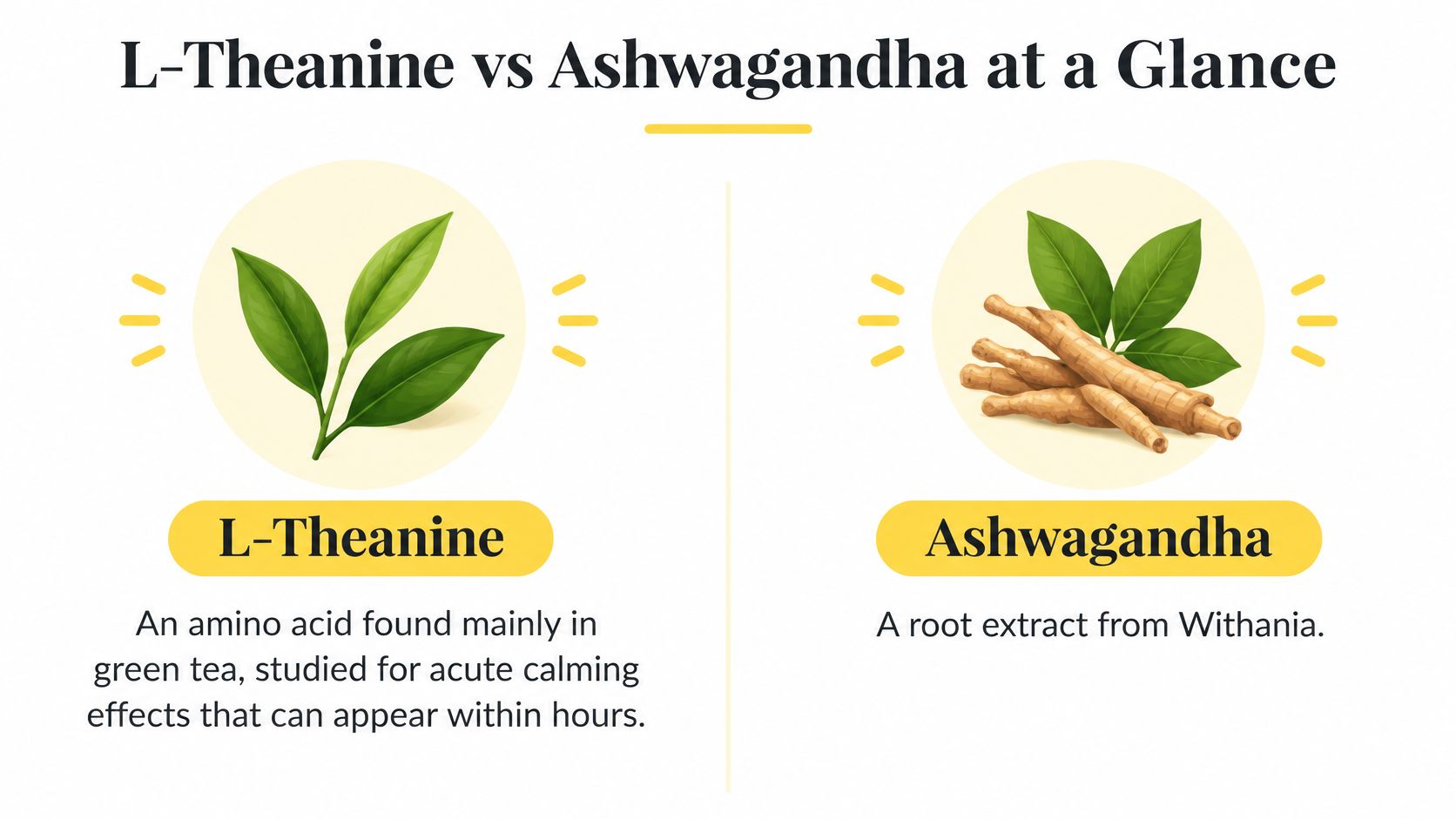
L-theanine is an amino acid found mainly in green tea, and the human trials behind it measure calm within hours of a single dose. Ashwagandha is a root extract from Withania somnifera, an Ayurvedic herb classed as an adaptogen, and its trials measure change after weeks of daily use. One suits a situation, the other suits a routine, and neither is a substitute for treating a diagnosed anxiety disorder with a clinician.
| Feature | L-Theanine | Ashwagandha |
|---|---|---|
| Source | Amino acid found mainly in green tea | Root of Withania somnifera, an adaptogenic herb |
| Typical trial dose | 200 mg in a single beverage dose | 240-400 mg daily in the cited trials |
| Time to measurable effect | Within about one to three hours | Several weeks of daily use (60-day trial) |
| Australian clinical evidence | No Australian trial identified in the sources reviewed | One 108-participant trial and one planned 80-adult trial |
| Main safety flag | No TGA liver alert identified in the sources reviewed; individual suitability still needs checking | TGA warning for rare, potentially severe liver injury |
| Australian regulatory listing | No matching ARTG count identified in the sources reviewed | 374 ARTG Listed products as of 18 November 2024 |
Two cells sit deliberately thin. The sources reviewed contain no Australian trial for L-theanine and no ARTG listing count for it, and an honest gap beats a guess when you're standing in a shop with your phone out.
What the table actually tells you: the deciding differences are the safety flag and the register entry, not the number of minutes until you feel something.
If you're mapping the wider adaptogen shelf, how rhodiola and ashwagandha compare is worth the detour, because rhodiola sits at the stimulating end of the category while ashwagandha sits at the calming end. Getting that axis straight stops you buying two products that pull in opposite directions.
Picture a shopper holding two bottles in the same aisle. The left one names a green tea compound in milligrams. The right one names a root, a plant part and an extract. Both front labels use the word calm. The difference in what's inside is bigger than the difference in what's promised.
L-theanine occurs naturally in green tea leaves, which is why a cup of tea feels different from a cup of coffee with the same caffeine load. The proposed mechanism involves calming neurotransmitters, GABA, dopamine and serotonin among them, and a good share of that work comes from laboratory and animal studies rather than from people. In humans, what's been measured is a stress response under controlled conditions, not a mood transformation.
For ashwagandha, the raw material is the root of Withania somnifera, used in Ayurvedic practice and sold as an adaptogen on the claim that it helps the body manage stress and cortisol. That claim is only as good as the extract in the bottle. KSM-66 and Shoden are standardised extracts with different concentrations and different manufacturing, and neither behaves like a generic powder. Root-only material and root-and-leaf material are not interchangeable either, whatever the front label implies.
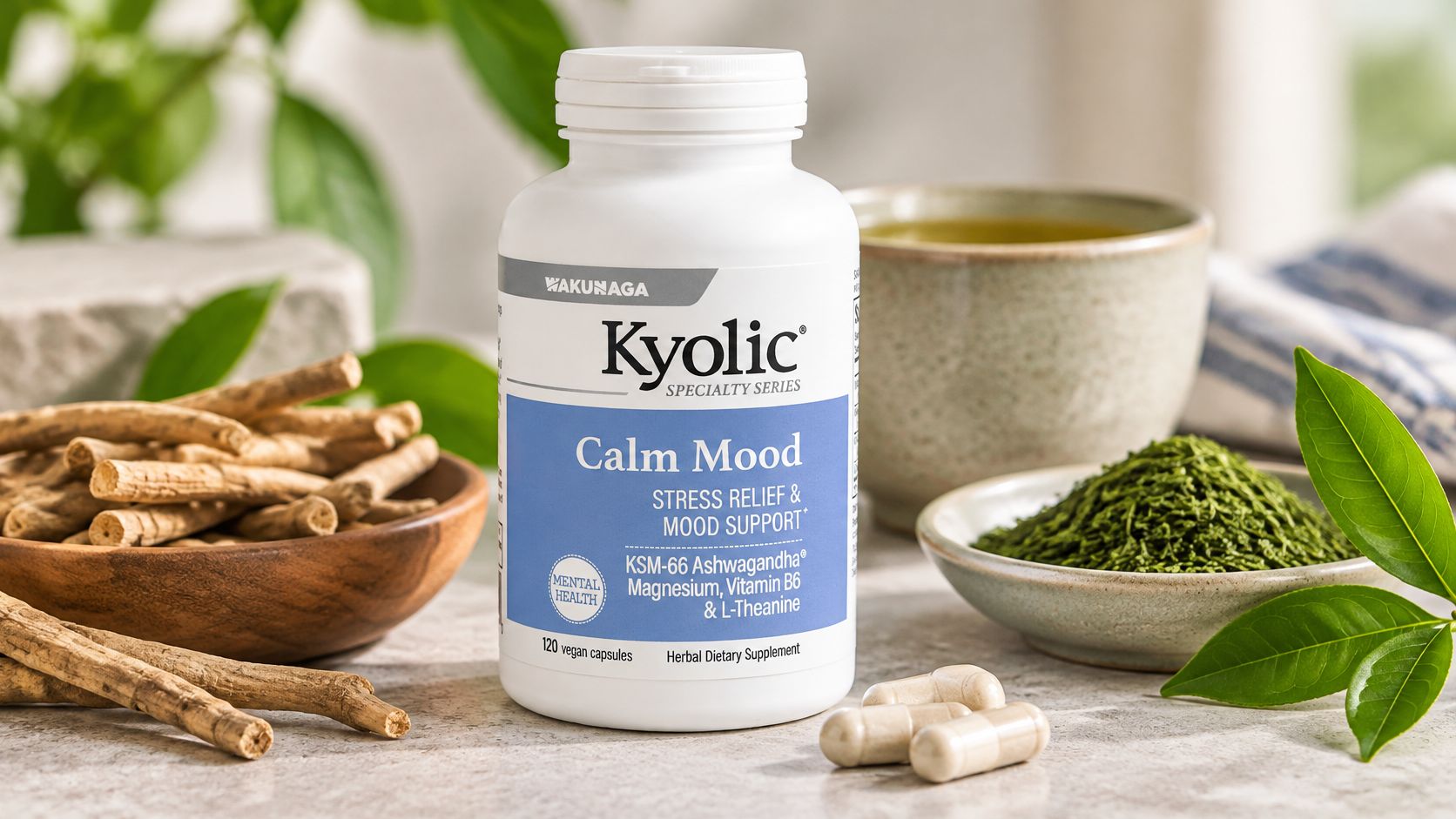
A label like Kyolic Specialty Series Calm Mood, Vegan Capsules shows why the detail matters. Each capsule lists 300 mg of KSM-66 Ashwagandha root extract, 150 mg magnesium, 15 mg vitamin B6 and 50 mg L-theanine, so one capsule carries two of the ingredients this comparison is about. Those amounts are not the trial amounts, and that's exactly the sort of gap a careful buyer should notice.
Label claims describe intent. They don't confirm results. For where ashwagandha fits within the broader category, our guide to adaptogens and everyday stress explains the topic in plain terms.
Four rows summarise everything the cited sources measured in people. Read them as separate experiments, because that's what they are, and no trial in this set put the two ingredients head to head.
| Ingredient | Study | Dose | Duration | Reported result |
|---|---|---|---|---|
| L-theanine | Swinburne University crossover, 34 adults aged 18-40 | 200 mg in a beverage with phosphatidylserine, alpha-GPC and chamomile | Single dose | Lower subjective stress at 1 hour; lower salivary cortisol at 3 hours; higher posterior alpha at 2 hours; no cognitive-score gain |
| Ashwagandha | Randomised double-blind trial in stressed healthy adults, Shoden extract | 240 mg daily | 60 days | Hamilton Anxiety Rating Scale improved (P = .040) |
| Ashwagandha | Only Australian study inside a review of 20 studies and 1,249 adults | 400 mg daily | 12 weeks | 108 adults aged 40-75 (52/56); outcome not stated in sources |
| Ashwagandha | Planned ANZCTR trial, 40 adults in Australia and 40 in India | 300 mg or placebo daily | 8 weeks | Results not reported in the sources reviewed |
| L-theanine | Australian clinical trial or sleep endpoint | No Australian L-theanine dose reported | No sleep-study duration reported | None identified in the sources reviewed |
The Swinburne trial is the strongest acute data either ingredient has. Thirty-four healthy adults took a beverage with 200 mg of L-theanine, and relative to placebo their subjective stress dropped during a multitasking stressor one hour after dosing, with salivary cortisol lower at three hours and posterior alpha-band activity higher at two hours, particularly in participants with higher trait anxiety. Cognitive-performance scores did not improve. The drink also contained phosphatidylserine, alpha-GPC and chamomile, so crediting L-theanine alone overstates the case.
The ashwagandha trial runs on a different clock. Stressed healthy adults took 240 mg of a standardised Shoden extract daily for 60 days, and Hamilton Anxiety Rating Scale scores improved against placebo at P = .040. Weeks of daily use, a named extract, one specific dose. A generic root powder at an unstated milligram amount is not a test of that finding.
Australia-specific evidence is stronger for ashwagandha, but only relatively. A systematic review and meta-analysis pooled 20 studies and 1,249 adults, and just one of those studies ran in Australia: 108 participants split 52/56, aged 40-75, on 400 mg daily for 12 weeks (ANZCTR trial record). A separate registered Australian trial planned to recruit 80 adults, 40 here and 40 in India, on 300 mg or placebo for 8 weeks. Most of the pooled evidence came from India or the United States.
That imbalance has a practical consequence. Ashwagandha can be described as an adaptogenic herb with emerging Australian clinical evaluation. It cannot be described as a treatment with conclusively established local effectiveness, and more local research doesn't make it a universal winner over anything.
Two gaps are worth naming. No source reported a sleep endpoint for either ingredient, despite sleep being how most of these products are sold. And no Australian L-theanine trial turned up at all, which means any Australian claim about theanine rests on overseas work. For a closer look at effect sizes in the anxiety literature, this review of what the ashwagandha anxiety data shows is a useful companion read.
Formulas that stack actives, such as Switch Nutrition Adrenal Magnesium Support Powder Lemonade, list ashwagandha alongside naturally occurring L-theanine from Camellia Sinensis and magnesium. That's convenient and readable, and it makes attribution harder if something changes in how you feel.
Move from trial outcomes to what a package in an Australian shop can prove, and the answer is narrower than the shelf suggests. As of 18 November 2024, 374 Australian complementary medicines containing ashwagandha (Withania somnifera) were listed on the Australian Register of Therapeutic Goods, according to the published analysis of the ingredient's regulatory status.
Those products are Listed medicines. That word has a specific meaning: the Therapeutic Goods Administration did not evaluate each product for efficacy before it reached the market. Listing requires compliance with Australian rules on safety, quality, manufacturing and permitted claims. It does not mean the regulator confirmed the product reduces stress, improves sleep or outperforms anything else.
The ingredient's regulatory history reaches back to 1990, when its use was grandfathered into the TGA framework because it was already in supply when the scheme began. That explains why Australian shoppers meet far more ashwagandha products and claims than products supported by Australia-specific L-theanine evidence. It explains market presence, nothing about outcomes.
Registration, shelf space and a measured effect are three different facts. A pack can have the first two without the third.
Read the AUST L number to confirm listing, then look for the botanical name Withania somnifera and whether the material is root or leaf. Find the extract name, Shoden or KSM-66, if one is stated. Then convert everything to milligrams per serving, not per bottle, and line that number up against the evidence: 200 mg L-theanine in a single mixed drink, 240 mg Shoden daily for 60 days, or 300-400 mg ashwagandha daily in the Australian protocol and study.
If sleep is the goal rather than daytime stress, our guide to the best sleep supplements in Australia covers how products in that category are put together, since the mechanism you're buying for is different from the one in a stress product.
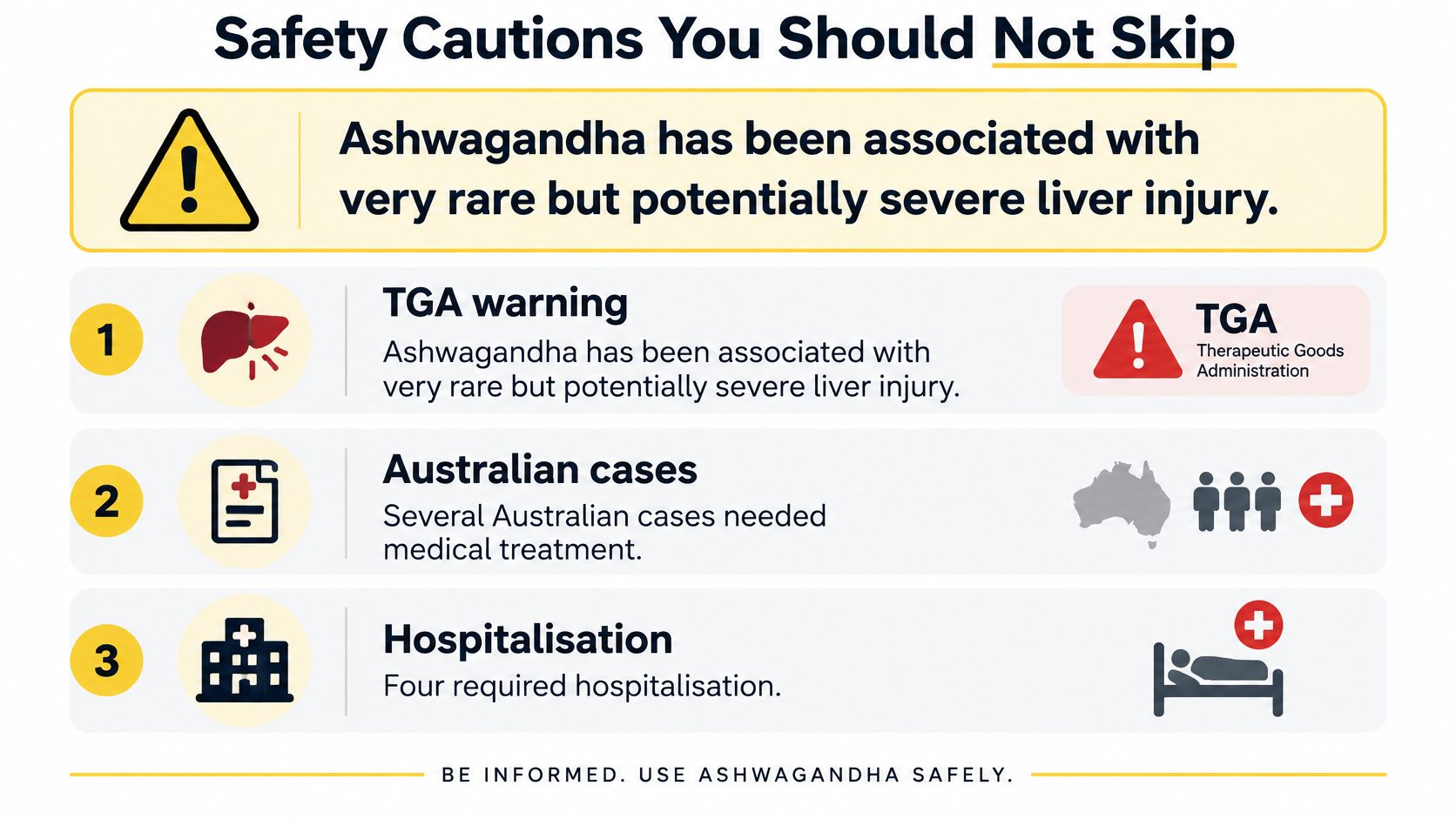
Start with the sentence most comparison articles leave out. Australia's Therapeutic Goods Administration reports that Withania somnifera, ashwagandha, has been associated with very rare but potentially severe liver injury. Several Australian cases required medical treatment and four required hospitalisation, according to the TGA safety alert on Withania-containing preparations.
The TGA advises people with current or previous liver problems to avoid it, and advises anyone taking it to stop and seek medical advice if jaundice, dark urine, nausea, unusual tiredness, vomiting, abdominal pain or appetite loss appears.
Attribution isn't always clean. In two newer Australian reports, other ingredients in the same products may also have contributed to the liver injury. That's an argument for reading the whole formula rather than the headline herb, and it's also an argument against stacking three calming products and hoping you'll notice which one disagrees with you.
The sources reviewed did not identify an equivalent TGA liver alert for L-theanine. That's a statement about the evidence available, not a guarantee of safety. Absence of a warning is not a clean bill of health.
If you'd rather hear the caution explained aloud, this short walkthrough covers the same ground.
Natural does not mean low risk. It means the risk hasn't been marketed to you.
A combination can be easier to buy and harder to assess. TGA records for a listed combination product show medicines containing both L-theanine and ashwagandha entering the Australian Register of Therapeutic Goods in 2025, with further theanine-containing calming products recorded in 2026. Meeting listing requirements is all the ARTG entry certifies; no trial compared the blend against either ingredient alone.
The products reflect existing interest in supplements. A 2025 consumer survey reported that 74% of Australians had used supplements in the previous year and 41% used them daily, with sleep problems and stress or anxiety among commonly named health priorities. A 2024 survey published in the International Journal of Naturopathic Medicine found that 55.9% of surveyed Australian adults (52 respondents) used herbal remedies including Withania, and 53.2% (49 respondents) used nutritional supplements including theanine. These small samples indicate reported use, not population-wide prevalence.
Supply has also grown. 6Wresearch's Australia ashwagandha market report put Australian ashwagandha imports up 20.27% from 2023 to 2024, against a 13.44% compound annual growth rate across 2020 to 2024.
That shelf convenience has a trade-off. If sleep changes, you feel sedated in the afternoon, or your stomach turns, L-theanine, ashwagandha and added magnesium could each be responsible. A blend makes it harder to identify the cause.
The contrarian point: combining ingredients can reduce the number of bottles while making the result less informative. Convenience comes at the cost of attribution.
For an ashwagandha trial, this guide to choosing an ashwagandha supplement in Australia explains how to compare a product's extract and dose with published protocols.
Bring a situation, not a product name, to the appointment. The first decision is fit, and the table below gives you a starting point for the conversation rather than a ranking.
| Situation | Discuss first | Reason |
|---|---|---|
| Acute stress before a demanding task | L-theanine | Stress change at 1 hour and cortisol change at 3 hours after 200 mg in 34 adults |
| Stress concerns lasting weeks | Ashwagandha | Hamilton Anxiety Rating Scale change after 240 mg Shoden daily for 60 days (P = .040) |
| Current or past liver problems | Avoid ashwagandha unless a clinician advises otherwise | TGA warning after several treated Australian cases, including four hospitalisations |
| Pregnant, breastfeeding, or taking blood pressure, sedation or diabetes medicines | Both, before any use | Safety and interactions depend on the person and the product |
| Wanting to tell which ingredient caused an effect | Single-ingredient product | ARTG combination listings from 2025 make attribution harder |
| Sleep as the only goal | Neither, on the current evidence | No sleep endpoint was reported in the sources reviewed |
Five questions to take with you. Which option fits this medical history? Could my current medicines interact with either ingredient or with the magnesium and B6 in the same capsule? Does this pack's extract and per-serving dose match 200 mg L-theanine, 240 mg Shoden, or 300-400 mg ashwagandha daily, and for how long should I take it? Which symptoms mean I stop the same day rather than at the end of the bottle? And if I already take magnesium or another calming product, does a combination add anything beyond making the cause harder to find?
If anxiety is the underlying reason you're reading this, the choice between talking therapy and medication is a separate and often more consequential conversation, and comparing therapy with medication for anxiety lays out how that decision is usually framed. Supplements sit alongside that decision, never in place of it.
At Wallaby Wellness, our Sleep & Stress range includes L-theanine supplements, stress and anxiety supplements and sleep supplements, and the wider catalogue covers adaptogens and ashwagandha so you can compare single-ingredient options before you consider a blend. Read the label, match the dose to the trials, and start with one change at a time.
If you'd rather compare the actual bottles than the marketing claims, Wallaby Wellness stocks L-theanine supplements, stress and anxiety supplements, sleep supplements and an adaptogen range that includes ashwagandha, all listed with their ingredient panels and doses. Start with a single-ingredient product, run one change at a time, and keep the TGA liver warning in view if ashwagandha is on your list. Visit Wallaby Wellness to check the label detail before you buy.