Best Sleep Supplements Australia Buying Guide
, 16 min reading time
Compare the best sleep supplements australia by ingredient, TGA melatonin rules and label checks before you buy in 2026.
Melatonin accounted for 40.65% of Australian insomnia-supplement market revenue in 2024, according to Grand View Research. That helps explain why it dominates shopping searches, but revenue isn't evidence that it's the right choice for your sleep problem.
The best sleep supplements Australia offers aren't necessarily the strongest powders or the most elaborate blends. A sensible choice starts with your sleep pattern, checks whether you need professional assessment, and ends with a legally available product whose label you can understand.
The same word, such as “magnesium” or “herbal”, can describe products with different ingredients and roles. Compare the ingredient, its amount and the reason it is included before choosing a formula.
| Ingredient | Usual role in formulas | How it is sold in Australia | Main caution |
|---|---|---|---|
| Magnesium citrate and similar forms | Supports normal muscle and nervous-system function | General complementary supplement | Check the form, dose and other magnesium products already used |
| Glycine | Included in formulas aimed at relaxation and sleep onset | Standalone powders or inside sleep blends | Check the serving amount rather than assuming brands are equivalent |
| L-theanine | Often included in wind-down formulas | General complementary supplement | It is not a treatment for insomnia |
| Tart cherry | A food-style ingredient included in some rest-focused products | Food-style ingredient or part of a blend | The amount per serve can be small |
| Holy basil or ashwagandha | Often included in stress-focused formulas | Herbal supplement | Ask a health professional about pregnancy, medicines and personal suitability |
| 5-HTP from Griffonia | Used in formulas making serotonin-related claims | Often inside multi-ingredient blends | Do not combine casually with antidepressants |
| Melatonin | Involved in sleep-wake signalling | Pharmacist-only or prescription medicine | Access depends on age, indication and pack limits |
Each ingredient plays a different role, so they cannot be swapped for one another. The table describes why manufacturers include them, not a guarantee that a product will improve sleep.
Magnesium supports normal nerve and muscle function, but that alone does not show that night waking is caused by low magnesium. Glycine is included for a different proposed role in relaxation and sleep onset. The ingredient name is only one part of the decision; the serving amount and the rest of the formula matter too.
If unwinding after work is your main difficulty, L-theanine or a simple relaxation-focused formula may be worth discussing with a pharmacist. When comparing magnesium products, check both the compound and the amount of elemental magnesium. Our guide to magnesium threonate and glycinate explains how those forms differ.
Tart cherry offers a food-style option, while holy basil and ashwagandha are commonly positioned around stress. A food origin or herbal label does not determine whether a product suits you.
Buying principle: An explanation of an ingredient's role in the body is not proof that the finished product will solve your sleep problem.
Choose the ingredient that most closely matches your goal, then check its dose and cautions. Treat the table as a starting point for a conversation with a pharmacist or GP, not a diagnosis.
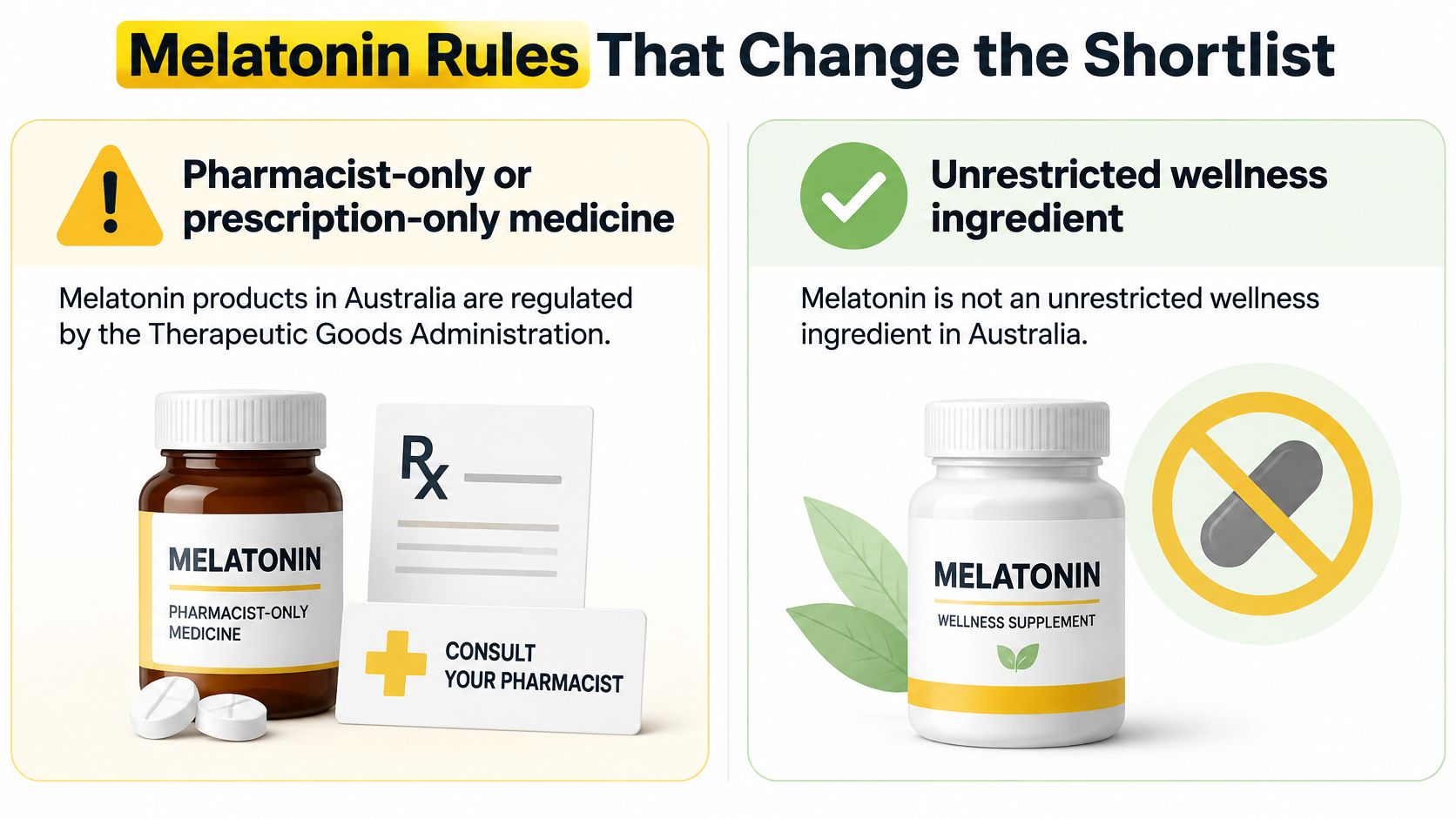
The Therapeutic Goods Administration's rules for melatonin products in Australia classify them as pharmacist-only or prescription-only medicines. The pharmacist-only pathways have specific formulation, strength and intended-use limits.
| Product type | Strength limit | Who it is for | Pack limit |
|---|---|---|---|
| Modified-release tablets | 2 mg or less | Short-term primary insomnia in adults aged 55 or older | No more than 30 tablets |
| Immediate-release products | 5 mg or less | Jet lag in adults aged 18 and over | No more than 10 dosage units |
These limits don't mean anyone with poor sleep can buy any melatonin product. A pharmacist considers the reason for use, the person and the formulation, as well as the strength shown on the packet.
Modified release means the tablet is designed to release its contents over time. Immediate-release products work differently, so the two forms aren't interchangeable just because they contain the same ingredient. The access rules determine which options belong on an Australian shopper's shortlist.
For adults over 55, RACGP sleep guidance describes improvement in limited sleep outcomes in approximately 30–50% of patients, a prolonged-release dose of 2 mg at bedtime, and insufficient evidence for treatment beyond about three weeks.
The 30–50% figure describes a limited sleep outcome, not a guaranteed night of sleep. A measured improvement may still be useful, even if the underlying sleep complaint remains.
The guidance also distinguishes limited evidence for treatment duration from longer safety observations in selected adults prescribed melatonin appropriately. Those observations don't justify indefinite self-treatment for everyone.
Before considering melatonin, clarify the intended outcome with a health professional. Feeling sedated isn't the only measure of benefit, and increasing the dose won't correct an unsuitable indication or timing.
An overseas retailer may list melatonin beside vitamins, gummies or sports supplements. That presentation doesn't make it legally equivalent to an Australian medicine or show that it suits an Australian shopper.
Unapproved products haven't undergone the same Australian assessment for quality, safety and efficacy. A polished label, customer reviews or a high-strength claim can't replace that assessment.
A higher number on a melatonin label doesn't make it a better choice. Check whether the formulation and intended use fit your circumstances.
Ask a pharmacist why a particular release form may be appropriate and what to do if it doesn't help. If your circumstances fall outside a pharmacist-only pathway, ask a doctor to assess the next step.
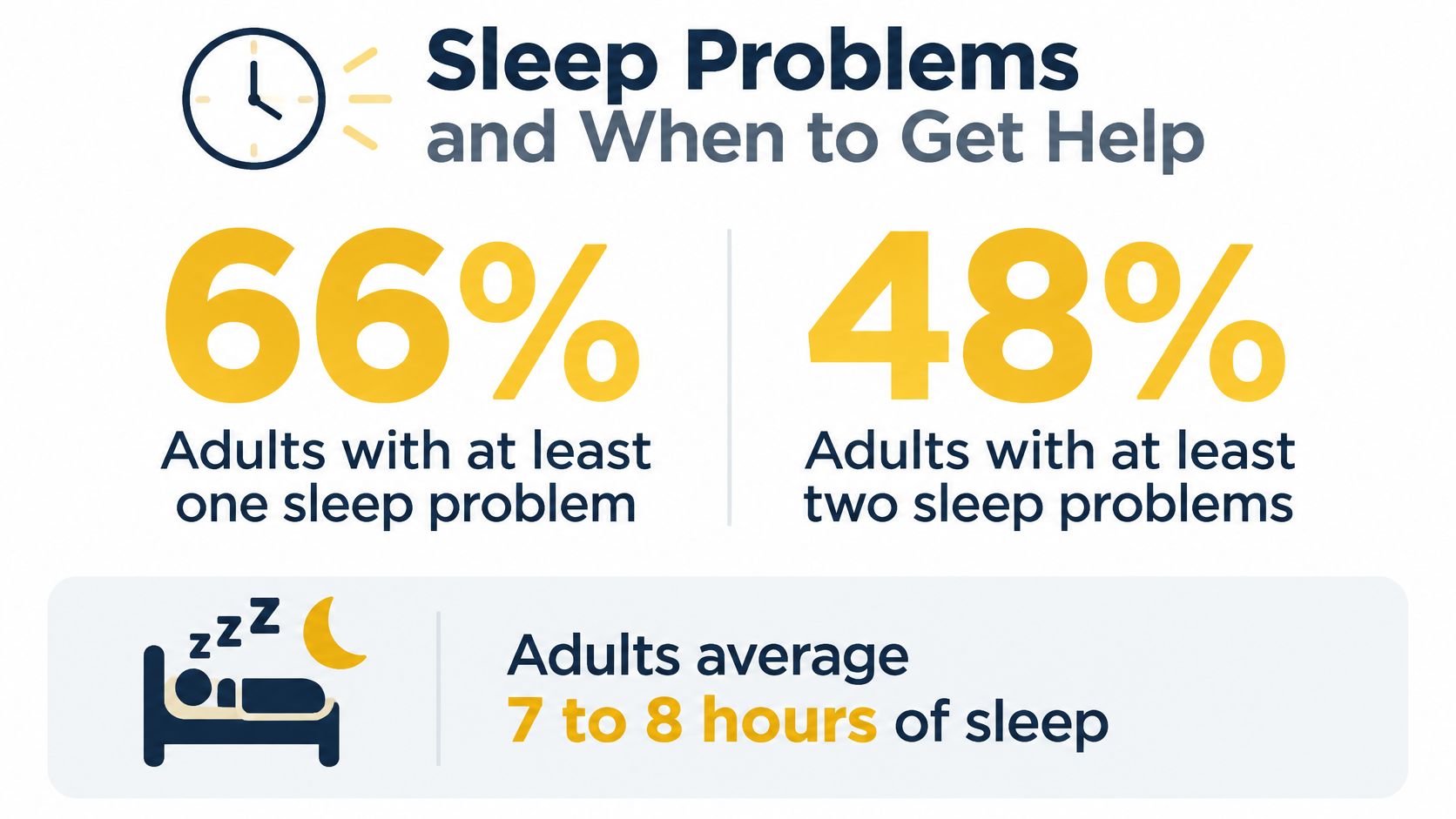
In Australia, 66% of adults experienced at least one sleep problem and 48% experienced at least two, according to the Australian Institute of Health and Welfare. Those figures show how often sleep problems occur, while the causes and symptoms can differ widely.
Someone may spend enough time in bed yet struggle to fall asleep, wake repeatedly or wake earlier than intended. Hours slept are only one part of the picture. Persistent sleep trouble warrants an assessment before a supplement is considered.
A warning light signals that something needs checking; it doesn't identify the cause. Sleep disruption may relate to bedtime habits, breathing, restless legs, a medicine effect, anxiety or a shifted body clock.
The Australasian Sleep Association reports that chronic insomnia affected approximately 3.2 million Australian adults in 2025, equivalent to 14.8% of adults. Occasional difficulty after a disrupted routine differs from an ongoing pattern that affects daily life. An assessment can help clarify the cause and whether a structured behavioural approach is appropriate.
Seek professional advice before adding a sleep product if you notice:
Don't drive if you're struggling to stay awake. A supplement trial can't establish whether unsafe daytime sleepiness will resolve.
Menopause can change sleep, particularly when night sweats or temperature discomfort are involved. The resource on better sleep during menopause with Lila offers further reading to support a conversation with your GP. A video can explain sleep-related terms, while a clinician can assess your symptoms.
Describe what happens instead of saying you sleep badly. Explain whether you struggle to drift off, wake repeatedly, wake too early, or feel unrefreshed despite spending plenty of time in bed.
Take photographs of your medicine and supplement labels, including occasional products and evening drinks. Mention anything marketed for mood, stress or recovery.
Useful questions include:
Temporary improvement doesn't rule out an underlying condition. Worsening symptoms call for care rather than a larger tub or a more complicated formula.
Read a sleep label from the product identity down to the warnings. A pleasant flavour, attractive packaging or a long ingredient story doesn't tell you whether the active amounts are suitable.
The visual checklist highlights the first decisions, but the full ingredient panel still needs your attention.
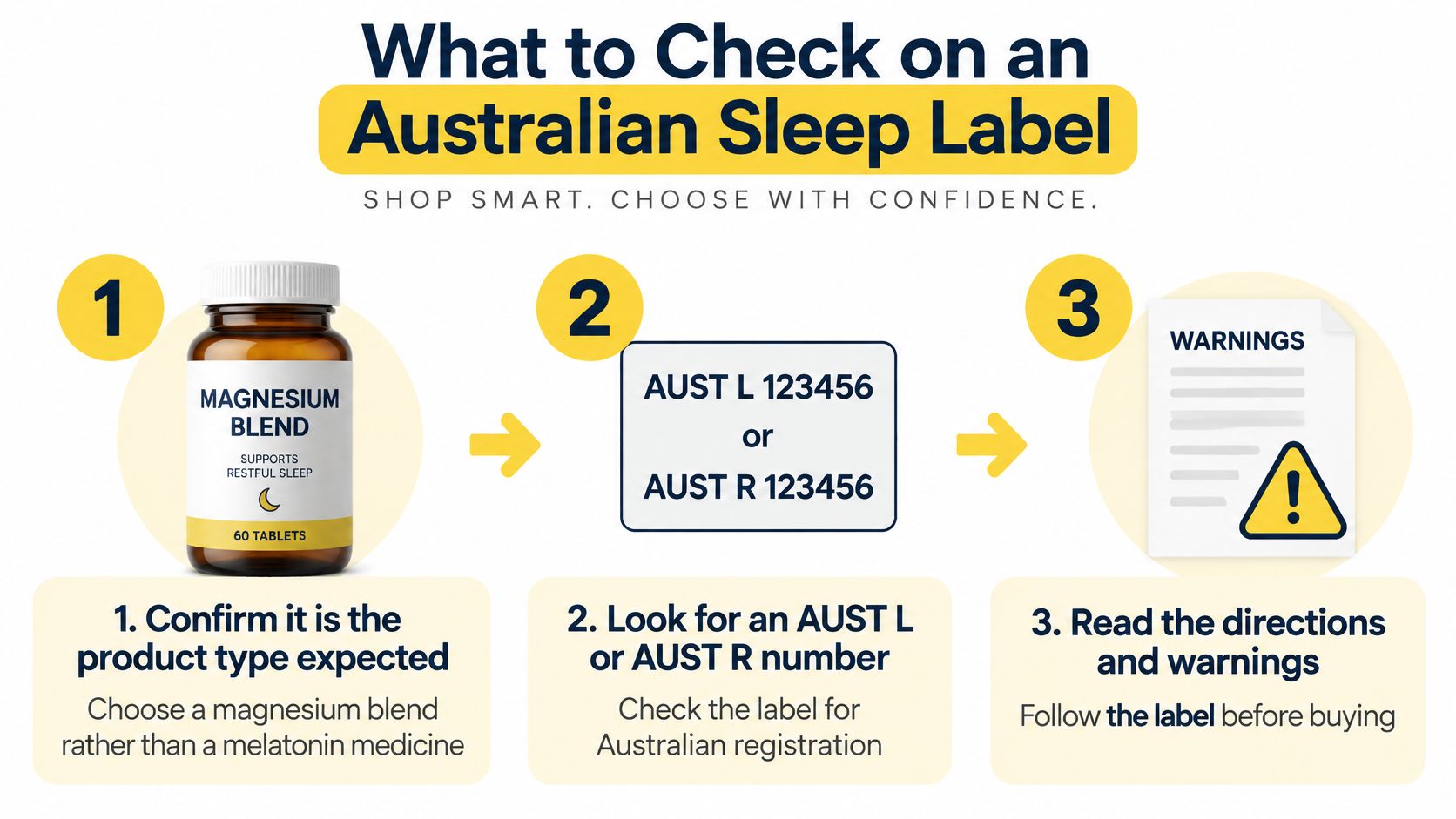
When comparing mineral products, put the labels side by side rather than comparing the largest number on each front panel. Our guide to buying magnesium glycinate in Australia provides a focused starting point for that task.
Photograph the directions and warnings if you're asking a pharmacist about an online listing. A product name alone may not identify the exact formulation.
Label rule: If the panel won't show the amount of the ingredient you came for, leave that product and choose one that will.
Switch Nutrition Sleep Magnesium is sold as a chocolate drink and in a sleep sachet format. Use these as examples of how to read a night-drink label, not as a ranking. Check the current packaging for preparation instructions, including whether to use warm or cold liquid and how to measure a serve.
A night-drink formula may combine magnesium citrate, L-glycine, Griffonia-derived 5-HTP, tart cherry, myo-inositol and holy basil. Other label entries may include soy-derived phosphatidylserine, activated vitamin forms, zinc and a probiotic such as Bacillus coagulans.
A list of ingredients shows what is in the blend, not whether the combination will improve sleep. If sleep changes after starting a multi-ingredient product, it can be difficult to identify which ingredient, if any, made a difference. A changed bedtime or evening routine may also affect the result.
| What you're comparing | Practical question |
|---|---|
| Hot-chocolate format | Will preparing it fit your evening routine without adding an unwanted meal or drink? |
| Cold sachet format | Does the individual portion suit your routine, and are its directions different? |
| Soy-derived ingredient | Is soy a personal allergy or dietary concern? |
| Stevia and flavouring | Do you tolerate and like the complete drink? |
| Gut-brain positioning | Does the label provide useful ingredient details alongside its claims? |
A blended drink may be convenient, but the number of ingredients makes checking the panel more important. Compare each format's current ingredient list, amounts, allergens and warnings. A chocolate drink and a sachet from the same range may not have identical formulas.
Wallaby Wellness sells sleep supplements, stress and anxiety supplements, L-theanine supplements and tart cherry supplements. These categories let shoppers compare multi-ingredient products with simpler options, while suitability depends on the individual product and the person taking it.
An evening tea is another format to consider. The guide to sleep tea and its ingredients can help you examine what a tea contains and how its claims are presented. The format alone does not show whether it suits your needs.
A good buying decision includes the option to buy nothing. Work through these steps so a supplement trial does not delay care or make it harder to tell what helps.
If a product remains suitable, Wallaby Wellness groups Sleep Supplements, Stress & Anxiety Supplements, L-Theanine Supplements and Hormone Balance Supplements in its Sleep & Stress range. Prices are displayed in Australian dollars. Category names help with browsing; they cannot identify why you are sleeping poorly.
Keep a short record of what you took, when you took it and what changed. Bring it to your review, so you can discuss the trial rather than relying on whether the container is empty.
Choose a clearly labelled product when self-care is appropriate, or book an appointment when assessment should come first. A purchase should not delay that appointment.
Wallaby Wellness sells sleep, stress and anxiety, L-theanine and magnesium supplements for shoppers comparing options for evening support. Visit Wallaby Wellness to compare products, then ask a pharmacist or GP about suitability if you are unsure.