Protein Powder for Weight Loss: Does It Really Help?
, 16 min reading time
Protein powder for weight loss works as a measured swap, not a fat burner. See how much protein you need and how to choose one.
The popular advice to add a protein shake to lose weight leaves out the most important question: what will it replace? If you already eat enough protein, another scoop may only add energy you don't need.
Protein powder for weight loss makes more sense as a calorie decision than a protein boost. It can be useful, but only when a measured dietary gap or a worthwhile food swap gives it a clear job.
Protein powder can support weight loss when it fits inside a calorie deficit. It doesn't burn fat by itself. A calorie deficit means taking in less energy than your body uses over time.
Think of your daily energy intake as water going into a bucket. Meals, drinks and snacks all pour something in, and a protein shake is another jug. Choosing a jug labelled high protein doesn't lower the water level. Unless you remove something else, you've added more.
That distinction matters because many Australian adults already obtain enough protein for general needs from ordinary food. A supplement isn't automatically an improvement just because it contains a nutrient your body needs.
A powder can be useful in different situations:
These aren't interchangeable. Someone who needs a convenient breakfast addition has a different problem from someone who already eats protein-rich meals but wants to reduce afternoon snacking.
Practical rule: Before adding a shake, name the gap it fills or the food it replaces.
A powder can't cancel an energy surplus, replace resistance exercise or supply everything you need from a balanced diet. Nor does drinking it after exercise guarantee fat loss.
The useful questions are about your food intake, appetite, serving size and total energy, not whether a tub has weight-management language on the front. Any promise that a scoop alone will produce fat loss deserves scepticism.
The Australian Dietary Guidelines recommend that protein provide approximately 15–25% of total dietary energy. That percentage describes how protein sits within an overall eating pattern, so whether you need more depends entirely on how much your meals already deliver.
For weight management, the CSIRO protein report reports average Australian adult intakes of approximately 103 g daily for men and 79 g for women, alongside weight-loss ranges of roughly 110–145 g and 85–110 g, respectively, depending on individual characteristics.
Average intake versus weight-loss protein ranges (CSIRO figures)
| Group | Average daily intake | Weight-loss range (CSIRO) |
|---|---|---|
| Men | About 103 g | 110–145 g |
| Women | About 79 g | 85–110 g |
| All adults | About 79–103 g across the sexes | Set an individual target using body size, age, activity and health |
Averages can mislead in both directions. If your intake already sits inside a suitable range, extra protein adds kilojoules while giving you little in return. If it falls short, the size of the gap tells you exactly what a powder would need to deliver. Your own intake still needs measuring, and the top of a range earns no extra credit for being a bigger number.
The calculation works like a budget check: your target is the amount needed, food already covers part of the bill, and only the remainder is worth supplementing.
Your appropriate protein target − protein already supplied by food = the gap to consider filling.
Record a typical day's meals, snacks, and drinks. Use nutrition information panels for packaged foods and a food-composition database for unlabelled foods. Record the amount you eat, rather than accepting an app's default portion.
Include less obvious contributors such as milk, bread, oats, legumes and nuts. Counting only meat or the protein food at dinner can make your intake look lower than it is.
Our protein intake calculator can help you estimate a starting point. Treat the result as a planning aid rather than medical advice, especially if you have a condition that affects your dietary requirements.
For a hypothetical worked example, suppose a woman's individually agreed target is 85 g, while her recorded meals supply 60 g. Subtracting her food intake leaves 25 g to obtain from a food adjustment or a suitable powder. Those are example inputs, not a universal target or a claim about what women usually eat.
A small shortfall may be easier to close by adjusting breakfast or lunch, since whole foods bring fibre and micronutrients along with the protein. A larger, recurring shortfall is where a supplement earns consideration, provided you find it convenient and tolerate it well.
Body size, age, activity and health can all shift the right target. Kidney health is particularly important to check before making a substantial increase.
Enough protein, delivered consistently, matters more than a large serving. Every gram beyond what your gap calls for still contains kilojoules, and the rest of your energy budget has to cover vegetables, fruit, wholegrains, healthy fats and the other foods that make an eating plan sustainable.
A useful way to understand protein powder is as a layered system. Energy control is the foundation, protein density sits above it, and appetite management and muscle support are possible benefits.
The hierarchy below shows why the foundation matters more than the scoop.
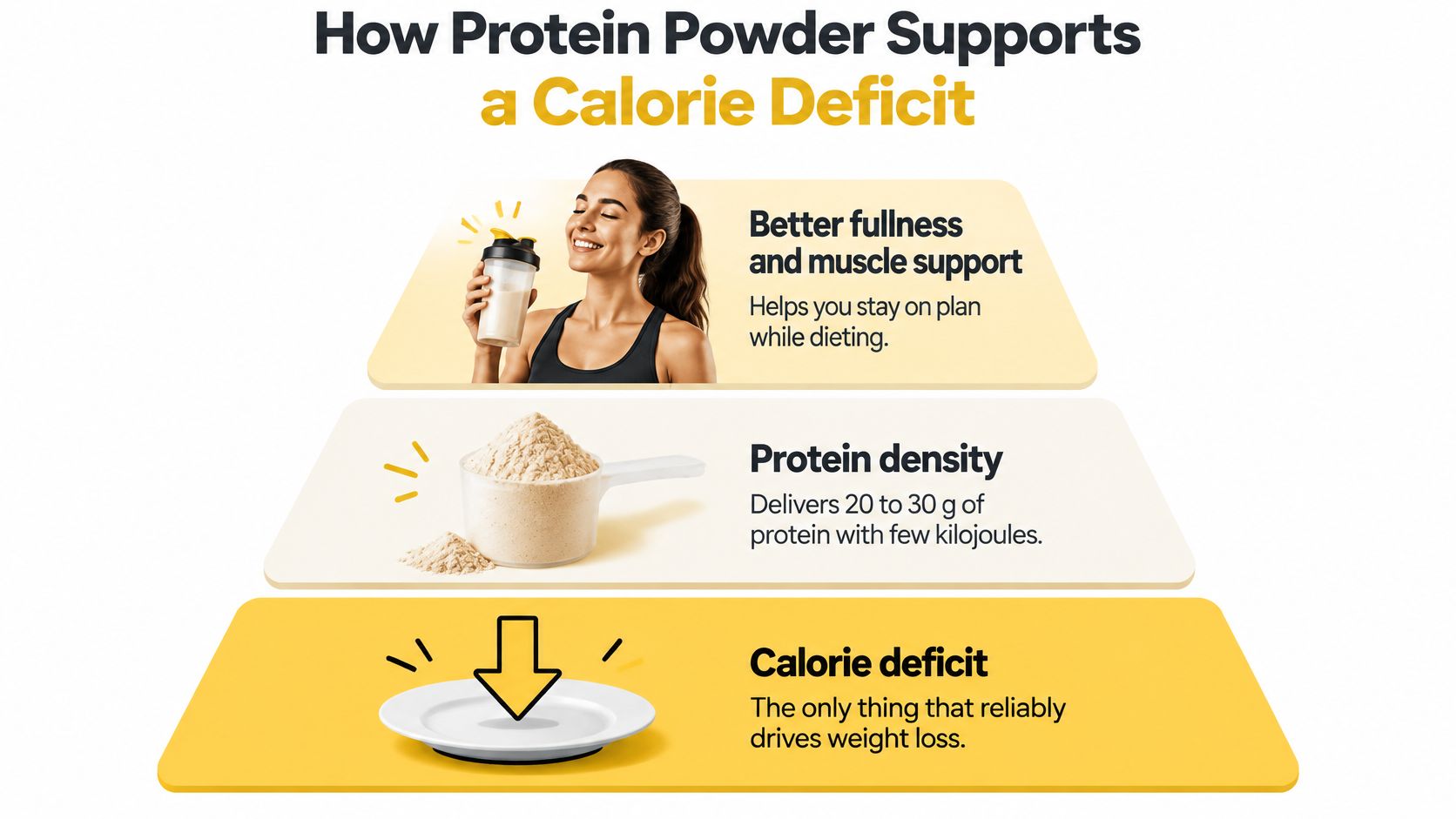
Protein density means how much protein a food provides relative to its energy content. A powder with limited added sugar and fat can help you obtain protein without using as much of your daily energy budget as a more energy-dense formulation.
The Australian Dietary Guidelines published through Eat for Health support controlling total energy intake while choosing nutrient-dense, lower-energy-density foods. Apply that principle to powders by comparing protein and kilojoules together, rather than selecting whichever tub advertises the biggest serving.
Our Australian calorie deficit calculator can help you estimate an energy starting point. Your appetite, activity, health and progress still need to inform how you use that estimate.
Protein can help you feel satisfied, making it easier to manage the interval between meals. But feeling fuller isn't the same as automatically eating less over the whole day.
Say you replace your usual afternoon bakery snack with a shake. The change is useful if the prepared shake supplies less energy and keeps you comfortable until dinner. It's less useful if you drink the shake, still eat the snack and then have your normal evening meal.
Adequate protein also supports lean tissue during weight loss, particularly alongside resistance exercise. Powder is one way of supplying that protein, not a substitute for training.
Better fullness is useful when it helps you follow a workable eating pattern, not when it becomes a reason to ignore portions.
Protein takes energy to digest, but that isn't a reason to treat it as calorie-free. Don't subtract a guessed digestion allowance from the label or assume a metabolic benefit will offset extra food.
For another explanation of the relationship between protein and weight management, watch the video below.
An Australian randomised trial involving 219 healthy older women in Western Australia compared a beverage supplying 30 g of whey protein daily with an energy-matched, low-protein, high-carbohydrate beverage over two years, finding no reduction in body weight or fatty-liver prevalence from increasing protein relative to carbohydrate.
The practical lesson is narrower than saying protein doesn't work. Changing the balance of protein and carbohydrate without lowering energy isn't the same as creating a deficit.
Add versus swap: what a shake does to daily energy
| Situation | What happens to daily energy | Likely effect on weight |
|---|---|---|
| Shake added on top of usual meals | Daily energy rises | May slow loss or contribute to gain if it removes the deficit |
| Shake replaces a sugary snack | Daily energy falls if the prepared shake supplies less | Supports a deficit when the swap reduces total intake |
| Shake replaces a meal, rest of diet unchanged | Falls only if the shake supplies less energy than the meal | Little advantage unless total energy falls |
| Shake added to a protein-rich meal, total kJ unchanged | Protein share rises, energy unchanged | Little change on its own |
The conditions in that table matter. A sugary snack isn't necessarily higher in energy than every shake, and replacing a meal doesn't guarantee a suitable nutritional result.
A common problem is the unrecorded smoothie. Powder, milk, banana, oats and nut butter may all have a place in your diet, but the whole drink needs counting. Logging only the powder misses most of what you prepared.
Start with the nutrition panel and your actual mixing method:
Don't assume flavoured means unsuitable. Check the ingredients and nutrition panel, because sweetness alone doesn't tell you how much energy a product contains.
A plain protein shake also isn't automatically a complete meal replacement. Repeatedly replacing balanced meals with powder and water can leave important dietary needs unaddressed.
Older adults, people with kidney disease and anyone taking medication that affects fluid balance or dietary requirements should get individual advice before substantially changing protein intake. A GP or dietitian can help distinguish a useful adjustment from unnecessary supplementation.
The best protein powder for weight loss isn't a particular flavour or ingredient. It's a product that supplies the protein you need, fits your energy budget and works with your dietary restrictions.
Compare types first, then compare actual labels. The name of the protein can narrow your choices, but it can't tell you the finished product's composition.
Protein powder types compared per labelled serve
| Powder type | Digestion and satiety | Best fit |
|---|---|---|
| Whey isolate | Faster-digesting dairy protein; lactose content needs checking | Dairy-tolerant users seeking a protein-dense option |
| Whey concentrate | Faster-digesting dairy protein; check lactose, fat and carbohydrate | Everyday use when its composition and price suit |
| Micellar casein | Slower-digesting dairy protein; may suit longer gaps between meals | People who prefer a thicker shake |
| Egg white | Dairy-free; assess your own fullness and tolerance | Dairy-free diets where egg is suitable |
| Pea or plant blend | Fullness and digestion reflect the formulation, including any fibre | Vegan and dairy-free diets |
There isn't a defensible universal protein figure for each type. Serving weights, flavourings and ingredient proportions differ, so confirm the amount on the tub rather than relying on a generic comparison.
Use the following visual as a shortlist, not a replacement for the product label.
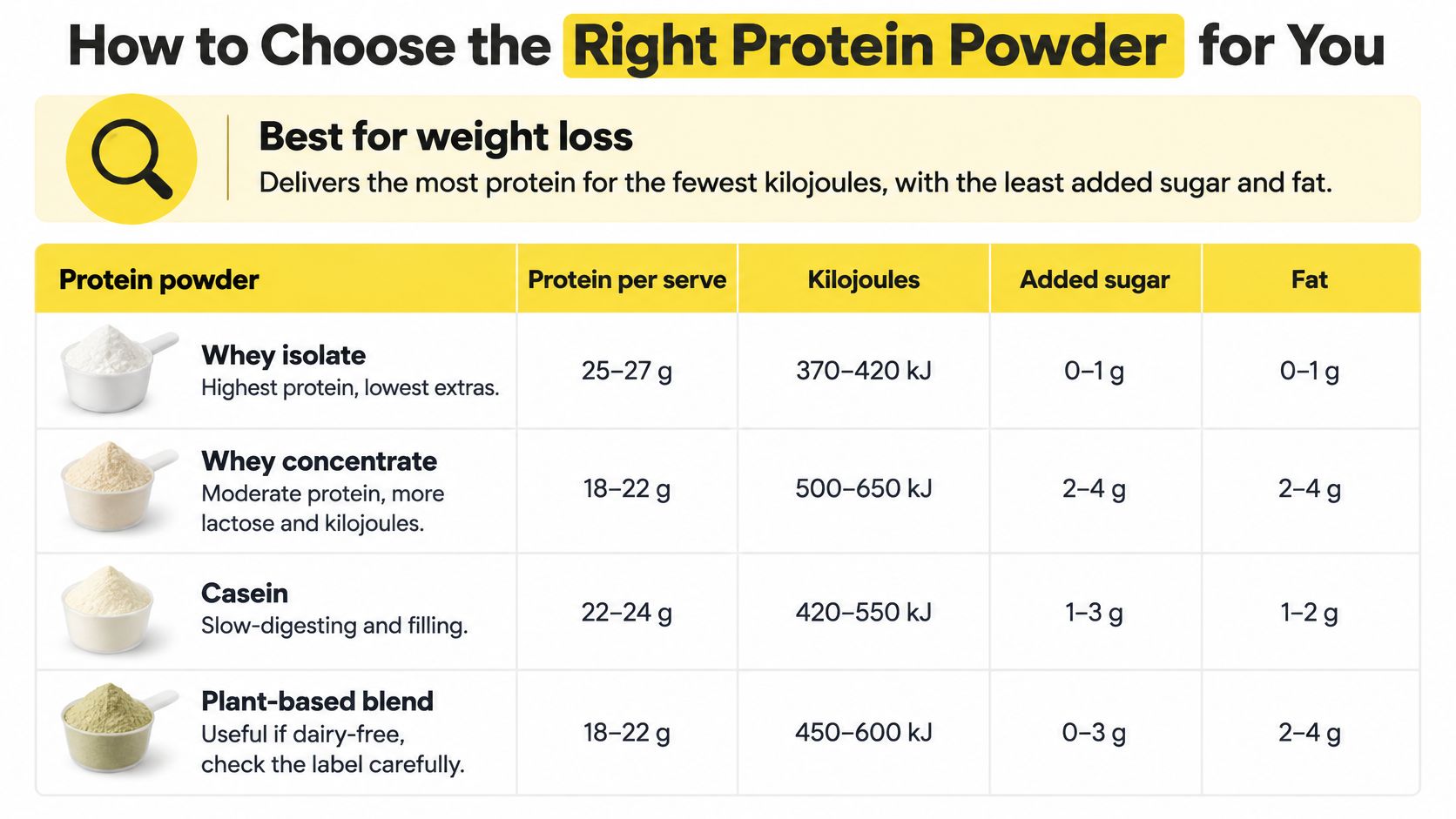
Whey and casein come from milk. Egg white can suit a dairy-free diet but isn't vegan, while a plant blend may suit both requirements. Our plant protein versus whey guide can help you compare those dietary choices.
Check the following details:
A short ingredient list can make a product easier to assess, but it doesn't prove superior weight loss. For example, Switch Nutrition Egg White Protein Powder Unflavoured is described as pure egg white protein without artificial flavours, sweeteners or fillers. That's a useful illustration of a simple label, not evidence that it produces better fat loss than a flavoured blend.
For a quick label test, identify your intended portion, read its protein and energy, check allergens, and decide what you'll mix it with. Then ask whether you'd willingly drink it regularly, because an unsuitable texture or taste can make an otherwise sensible purchase wasteful.
Compare value using price per gram of protein, not price per scoop. Divide the tub price by its stated number of serves, then divide that result by the grams of protein in each serve. This avoids treating a large scoop with less protein as better value.
Transparent ingredients and independent testing matter more than dramatic weight-loss promises. Sports supplements cover very different products, so don't treat a basic protein powder and a stimulant-heavy performance blend as interchangeable.
If a product advertises independent certification, check the named scheme's register and confirm the exact product or batch where applicable. Names such as Informed Sport or Informed Choice are worth investigating, but a logo isn't a guarantee that the product suits your medical needs.
Be cautious about products with:
Vegan branding also needs careful interpretation. An Australian observational analysis of 7,637 adults using 2011–12 survey data found plant-protein intake was associated with lower BMI and waist circumference in men, but it couldn't establish that plant protein caused those differences.
That finding isn't evidence that vegan powder burns more fat. Choose plant-based products for their dietary fit, composition and tolerability, rather than expecting an effect the study didn't test.
People with kidney disease, those taking medication, and pregnant or breastfeeding women should discuss supplementation with their healthcare professional. Check allergen declarations carefully if you react to milk, egg, soy or other ingredients.
For pregnancy-specific questions, Venus Health Co. on pregnancy protein offers additional reading to discuss with your maternity care team. Pregnancy isn't a setting for starting a weight-loss shake routine without clinical guidance.
Use a short decision process before buying a tub. The aim is a practical eating plan, not a growing supplement routine.
The visual summarises the decision.
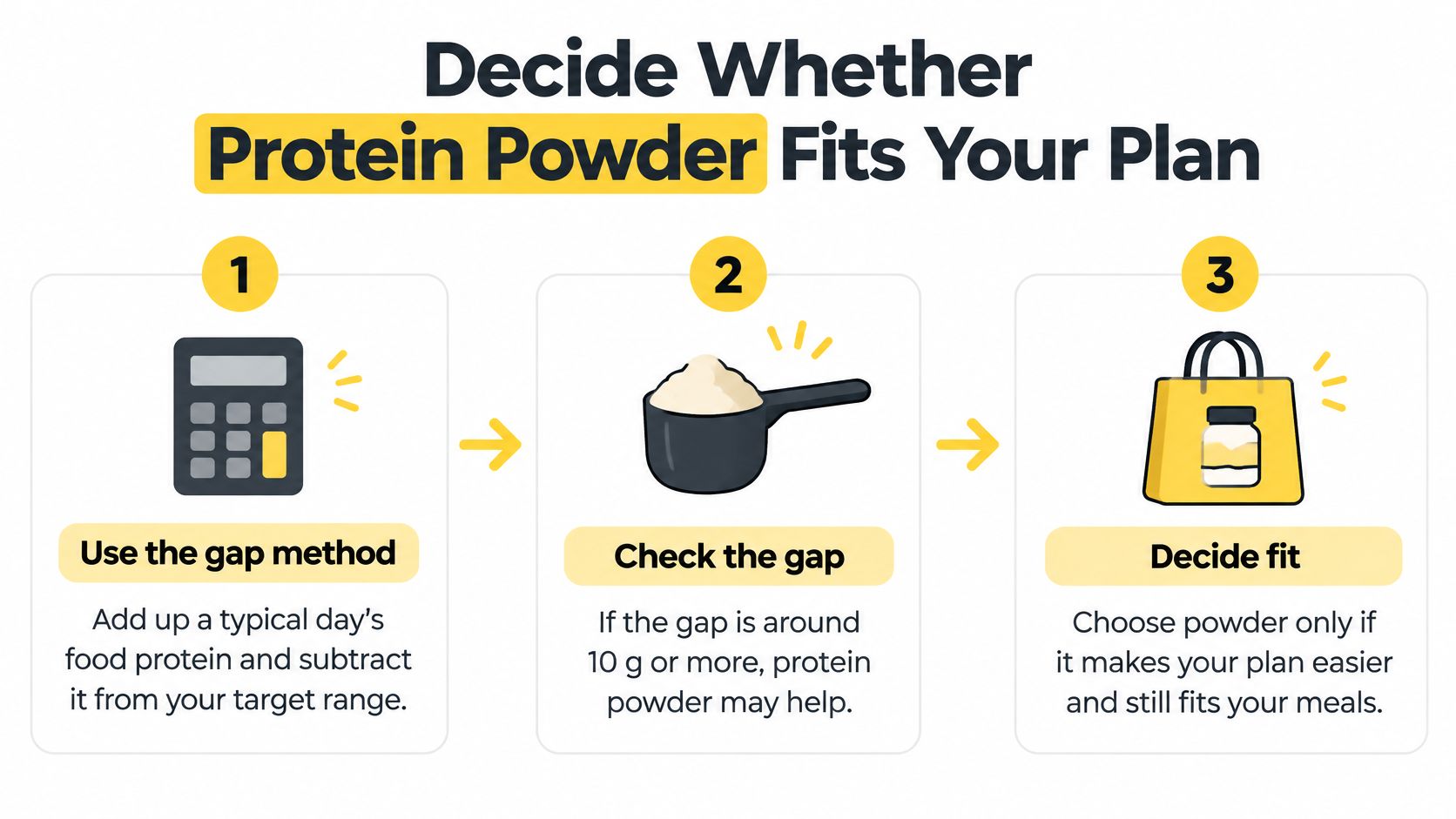
Yes or no: Use powder if it solves a measured problem within your energy plan. Skip it if it simply adds more to a diet that already meets your needs.
Confirm substantial changes with a dietitian if you have kidney disease, take medication or have other medical needs.
We offer whey protein isolate, micellar casein, egg white, bone broth and vegan protein supplements at Wallaby Wellness. Visit Wallaby Wellness to compare options against your measured protein gap, dietary requirements and planned food swap, rather than choosing by weight-loss claims alone.