Stevia vs Monk Fruit: Taste, Labels and Best Use
, 17 min reading time
Stevia vs Monk Fruit compared on taste, Australian rules, label reading and baking, so you can pick the right sweetener for your kitchen.
Which is sweeter, stevia or monk fruit? It's the question nearly every shopper asks, and it tells you least about what will happen in your coffee.
Potency is a laboratory comparison against sucrose in a model system. What you taste is a finished product: an active sweetener at a particular dose, sitting on top of a carrier that may account for most of the tub's weight, sold into a food category with its own permitted level. Two pouches on the same shelf can carry the same monk fruit claim and behave nothing alike.
The useful comparison, then, isn't stevia vs monk fruit as plants. It's stevia vs monk fruit as sold, dosed and regulated in Australia, which is what the rest of this article reads.
Strip away the marketing and the two sweeteners share a short spec sheet: plant origin, no sugar and negligible calories. They diverge on source plant, active compound, potency and the terms on which each was cleared for the Australian food supply.
| Factor | Stevia | Monk fruit |
|---|---|---|
| Source plant | Stevia rebaudiana, a South American plant | Siraitia grosvenorii, a perennial vine native to southern China |
| Active sweet compounds | Steviol glycosides | Mogrosides, mainly mogroside V |
| Sweetness compared with sugar | About 150 to 300 times sweeter | Pure mogroside V about 250 to 400 times; commercial extracts around 200 times |
| Australian regulatory status | Numerical ADI of 0 to 4 mg/kg body weight/day | Approved 23 January 2019 under application A1129; no numerical ADI set |
Potency and approval figures come from FSANZ's published review of sweeteners, covered under How Each Sweetener Is Made and Approved.
Read the rows in the order you'd interrogate a pack: plant, compound, potency, status. Row three gets the attention because it is the one carrying a big number. Row four is the one that shows whether anyone has measured how much of the stuff Australians eat. Stevia carries a daily intake figure you can check a diet against. Monk fruit was cleared on the strength of its application file, A1129, without a numerical cap.
Both are mainstream ingredients rather than specialist imports. Expert Market Research valued the Australian sugar-free food and beverage market at approximately USD 2,851.33 million in 2024 and identified stevia and monk fruit among the sweeteners used in it.
Those last two rows are the ones worth carrying into the supermarket aisle. Potency tells you the dose behind a serve. Status tells you the kind of scrutiny behind it.
FSANZ identifies stevia as steviol glycosides extracted from Stevia rebaudiana, a South American plant, while monk fruit extract comes from Siraitia grosvenorii, a perennial vine native to southern China. The plant part differs as much as the species. Steviol glycosides are leaf chemistry; mogrosides, of which mogroside V does most of the sweetening, are fruit chemistry. That difference in source is the first thing worth checking on a pack, because it predicts which compound name you will find in the ingredients list.
The two approval pathways are worth seeing side by side before the detail.
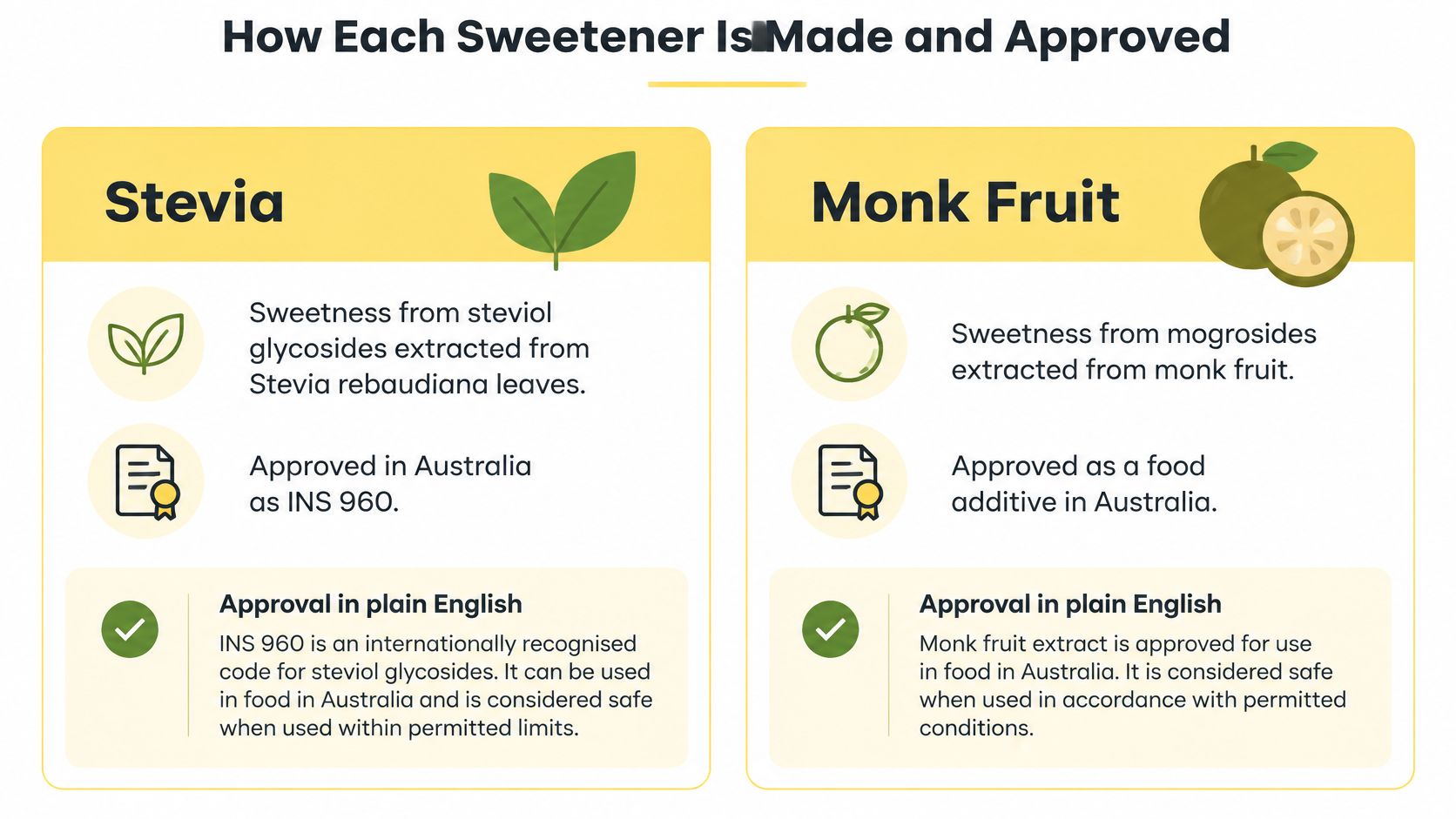
FSANZ has kept a numerical acceptable daily intake (ADI) for steviol glycosides of 0 to 4 mg per kilogram of body weight per day, a level intended to be safe if consumed daily across a lifetime. Its published review of sweeteners went further than setting the number. An analytical survey beginning in 2020 measured steviol-glycoside concentrations in foods on sale in Australia, then compared those concentrations with what people eat.
Under the baseline exposure scenario, mean estimated intake came out at 0.5 to 0.9 mg/kg body weight/day, equivalent to 10 to 20% of the ADI. The 90th percentile, the heavier consumers, landed at 0.8 to 1.7 mg/kg/day, or 20 to 40% of the ADI. Steviol glycosides were also the most frequently used intense sweetener in the reviewed Australian and New Zealand food database, ahead of sucralose and cyclamates, and the assessment found no public-health or food-safety issue, concluding that estimated exposure stayed below the ADI.
A numerical ADI is a ceiling you can calculate for yourself. A safety finding with no number attached is a verdict you take on trust.
FSANZ's Application A1129 sought permission to use monk fruit extract, also called luo han guo extract, as an intense sweetener, and the approval variation was gazetted on 23 January 2019. The risk assessment found no public-health or safety issues, so the agency set no numerical ADI. On potency, FSANZ reports pure mogroside V at approximately 250 to 400 times the sweetness of sucrose, against the 150 to 300 times it gives steviol glycosides.
Both sweeteners passed safety review; they differ in how much intake data exists behind them. Stevia has been in the local food supply long enough for regulators to measure real consumption and compare it against a published daily limit. Monk fruit is a newer permitted option, approved on a safety finding alone, with no population intake survey and no figure to weigh your own use against. For a shopper reading a label, that gap is the practical difference: a stevia product sits inside a measured system, while a monk fruit product asks you to trust the approval itself.
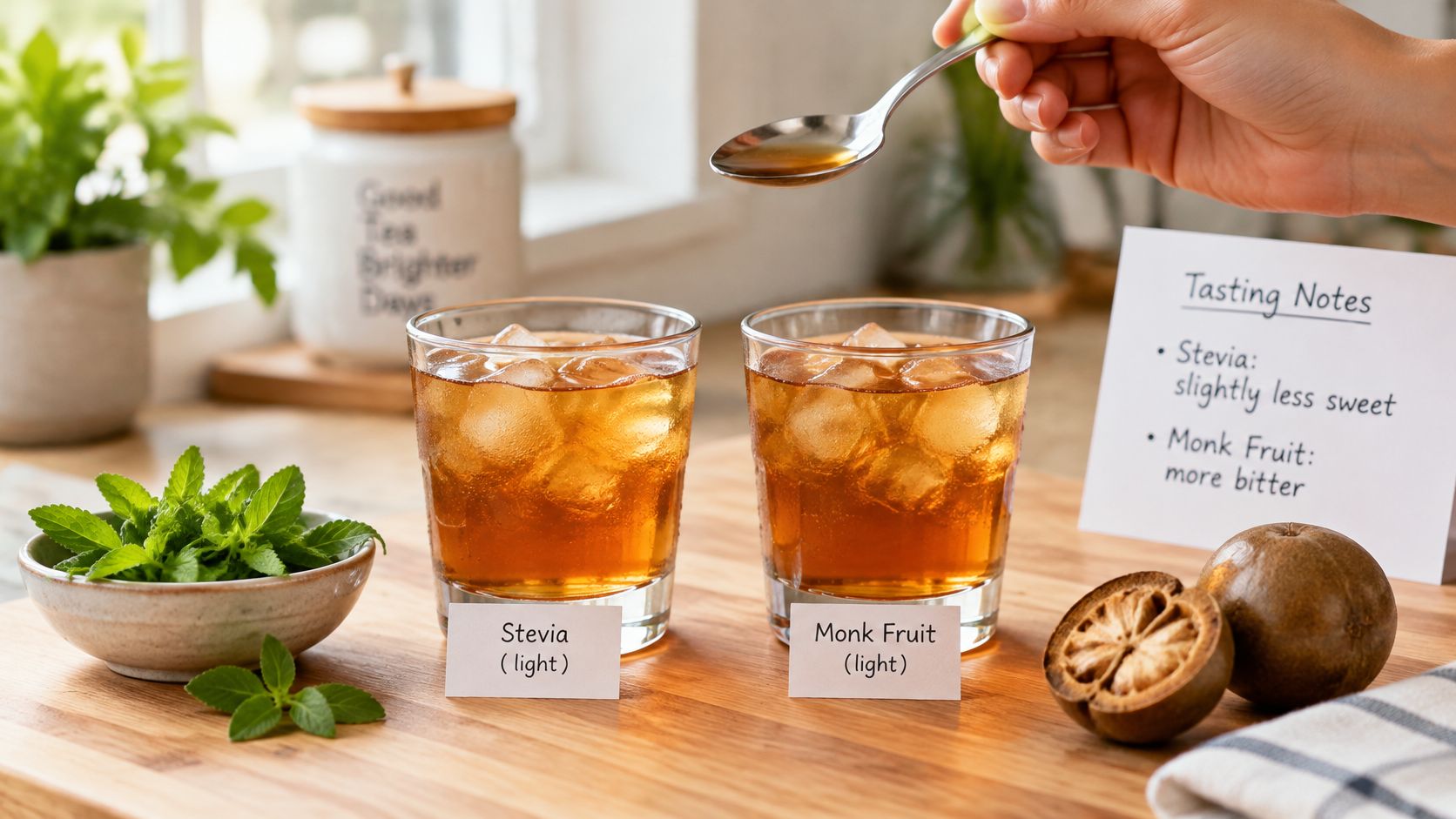
Potency and sensory performance are different measurements, and only one survives contact with a mug of tea. FSANZ's monk fruit assessment documents put commercial extracts at approximately 200 times the sweetness of sucrose depending on mogroside V concentration, then report what tasting found: monk fruit and stevia beverages were slightly less sweet and more bitter than sucrose or aspartame under the tested conditions.
That finding is the most useful line in the whole comparison. A 200x or 300x figure is an equivalence measured in a model system. Your drink is a different system, with acid, aroma, temperature and a sweetness curve that rises and falls over half a minute. Bitterness is what shows up as the curve drops.
Two sweeteners in the same mug, and the gap reveals itself in the finish rather than the first sip.
Bitterness scales with dose, which is why an intense sweetener that tastes clean in a small cup can turn medicinal in a large one. Steviol glycoside preparations are specified to a high minimum purity under the relevant preparation definition, which is a purity benchmark rather than a taste guarantee. Monk fruit carries an extra variable: mogroside V concentration sets both sweetness and dosing, so two products making the same front-of-pack claim can need different spoonfuls to reach the same sweetness. Read the dose per serve before you read the sweetness multiplier.
If you'd rather watch the comparison before buying, this walkthrough covers the same ground.
Morning drinks. Match by taste, then buy a small pack of a single-ingredient product first, such as Wallaby Wellness's stevia 100% pure extract powder, so you're assessing the sweetener rather than a carrier. If you're sweetening a drink you make yourself, start from a recipe you control: homemade hot chocolate from scratch gives you a base where the sweetener is the only variable and you can adjust by the spoonful.
Low-carb baking. Here sweetness is the least of your problems. Intense sweeteners add sweet taste and almost nothing else: no bulk, no browning, no structure. Expect paler, flatter, drier results and plan to adjust liquid and timing. A bulked blend solves more of that: an erythritol-based monk fruit blend, where the carrier makes up most of the pouch and the extract only a small fraction, measures like sugar and pours like it too. Note what the carrier brings with it: erythritol in quantity has a known laxative effect, so a whole cake's worth is a different proposition from a teaspoon in a cup.
Fruit desserts, sauces and dressings. Acid is the tool. A squeeze of lemon or a splash of vinegar suppresses the bitterness that ruins these sweeteners in plain water, which is why the same dose that tastes sharp in tea can taste clean in a compote.
Mixed-taste households. Sweeten the base lightly and leave the tub on the bench. Bitterness tolerance varies enormously between people, more than sweetness preference does, and one person's ideal cup is another person's reason to abandon stevia for good.
Trust your own palate at a fixed dose. Two sweeteners with identical regulatory standing can still split a household, and only the test in your own kitchen settles it.
There's a decent chance the tub in your hand isn't really stevia or monk fruit. It's a blend, and the sweetener named on the front may be a small fraction of the contents. The rest is carrier, because something has to give an intense sweetener enough volume to be scooped with a teaspoon.
That isn't a con. Bulked blends are easier to measure and behave more like sugar in a recipe. The issue is that the front of the pack sells the plant while the back of the pack sells the carrier, and only one of those determines what you're paying for.
| Label term | What it usually signals | What to check |
|---|---|---|
| Stevia leaf extract or steviol glycosides | Stevia sweetener, possibly purified | Active sweetener percentage and INS 960 listing |
| Rebaudioside A | Purified stevia glycoside used in many blends | Its share of the blend and the dose per serve |
| Monk fruit extract or luo han guo extract | Monk fruit sweetener | Mogroside V content if the pack states it |
| Mogroside V | Main monk fruit sweet compound | Concentration, since it changes sweetness and dosing |
| Erythritol blend | Bulking carrier added to the sweetener | Carrier share and the sweetness per gram of the blend |
| Dextrose blend | Sugar-based bulking carrier | Calories per serve and carrier share on the pack |
Three checks carry most of the weight. Active sweetener percentage: a blend carrying 1% monk fruit extract and one carrying a third of the tub as actives are different products at the same price. Carrier type and quantity: erythritol, dextrose and maltodextrin add weight without adding much sweetness, and dextrose brings sugar calories along with it. Dose per serve: the serve size printed on the pack tells you how much sweetness a scoop provides, which matters more than any claim above it.
One more layer applies in Australia. Permitted levels for steviol glycosides vary by food category under the Food Standards Code, so a product's compliance depends on what it is as well as how much sweetener it holds. A sweetener sold for home use and a sweetener built into a formulated drink aren't assessed against the same numbers.
The same checklist, in visual form, for the aisle.
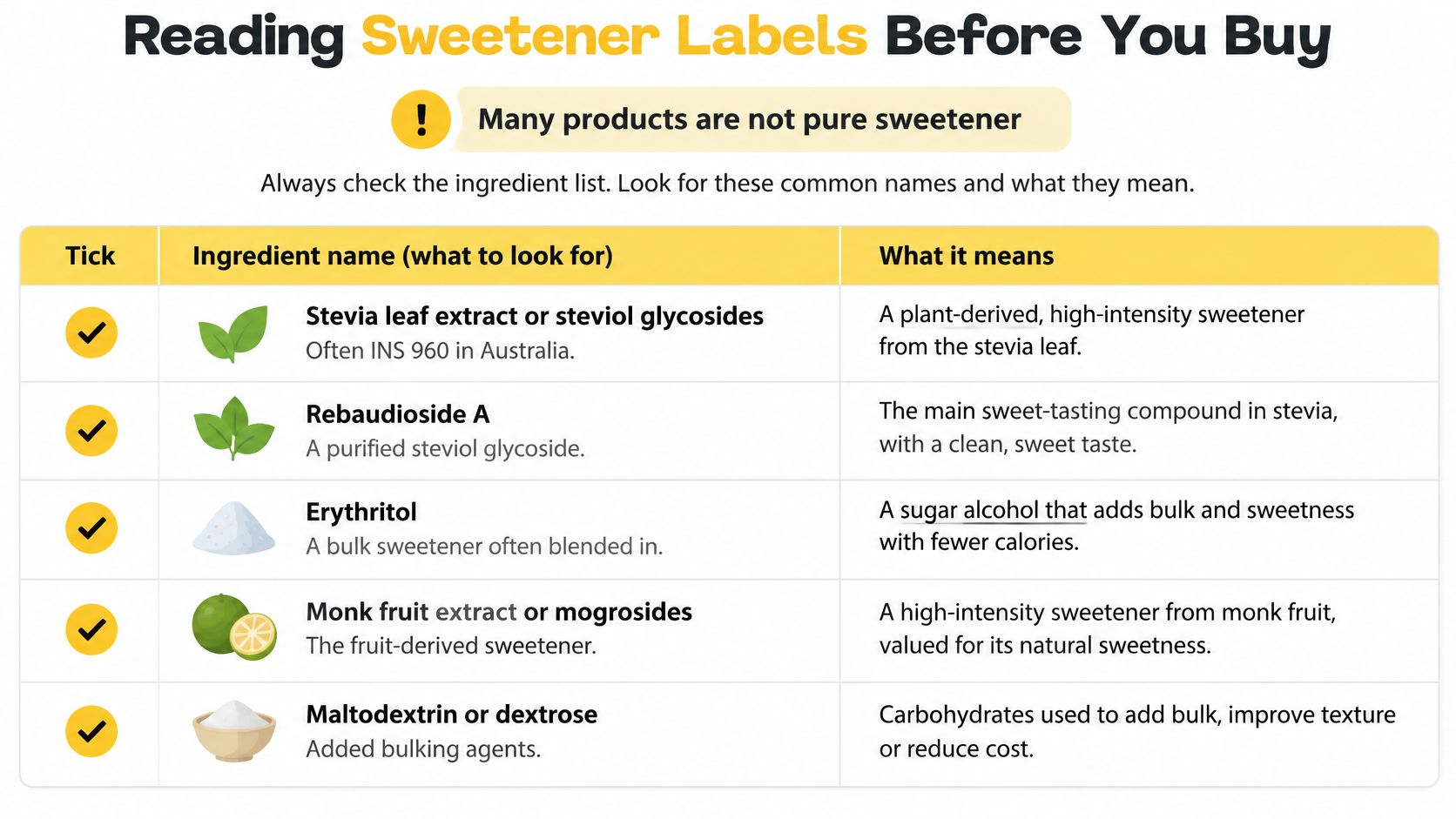
Before you buy, run five checks in order: the name of the sweetener, the active percentage, the carrier and its quantity, the dose per serve, and the category the product is sold for. If you want to see how those checks read on a real panel, the PBCo - Monk Fruit & Erythritol Blend Natural Sweetener shows the pattern in one glance.
Two tubs on the same shelf tell you nothing until you convert price into cost per sweet serve. That's the number deciding whether a $9 pouch or a $24 pouch is the better buy, and it's simple division once you know which figures to use.
Say a 200 g bulked blend sells for $12, and the pack directs a 4 g serve per drink. The tub holds 50 serves, so each serve costs 24 cents. If 4 g of that blend sweetens like 8 g of sugar, the tub delivers the sweetness of 400 g of sugar for $12, roughly $3 per 100 g of sugar-equivalent sweetness.
Now take a concentrated extract: 50 g at $20, dosed at 0.2 g per drink, which gives 250 serves at 8 cents each. If 0.2 g sweetens like 8 g of sugar, that tub covers 2 kg of sugar-equivalent sweetness for $20, or $1 per 100 g. Those prices and doses are made up. The method isn't.
Run the division first: a big tub of a weak blend can cost more per sweet serve than a small, concentrated one.
Two things overturn the result. Dosing accuracy matters more with a concentrated extract, because a small error is a large percentage error. And if you end up using twice the dose because the weaker blend tastes milder, the arithmetic flips against you.
A cheaper tub is often the more expensive one per serve, and a costly concentrated extract can be the cheapest way to sweeten a cup. Divide before you decide.
By the time you've read a label and run the division, the choice usually makes itself. Where it doesn't, decide by the job the sweetener has to do.
Go with stevia when you want the sweetener with the longest Australian exposure record and a numerical ADI you can work from. It suits anyone who sweetens several cups a day, because concentrated extract is the cheapest route per sweet serve and the dose is small enough that a tub lasts months. The trade-off is real: you'll be adjusting the dose until the bitter tail disappears, and some people never fully lose it.
Monk fruit fits when you want the newer approved option with higher stated potency, when you're buying a bulked blend for baking anyway, or when stevia has already beaten you in plain drinks. In a cake, the carrier does the structural work regardless of which plant supplied the sweetness, so the extract matters less than what it's blended with.
For most shoppers, three things settle it: whether the product carries enough active sweetener to be dosed sensibly, whether the carrier suits your gut, and whether the serving size matches your eating habits. That's why the same person can love one monk fruit product and reject another without contradiction. Stock has widened for both: 6Wresearch reports Australia's alternative-sweeteners imports grew by 2.9% year over year in 2024, in a category that includes stevia and monk fruit extract.
Read the panel for the blend, the dose per serve and the Australian category. The front of the pack can stay unread.
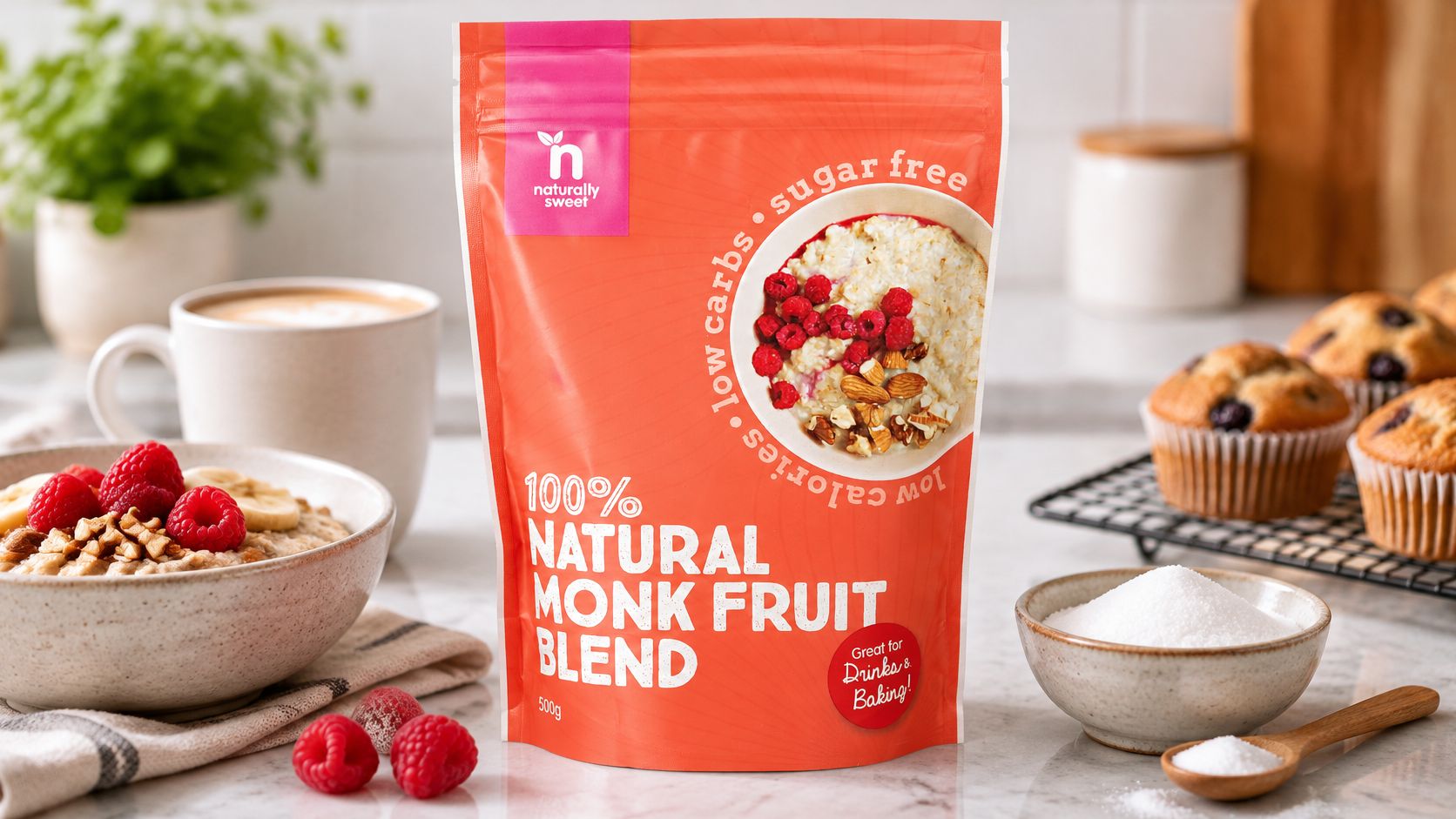
Retail listings carry the same detail you'd check in the aisle. One example of the bulked format is Naturally Sweet Natural Monk Fruit Blend, an erythritol and monk fruit blend sold as a 1:1 swap for sugar.
The same reasoning applies to any sweet swap. If you're also weighing liquid sugars, the choice between maple syrup and honey comes down to what else arrives alongside the sweetness.
Pick two products that match how you use a sweetener. Check both against the label table, run the taste test in your usual drink, and buy the one that tastes right at the serve you'll use. Twenty minutes of checking costs less than one abandoned tub.
Wallaby Wellness carries natural sweeteners within its pantry range, so you can check the actives, the carrier and the serve size before committing to a tub. If you're ready to put these label checks into practice, browse the range at Wallaby Wellness and compare the panels side by side.