Collagen Peptides vs Marine Collagen: Which Suits You?
, 17 min reading time
Collagen peptides vs marine collagen explained: how source, composition, diet fit and label claims differ, and which Australian shoppers should choose.
The popular advice to choose marine collagen because it absorbs better skips the most useful buying questions. Marine describes the source, not a superior supplement form. A fish-derived powder can itself be collagen peptides, so comparing collagen peptides vs marine collagen as separate categories starts with a misleading distinction.
For Australian shoppers, the practical comparison is between finished products: what animal they come from, how much hydrolysed collagen they supply, what evidence supports the formulation, and whether the ingredients suit your diet. An impressive source claim can't compensate for an unclear dose or an unsuitable allergen declaration.
| Feature | Collagen peptides (bovine or porcine) | Marine collagen (fish) | What to check |
|---|---|---|---|
| Source | Cattle or pigs, including hides and bones | Fish skin, scales or bones | Confirm the animal source on the label |
| Form | Hydrolysed peptide powder, capsules or drink mix | Hydrolysed peptide powder, capsules or drink mix | Both can be sold as collagen peptides |
| Fish allergen | Not inherent to the collagen source | Fish-derived, carries fish-allergen risk | Read the full allergen and cross-contact statements |
| Suits a fish-free diet | Yes, if other ingredients and cross-contact controls suit | No | Check the complete formulation |
| Suits a vegan diet | No | No | Neither source is vegan |
| Source-specific advantage | Not established | Not established | Compare dose, peptide profile and trial endpoints |
| Peptide dose per serve | Product-specific amount | Product-specific amount | Read grams of peptides per serve, not scoops |
Source tells you whether a product meets your dietary boundaries. A label that says only collagen peptides doesn't give you enough information to distinguish fish from cattle or pigs, and that gap matters more than any front-label claim about premium sourcing.
Form tells you how the ingredient has been prepared and supplied. Powder versus capsules is a delivery choice, not proof that the collagen inside performs differently.
The fish-allergen row needs careful interpretation. Bovine collagen isn't fish-derived, but that doesn't establish that every finished bovine product is appropriate for someone with a fish allergy. Added ingredients and manufacturing cross-contact still need checking, and the allergen sections later in this article work through those distinctions in detail.
Elimination beats evaluation. Before comparing trial evidence or peptide profiles, cross off anything that conflicts with your dietary or safety requirements, since no performance claim can justify a product you can't safely take.
The evidence row prevents another shortcut: neither column earns an automatic performance advantage. A buyer needs information about the actual peptides and intended outcome before treating one product as better supported.
The dose row is equally important. A serving is the manufacturer's recommended quantity of the whole product, which may include flavours, sweeteners or other actives alongside collagen. Two tubs can look identical on the shelf while delivering very different peptide amounts per scoop. Peptide grams are the useful comparison, not the size of the scoop.
For the order in which to work through these checks on a physical label, the step-by-step checklist later in this article sets it out.
Collagen peptides are collagen that has been hydrolysed, meaning broken into smaller peptide fragments. The term describes processing. Marine collagen identifies fish as the source, and manufacturers can hydrolyse that collagen too.
That makes marine collagen peptides a coherent description, not a hybrid of competing supplement categories. Source and processing answer different questions, and a useful label should disclose both.
Under Standard 1.2.7, a business self-substantiating a general-level health claim must notify FSANZ and certify that a systematic review establishes the claimed food–health relationship; the FSANZ notification register records collagen-related notifications beginning in March and April 2021.
Those entries include claims concerning hydrolysed or bioactive collagen peptides and skin surface structure and density. Other entries concern fish collagen peptides and claims about hydration, elasticity and wrinkling, plus hydrolysed marine collagen and protection against skin collagen degradation.
The terminology matters more than the marketing wording. The register itself includes fish collagen peptides, demonstrating why marine and peptides shouldn't be treated as opposites.
Label-reading principle: A notified food–health relationship isn't an independent endorsement of every product carrying similar words.
Notification doesn't guarantee that a claimed effect will occur for every consumer. Businesses must still frame claims within the applicable food-labelling and advertising rules, rather than present a food ingredient as an automatically proven medical treatment.
Shoppers may also encounter collagen type terminology alongside source and processing descriptions. For context on that additional label language, GutRx's collagen types explained for supplement shoppers is a useful companion resource.
If your decision is specifically between animal origins, our marine collagen vs bovine collagen comparison narrows the question appropriately. Keep the practical requirements separate: a named source, a clear hydrolysis description and a declared peptide amount.
A peptide can reach the bloodstream in larger amounts and still produce no measurable difference in skin, joint or nail outcomes. Absorption and efficacy are separate questions, and collagen marketing often treats an answer to the first as an answer to the second.
Head-to-head comparisons of peptides matched for molecular weight and composition have not consistently established source-specific advantages across skin, hair, nail or wound-healing outcomes. The trial record does not support a source-based superiority claim. Where outcomes do differ between products, the more plausible explanations are dose, peptide profile and study duration rather than the animal the collagen came from.
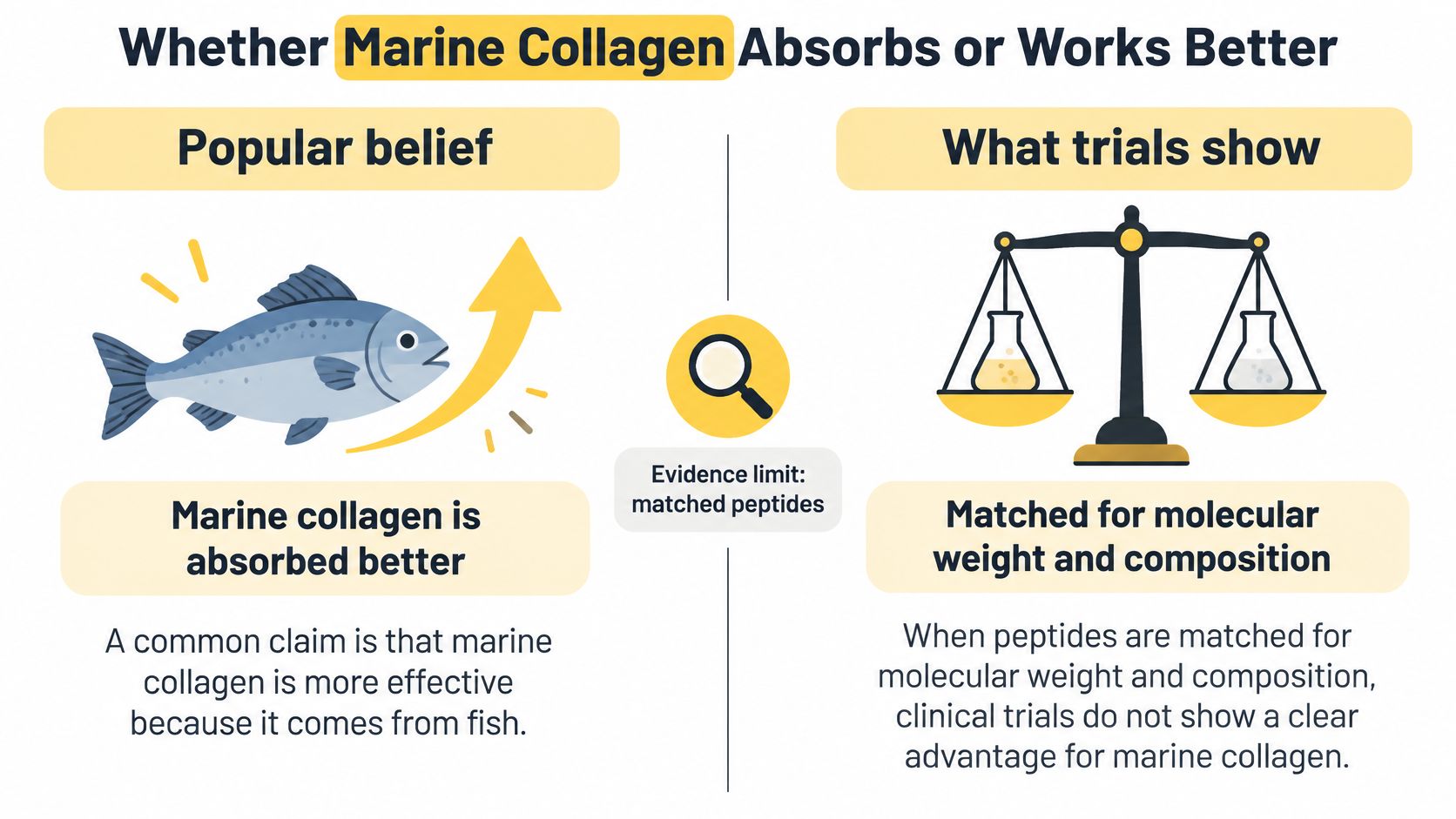
A CSIRO Publishing clinical review reports that a 2024 randomised crossover comparison of fish, porcine and bovine hydrolysates found no significant difference in free hydroxyproline absorption, and describes mixed evidence of modest osteoarthritis-related improvements after approximately six months.
That null result is the more informative finding. When three different animal sources produce equivalent uptake of the marker researchers use to track collagen absorption, the case for paying a premium on source grounds weakens considerably.
Free hydroxyproline is a short-term uptake marker. It helps researchers compare what happens after ingestion, yet it cannot tell a shopper which product will deliver the best long-term result. Even where one formulation shows greater systemic exposure than another, the missing step is demonstrating that people experience better outcomes because of it.
For joints, modest improvements in pain, flexibility or quality of life should not be translated into a promise that collagen will treat everyone's symptoms. Findings for oral collagen hydrolysates do not establish marine superiority either, since most positive trials test collagen peptides generally rather than compare sources directly.
Skin hydration and elasticity findings are promising, while joint evidence remains limited and mixed. Questions remain about dose, duration, source and quality control, so a product's evidence needs to match the outcome you care about.
Ask what the trial measured. A hydration endpoint is not a hair-growth result. An absorption experiment is not a joint-pain trial.
Australian regulatory status is a separate question again. The Therapeutic Goods Administration's ARTG guidance states that products not entered in the Australian Register of Therapeutic Goods have not been assessed by the TGA for quality, safety or effectiveness. Register entry also does not prove every advertised benefit, since assessment covers the product as entered rather than each marketing claim a seller later attaches to it.
Compare the finished peptide profile, daily amount, trial endpoint and quality controls before paying for a source-based performance promise.
Our analysis of why collagen supplements fail to deliver on their promises applies whenever expectations exceed what a formulation's evidence can support. The defensible conclusion is narrower than either marketing extreme: marine collagen is a source, and source alone does not settle efficacy. Dose, label transparency and allergen suitability should carry the decision.
For someone with a fish allergy, marine collagen's origin is a safety issue, not an argument about effectiveness. Don't assume hydrolysis removes the need for fish-allergen precautions. Read the source declaration, complete ingredient list and cross-contact advice, and get professional guidance if suitability is uncertain.
Dietary preferences create different exclusions. A pescatarian avoiding terrestrial animal ingredients may prefer fish-derived collagen, while someone eating fish-free can consider suitable bovine or porcine products. Neither option fits a vegan diet.
The 24th Australian Total Diet Study recorded mean uncoated seafood consumption of 14.0 grams per day among Australians aged 17 years and over, compared with 112.5 grams per day among people who consumed that food.
The useful lesson is about denominators. A population average includes people who didn't eat the food, so it can look very different from consumption among eaters.
Neither figure estimates what's in a marine collagen powder. Using seafood intake to calculate a supplement's contaminant risk would require information about the ingredient, processing and finished product that those dietary averages don't supply.
The same boundary applies to broad claims about seafood and contaminants. A dietary-exposure finding can justify asking questions about marine ingredients; it cannot establish that a particular collagen supplement is unsafe.
A transparent supplier should be able to address practical questions rather than rely on a general purity slogan:
A claim such as marine purity isn't a substitute for those answers. Equally, a bovine product shouldn't receive a free pass because the conversation started with fish.
Treat allergen suitability, contaminant controls and efficacy as separate assessments. A product can satisfy your source preference without having enough evidence for its advertised benefit, or have relevant efficacy evidence while remaining unsuitable for your allergy.
The useful information on a collagen pack sits below the front-of-pack claim. The decision rests on what the product contains, how much collagen it supplies per serve and whether the remaining details support a fair comparison. Marine collagen can be a sensible source choice, but source alone does not make it a superior form. Dose, label clarity and allergen risk should decide the shortlist.
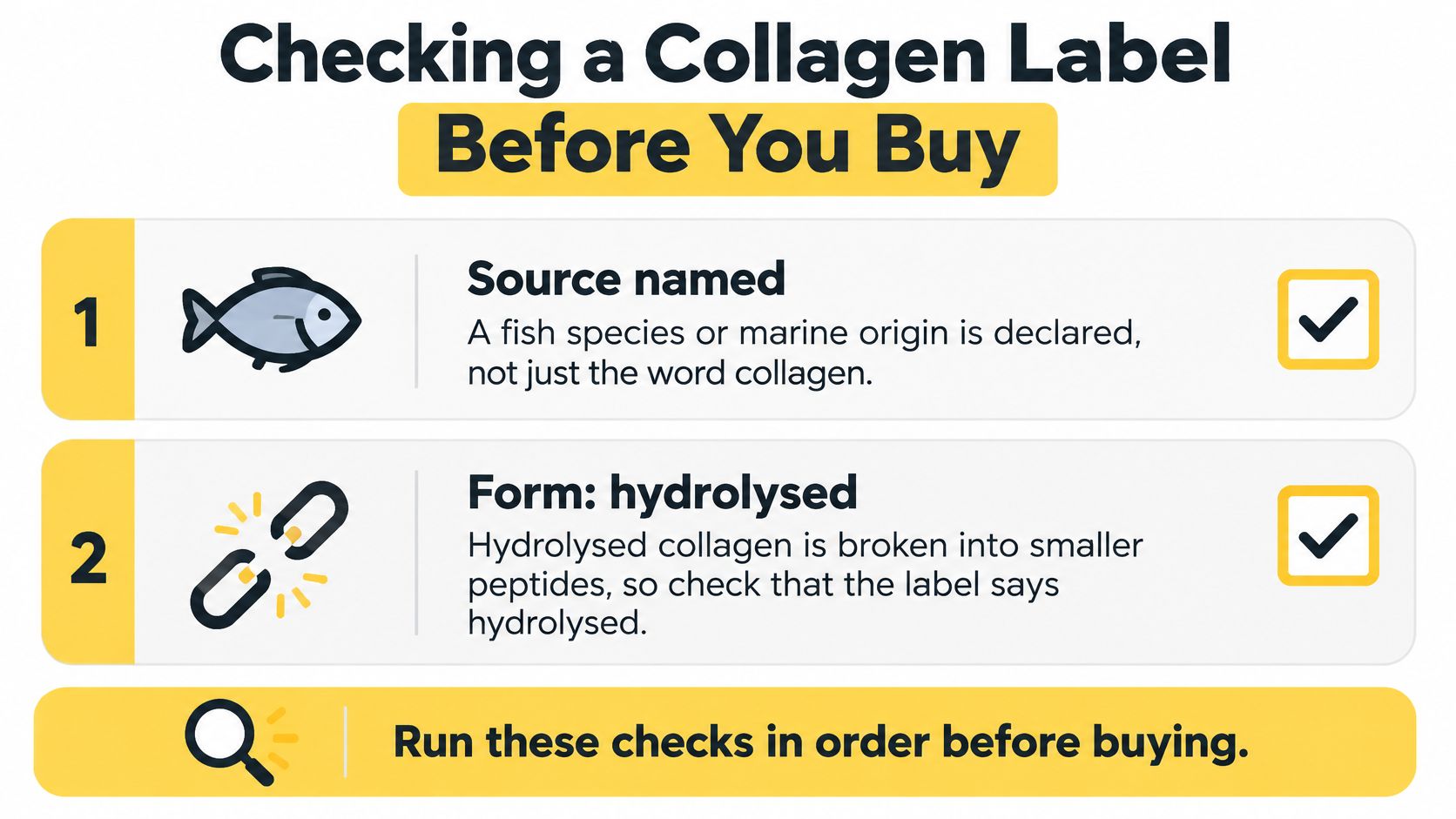
Work through the same fields for each product, in the same order. That keeps marine, bovine and porcine options comparable and stops marketing language from filling gaps.
Use the checklist as the comparison sheet. Columns for source, peptide grams, added ingredients, allergens and evidence are enough for a first pass. Where a seller gives only total powder weight, leave the peptide amount unresolved. Do not convert pack size or protein content into a collagen dose by assumption.
A blend with collagen plus other ingredients should be assessed as that blend. Protein on a nutrition panel may include protein from ingredients other than collagen, so it cannot stand in for the labelled peptide amount. For value, compare price against the stated peptide amount per serve rather than tub size. Keep that calculation separate from dose selection: a larger amount is not automatically the amount you need.
The practical conclusion is simple. If the source, dose or allergen information is missing, the product stays off the final shortlist until those details are clear. Our guide to choosing the best collagen supplement in Australia offers another way to organise that shortlist once the label checks are done.
| Situation | Lean towards | Reason to check |
|---|---|---|
| Fish allergy | Bovine or porcine collagen peptides, subject to full label checks and appropriate advice | Marine collagen carries fish-allergen risk |
| Avoiding bovine products for dietary or personal reasons | Marine collagen if fish suits your diet | A source preference, not proof of better results |
| General skin or joint goal without a source restriction | Choose on dose, relevant evidence and quality controls | Source alone doesn't decide outcomes |
| Mixing into coffee or smoothies with a plain taste | An unflavoured powder, including a suitable marine option | Check added vitamin C and hyaluronic acid against your goal |
| Chocolate drink | A suitably flavoured mix, marine or otherwise | Check added sugar and carbohydrate per serve |
| Vegan or fish-free diet | Vegan, neither; fish-free, consider suitable bovine or porcine products | Vegan and fish-free are different dietary requirements |
Fish allergy makes fish-derived collagen an unsuitable starting point. A terrestrial animal source still needs a finished-product assessment rather than an assumption of safety.
Avoiding bovine ingredients is a valid reason to choose marine collagen. You don't need to attach an unsupported absorption advantage to justify a dietary preference.
For a general skin or joint goal, ask for evidence relevant to that outcome. Neither an attractive source story nor added ingredients establish that the finished product has been tested for your intended use.
An unflavoured powder may fit an existing coffee or smoothie routine, but that convenience doesn't require fish-derived collagen. Chocolate flavour is also a formulation choice, not a property of marine origin.
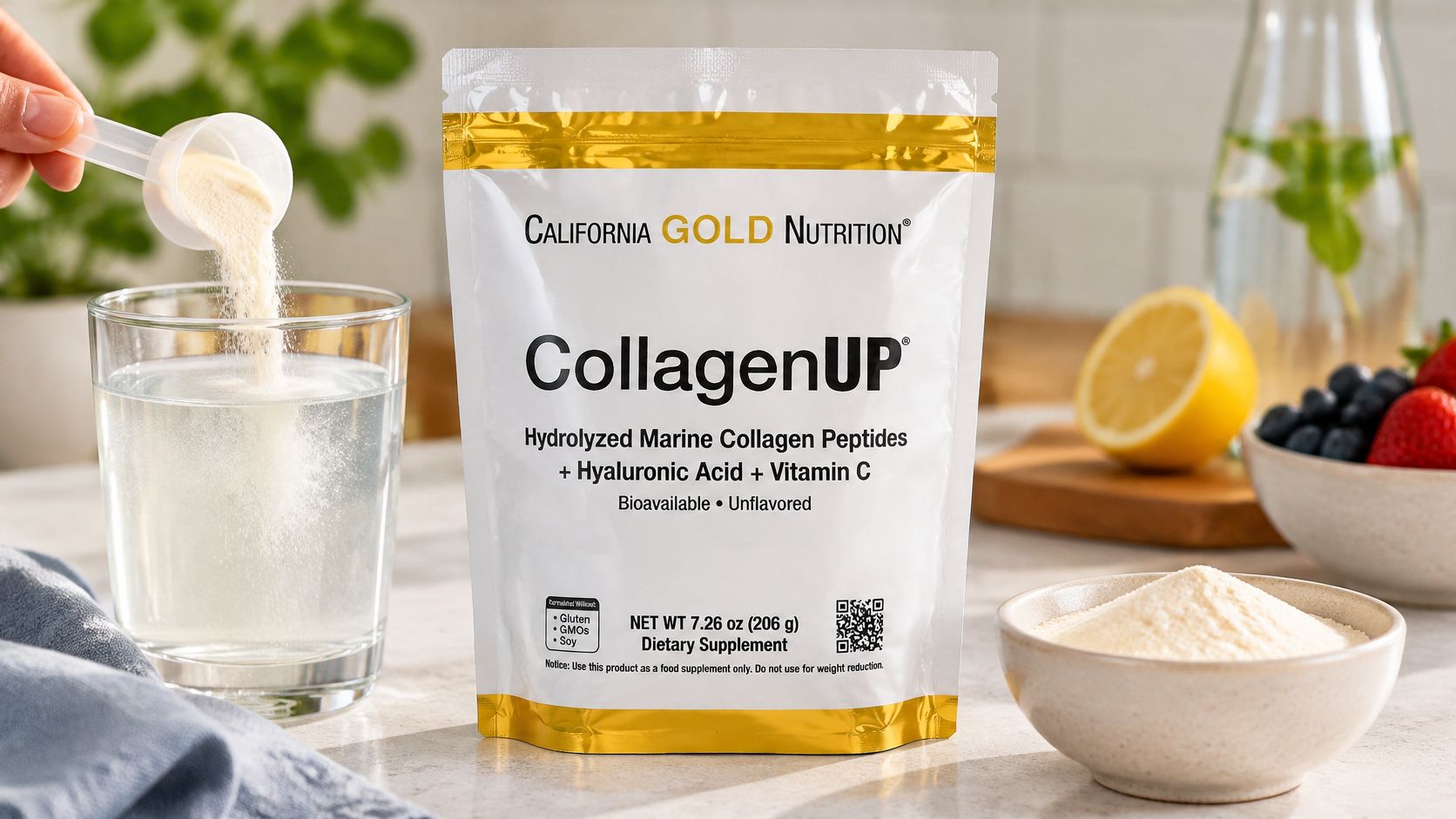
One concrete combination is California Gold Nutrition CollagenUP® Marine Collagen Peptides with Hyaluronic Acid & Vitamin C, an unflavoured powder combining hydrolysed marine collagen peptides, hyaluronic acid and vitamin C. It illustrates why you should compare the complete ingredient list rather than treat every marine powder as the same product.
The dietary distinction in the final row matters. Fish-free doesn't mean animal-free. Someone avoiding fish may still accept cattle- or pig-derived collagen, whereas someone avoiding all animal ingredients should choose neither.
Use source to satisfy your restrictions and preferences. Use product-level evidence to assess performance claims, and don't let taste or convenience stand in for either check.
Finish with a decision you can explain from the label, not a ranking based on the word marine. Keep the shortlist small enough that missing serving, source or allergen information can be resolved before ordering.
Use the label checklist as the final filter. Check the declared peptide amount per recommended serve, then compare that figure against the other products still in contention. Scoop size, tub weight and a larger-looking serving do not answer the dose question. Increasing the labelled amount to copy a trial is a separate decision that needs professional advice.
Apply the dietary checks from the checklist only where they affect the remaining products. Allergen declarations and sourcing statements should be read against the actual formulation, including any added ingredients. Products supplied as Australian therapeutic goods should be assessed under the labelling that applies to that category, while foods should be read as foods.
Personal suitability also belongs at this stage. Pregnant or breastfeeding readers, people taking prescription medicines and people managing a health condition should speak with a doctor or pharmacist before starting. Take the full ingredient list and proposed daily serving, so the discussion covers the product being considered rather than collagen in general.
A practical comparison is simpler than it looks. If one product declares 2.5g hydrolysed collagen peptides per serve and another declares 5g, the second provides twice the labelled peptide amount per serve. That does not make it automatically better, because the evidence for the intended outcome still matters. It does show why "marine" alone cannot settle the choice.
If the peptide amount is undisclosed, dose comparison stops there. If the source is unclear, dietary fit cannot be judged reliably. If the allergen information leaves a material question open, waiting for clearer product information is more defensible than treating uncertainty as a safety test.
You also don't need to buy collagen just because a preferred source exists. Marine is a source, not a superior form, and a clear label should carry more weight than a broad superiority claim.
Our Supplements category includes Collagen & Beauty alongside Vitamins & Minerals, Gut & Digestive and other supplement categories. Visit Wallaby Wellness to shortlist collagen options, compare their listed ingredients and serving information side by side, and resolve source or allergen questions before ordering.