Marine Collagen vs Bovine Collagen: A 2026 Comparison
, 17 min reading time
Marine collagen vs bovine collagen compared by source, forms, dietary needs and label checks, with what the evidence does and does not show.
The most repeated advice in the marine collagen vs bovine collagen debate is to pay more for marine: smaller peptides, better absorption, a cleaner and greener story. Treat that as marketing until a label proves otherwise. Peptide size is set by how a manufacturer hydrolyses the raw material, not by whether the animal swam or grazed, and a fish-derived ingredient isn't automatically Australian, low-impact or more tightly regulated.
What separates a good collagen product from a mediocre one is a short list of specifications: grams of collagen peptides per serve, collagen type, degree of hydrolysis, allergen and species disclosure, contaminant testing, and the exact wording of the claim on the pack. Source sits on that list, but it sits near the bottom. Once you sort products by those factors, plenty of bovine powders outrank plenty of marine ones, and the reverse is just as common.
A quick side-by-side view helps, provided it stays honest about what each factor decides. Marine and bovine collagen differ in animal origin, the collagen types they typically supply, their allergen profile and their fit with different diets. In Australia, both are assessed through the same regulatory lens: an oral product promoted for skin, hair or nails is judged on its claims rather than its species.
The practical differences are narrow enough to fit on one chart.
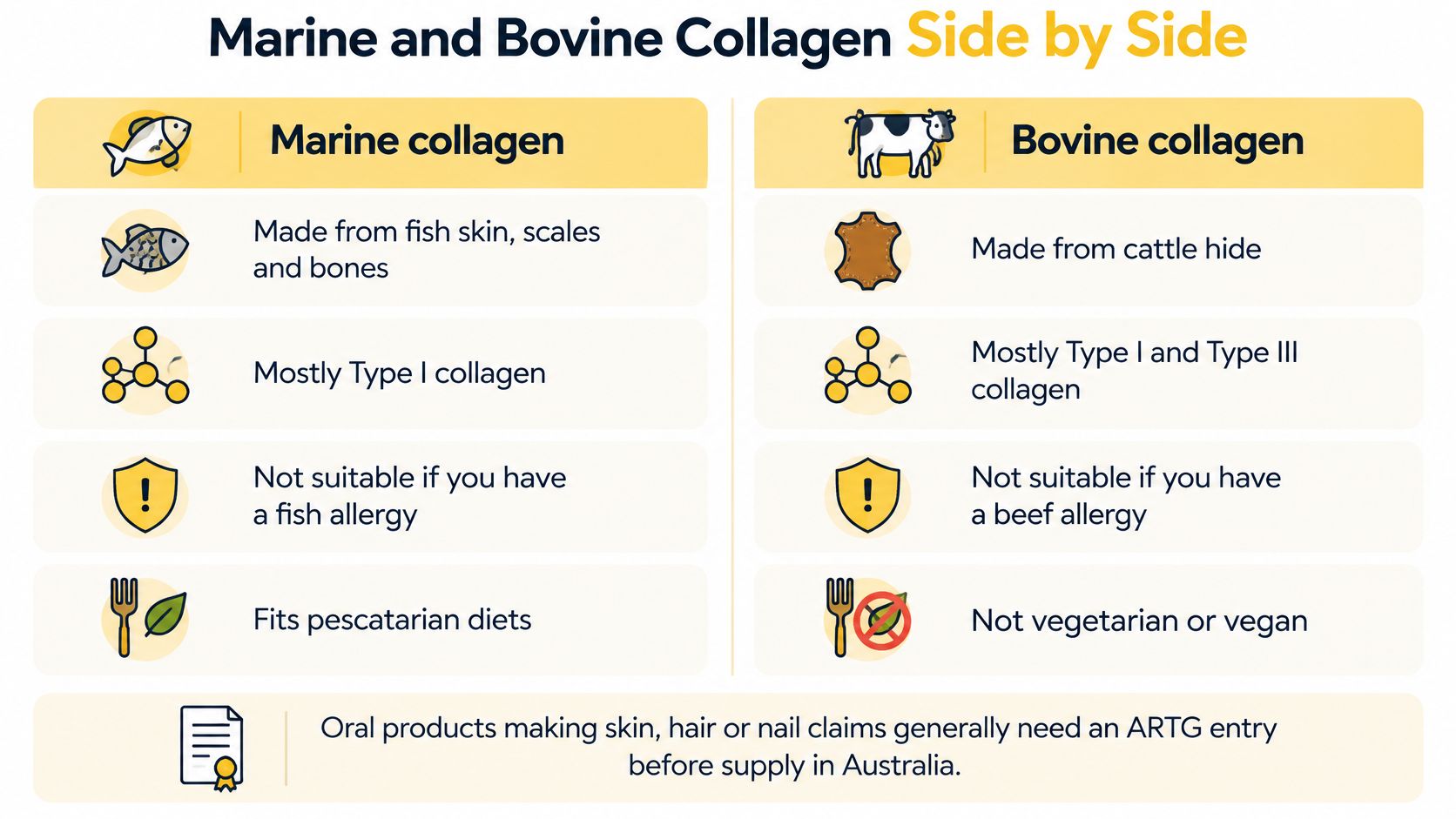
| Factor | Marine collagen | Bovine collagen |
|---|---|---|
| Animal source | Fish skin, scales and bones | Cattle hides and bones |
| Typical collagen types | Mostly Type I; some blends add Type III | Types I and III |
| Allergen flag | Fish; name the species on the label | No fish allergen; check other ingredients |
| Imino-acid content per 1,000 residues | 178–214 | 215–225 |
| Dietary fit | Suits pescatarians | Not suitable for vegetarians |
| Regulatory status | Set by claims, not by source | Set by claims, not by source |
The imino-acid row is useful context, not a buying verdict. Those figures describe compositional differences between marine collagen and bovine collagen sources and dietary suitability, but they do not show that one source automatically works better in a finished supplement. Hydrolysis, dose and product formulation sit between the raw material and the scoop.
Some rows in that table are hard filters, and they come before any comparison of peptide quality. A fish allergy or a choice to avoid seafood rules out marine collagen, whatever the formulation looks like. Vegetarian diets rule out both sources, because collagen comes from animals. Those are diet and safety boundaries, not rankings of which animal is superior.
That leaves a more useful shopping question: which product tells you the most about what is in it? A marine powder with a named species, a stated peptide dose and published testing gives you more to assess than a bovine powder hidden inside a vague blend. The reverse also holds. A well-documented bovine product can be the clearer choice beside a marine product that says little beyond the word "marine". Our guide to choosing the best collagen supplement in Australia works through that product-level comparison in more detail.
Practical rule: use the animal to rule products out, then use the label to choose between the ones left.
"Marine" tells you the ingredient came from a fish. It doesn't tell you which fish, from which fishery, processed in which country, or whether that fish was caught for its skin. Those are the questions that decide whether a marine product deserves its environmental halo.
There's a real circular-economy story here, and it's Australian. Swinburne University reported in July 2024 that Australian seafood processing generates up to 90,000 tonnes of waste annually, including heads, tails, guts, skin and scales, and described research converting those by-products into collagen for food, cosmetics and pharmaceuticals. Collagen made from that stream turns a disposal problem into an ingredient.

Bovine collagen has the same structural argument available to it. Hides and bones are by-products of cattle raised for meat, so a bovine peptide powder can also be a waste-derived ingredient. Neither source wins the sustainability point on identity alone.
The honest gap is that almost nobody publishes product-level impact accounting. Which specific collagen has the lowest footprint once you count sourcing, processing, transport, refrigeration, packaging and by-product use is a question the category hasn't answered.
When a label says "sustainable" or "ethical", ask for the sourcing statement behind the word. If the answer is a slogan rather than a species, a country and a by-product claim, you've learned something about the brand.
Raw collagen is a long, tightly wound triple helix, and in that form it will not dissolve in your morning coffee. Manufacturers use enzymes to cut it into short chains, and those hydrolysed collagen peptides are what almost every powder, capsule and drink contains. Hydrolysis makes the supplement mixable, and it also erases much of the practical difference between fish and cattle.
The compositional difference people cite is real, though narrower than the marketing suggests. Proline and hydroxyproline, grouped as imino acids, stabilise the triple helix and set its thermal resistance. A review hosted by James Cook University reports that marine collagens carry measurably fewer imino-acid residues per unit of protein than mammalian collagens, including bovine sources. The same pattern holds for alanine: fish values shift with the species and overlap with typical bovine values rather than sitting in a separate category. The two sources differ on the label more consistently than they differ in a gram-for-gram amino acid comparison.
Fewer imino acids means a less thermally stable helix, so unhydrolysed marine collagen denatures more readily than unhydrolysed bovine collagen. That matters if you are formulating a scaffold, a film or anything else that faces heat and mechanical stress, where bovine material is the sturdier starting point.
It matters far less in a tub of powder stirred into a cold smoothie. Once enzymes have chopped the helix into peptides, the source-dependent denaturation temperature stops governing how the product behaves in your glass. Peptide-size distribution and processing conditions take over, and both are set in the factory rather than fixed by the animal. A gently hydrolysed marine powder can outperform a harshly processed bovine one, and vice versa, which is why origin is a weak predictor of peptide quality on its own.
If a supplier wants your business, four documents tell you more than any origin story:
Composition tells you what the protein contains, not what the finished product does. Once both materials are enzymatically hydrolysed into peptides, absorption and physiological activity depend on peptide-size distribution, processing conditions, dose and product quality rather than origin alone, so none of the four documents above proves a clinical outcome by itself. What they do is narrow the field to products that can show their working, and that is a filter a marine or bovine claim cannot provide on its own. If your goal is essential amino acid coverage rather than connective-tissue support, the comparison you want is a different one, such as our breakdown of plant protein vs whey.
Format affects the daily dose more reliably than species does. A well-made marine powder and a well-made bovine powder with similar hydrolysis will mix into cold water in much the same way. The practical decision is therefore about routine, dose clarity and what else comes in the serving. Compare those details before treating the animal source as the deciding factor.
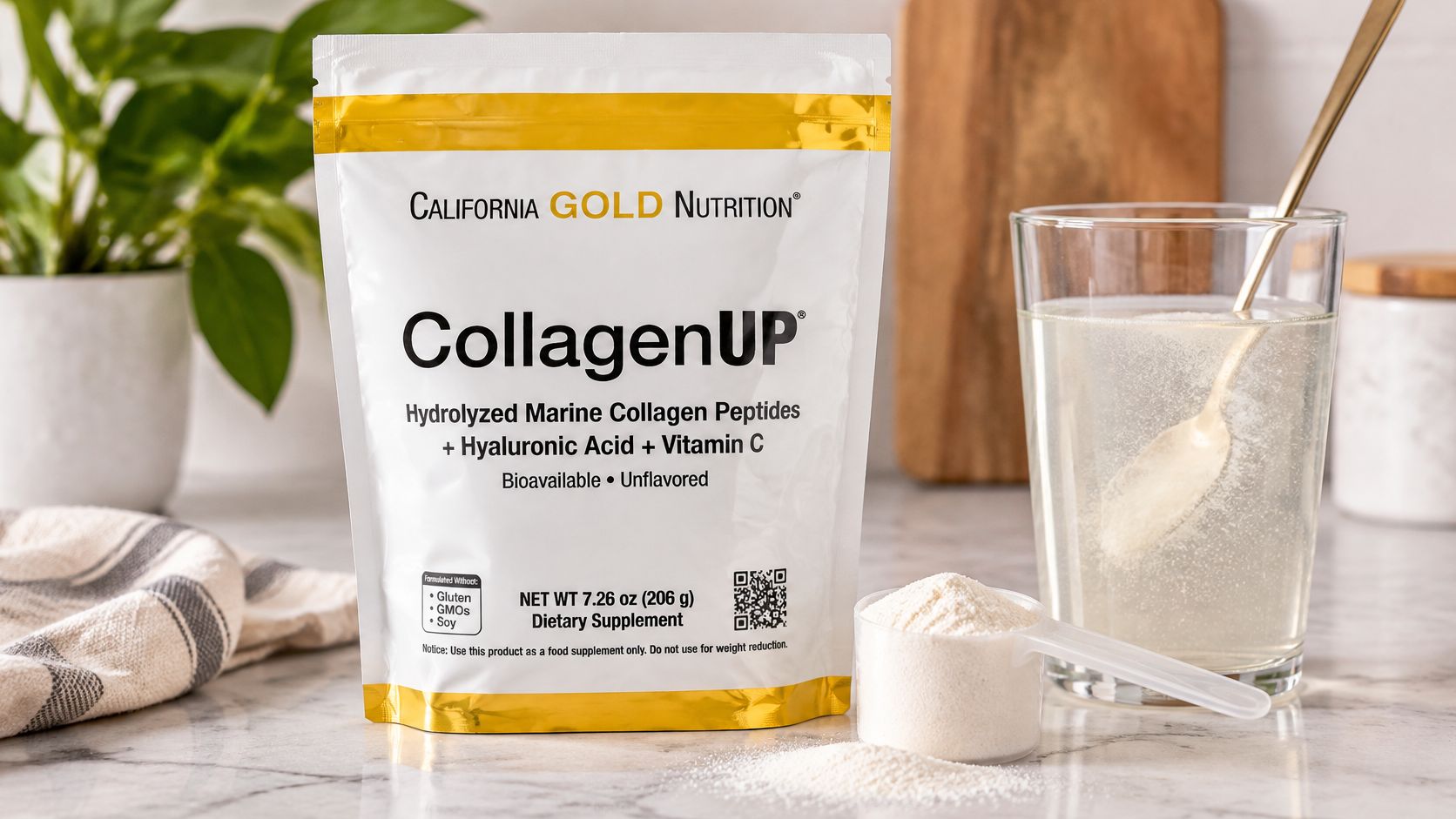
Unflavoured peptide powders are the default for both sources, stirred into coffee, smoothies or water. They usually give you the clearest read on dose, because a single-ingredient powder has nowhere to hide a small serving. Read the scoop size in grams, then check that the grams listed are collagen peptides rather than total powder weight including flavour and sweetener. That distinction matters more than whether the tub says marine or bovine.
Capsules and tablets deliver a measured dose with no mixing and no taste, which suits travel and people who won't stir a powder into anything. The trade-off is arithmetic: a capsule holds a fraction of what a scoop holds, so matching a powder dose can mean several capsules a day. Check the shell too, since bovine gelatine capsules undo a decision to avoid cattle. A capsule can look precise, but the dose per day is what makes it comparable.
Collagen bars and ready-made drinks bring other proteins, sugars and fats along with them. That can be reasonable as a snack, but the collagen per serve is often modest and the label may not separate it from total protein. If you're taking collagen for a specific dose, a bar is a convenience product rather than a reliable delivery method. For a closer look at how liquid and powder formats stack up in practice, Skin Perfection on collagen formats is a useful companion read.
Combination products pair collagen with vitamin C, hyaluronic acid, biotin or MSM. These formulas can be useful when the extras are ingredients you intended to buy anyway. They become less efficient when the added compounds are the reason the product looks more impressive than the collagen dose warrants.
California Gold Nutrition CollagenUP® Marine Collagen Peptides with Hyaluronic Acid & Vitamin C is an unflavoured powder that combines hydrolysed marine collagen peptides with hyaluronic acid and vitamin C in one scoop. It shows how format and added ingredients can change the purchase decision without changing the basic source question. Marine origin does not by itself prove better sustainability, an Australian source or a stronger result, and Australian regulation applies to these products in the same way it applies to bovine options. The label still carries the useful evidence.
Compare any two formats with three numbers: grams of collagen peptides per serve, cost per serve in Australian dollars, and everything else in the serve. A combination product only wins if you'd otherwise buy those extras separately.
Dietary fit starts with the ingredient list, not the animal. Marine collagen is fish-derived, so a fish allergy rules it out unless the specific product states otherwise. Bovine collagen avoids fish allergen exposure, but it remains cattle-derived, which matters for vegetarians and shoppers following religious dietary rules that restrict beef. Certification should be checked on the exact product, because a brand-wide assumption can miss flavour variants, shared equipment and processing aids.
A pescetarian can use marine collagen when the source and by-product handling are clear, while neither source fits a vegan diet. Hidden ingredients also matter. A flavoured blend may bring dairy or soy into the serve, and a capsule or powder may include other allergenic excipients. The source animal answers one question, then the full label answers the rest.
The most common nutritional mistake is treating a collagen scoop as interchangeable with a protein scoop. A dietary-protein analysis published in the National Library of Medicine's PMC archive found that a dietary-protein analysis published in the National Library of Medicine's PMC archive reported about 39% collagen for both bovine and marine collagen peptide samples under the evaluated protein-quality calculation, with tryptophan identified as a limiting amino acid for the marine sample and cysteine plus methionine for the bovine sample.
Those limiting amino acids explain the practical trade-off. Collagen is a specialised connective-tissue protein with an unusual amino acid profile, not a complete protein. It can help add targeted peptides to a routine, yet it should not replace whey, dairy, egg or soy when the goal is broad essential amino acid coverage. For athletes, the cleaner approach is to keep collagen as an adjunct and meet the main protein target from complete sources. That distinction matters because a scoop can look impressive on a supplement label while still being weak as a general protein serving.
Dose also changes the decision. A skin-focused shopper should compare collagen type and collagen peptides per serve, then ask whether the evidence applies to that exact formulation. A generic story about collagen does not establish the same result for every powder, drink or capsule. If the goal is skin appearance, the amount and composition in the finished product matter more than the marketing category.
Talk to your GP or pharmacist first if you're pregnant or breastfeeding, managing a kidney condition, on a restricted-protein diet, taking regular medication, or considering collagen for a child. Those situations change the risk calculation before source preference does. After those checks, a supplement order can also qualify for free shipping on orders over $150 AUD year-round with code FREE150.
An oral collagen product promoted for improving the appearance of skin, hair or nails is generally a therapeutic good in Australia. The Therapeutic Goods Administration's register entry 318054, recorded on 29 May 2019 for a product containing hydrolysed collagen, vitamin C and biotin, shows how that framework applies in practice: unless an exemption applies, such products must be entered in the Australian Register of Therapeutic Goods before they can be imported, supplied or advertised here.
Marine products sit in the same system. The TGA's ARTG search records Bioglan Marine Collagen Peptide Booster with an ARTG date of 2 September 2021, alongside later collagen entries. Source created no separate regulatory lane, and a marine powder made from imported fish skin is no more Australian, and no greener by default, than a bovine one. Both answer to the same register.
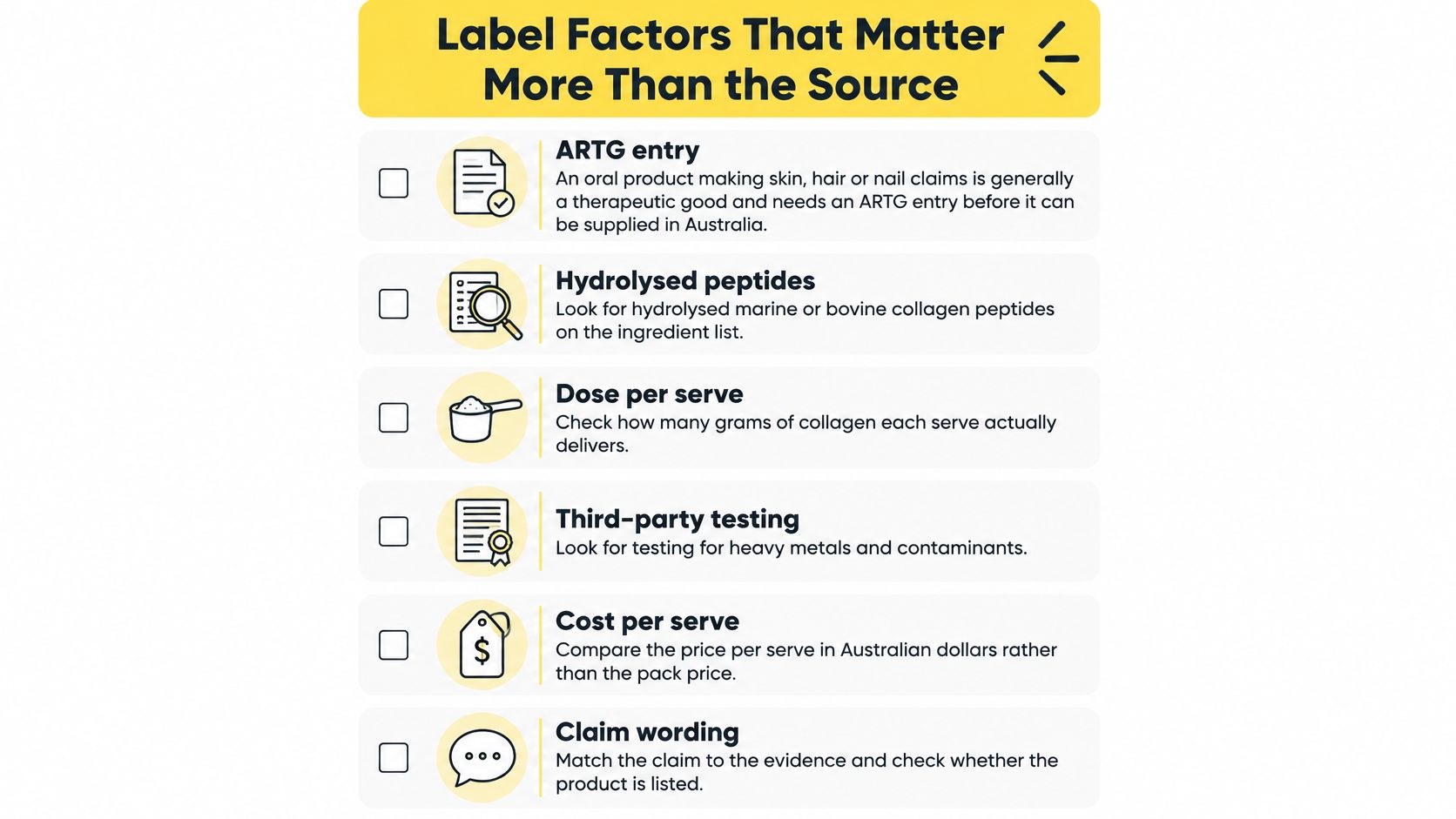
| Label factor | What to look for | Red flag |
|---|---|---|
| ARTG entry | Entry number traceable on the TGA register for the exact product | Brand name only, no product entry |
| Collagen type | Type I, Type III or both named | Only 'collagen' with no type |
| Hydrolysis and molecular weight | Degree of hydrolysis and peptide size stated, ideally batch-tested | 'Hydrolysed' with no detail |
| Dose per serve | Grams of collagen peptides per serve | Proprietary blend hiding collagen grams |
| Allergen and species statement | Fish species named for marine; cattle origin stated for bovine | Fish-sourced product with no allergen warning |
| Claim wording | Specific claims tied to the product and its evidence | Vague promises such as 'beauty from within' with no evidence |
| Contaminant testing | Heavy metal and microbial results available | No testing information for a marine product |
Work down that table in order, because the first row can end the search. An ARTG entry belongs to a specific product, not to a brand, so a company with one listed item isn't vouching for everything else it sells. Search the register for the product name on your tub, and treat a mismatch as a stop.
The dose row catches the most common quiet failure. A blend that lists collagen alongside hyaluronic acid, biotin and vitamin C without separating the grams leaves you unable to compare it with anything, including a cheaper single-ingredient powder. Ask for the collagen figure per serve, and if the answer isn't forthcoming, you're buying a story. Our article on why collagen supplements don't work covers the formulation and dosing gaps behind disappointing results.
The animal on the front of the tub tells you where the protein started. The label tells you whether the product can back its claims. Only one of those is evidence.
Once allergy and diet have narrowed your shortlist, the remaining work is comparing specifications line by line. Browse the collagen and beauty collection at Wallaby Wellness, check the grams of collagen per serve against the products you're considering, and pick the one whose label answers the most questions.