Health Properties of Zinc: Roles, Foods and Safe Intake
, 16 min reading time
Discover the health properties of zinc: immune support, wound healing, cell growth, daily intake, food sources and supplement safety for Australians.
If zinc helps your immune system, why wouldn't taking more make you healthier? The missing piece is that getting enough zinc and taking extra zinc aren't the same thing. Your body needs a steady dietary supply, but concentrated products can add up in ways that aren't obvious from any single label.
The health properties of zinc make more sense when you start with its everyday jobs inside cells, rather than promises on supplement packaging. Food intake, absorption and total exposure all matter when deciding whether zinc is helping or creating an avoidable risk.
Some of the proteins that read your DNA can only do their job because a zinc ion holds them in the right shape. These structures, called zinc fingers, let proteins grip specific stretches of genetic code and switch gene activity up or down. That single detail captures zinc's wider job: it sits inside cellular machinery, helping enzymes run chemical reactions and keeping proteins correctly folded.
Zinc supplies no energy the way carbohydrate or fat does. Its value lies in the work it enables inside cells, which is why low intake can show up in several places at once.
The effects of inadequate zinc can overlap with many other health problems. Use the examples below to understand its roles. None of them is a reliable way to diagnose yourself.
| Body process | Role of zinc | Where you notice it |
|---|---|---|
| Immune defence | Supports development and activity of immune cells | Low intake can impair normal immune responses |
| DNA and protein synthesis | Helps enzymes copy DNA and build proteins | Growth and tissue repair require an adequate supply |
| Cell division | Helps cells divide and renew, including skin, hair and gut lining | Deficiency can affect tissues that renew regularly |
| Wound healing | Supports tissue repair after injury or surgery | Inadequate zinc can interfere with normal healing |
| Growth and development | Supports developing tissues during childhood, adolescence and pregnancy | Deficiency can impair growth and development |
| Taste and smell | Supports normal sensory function | Changes in taste or smell can occur with low zinc |
| Antioxidant defence | Contributes to proteins involved in protection against oxidative stress | This is a cellular role, not something you can reliably feel |
These are ordinary biological functions that depend on adequate nutrition. None of them appears only when you take a supplement.
The pyramid below ties those cellular jobs back to regular dietary intake.
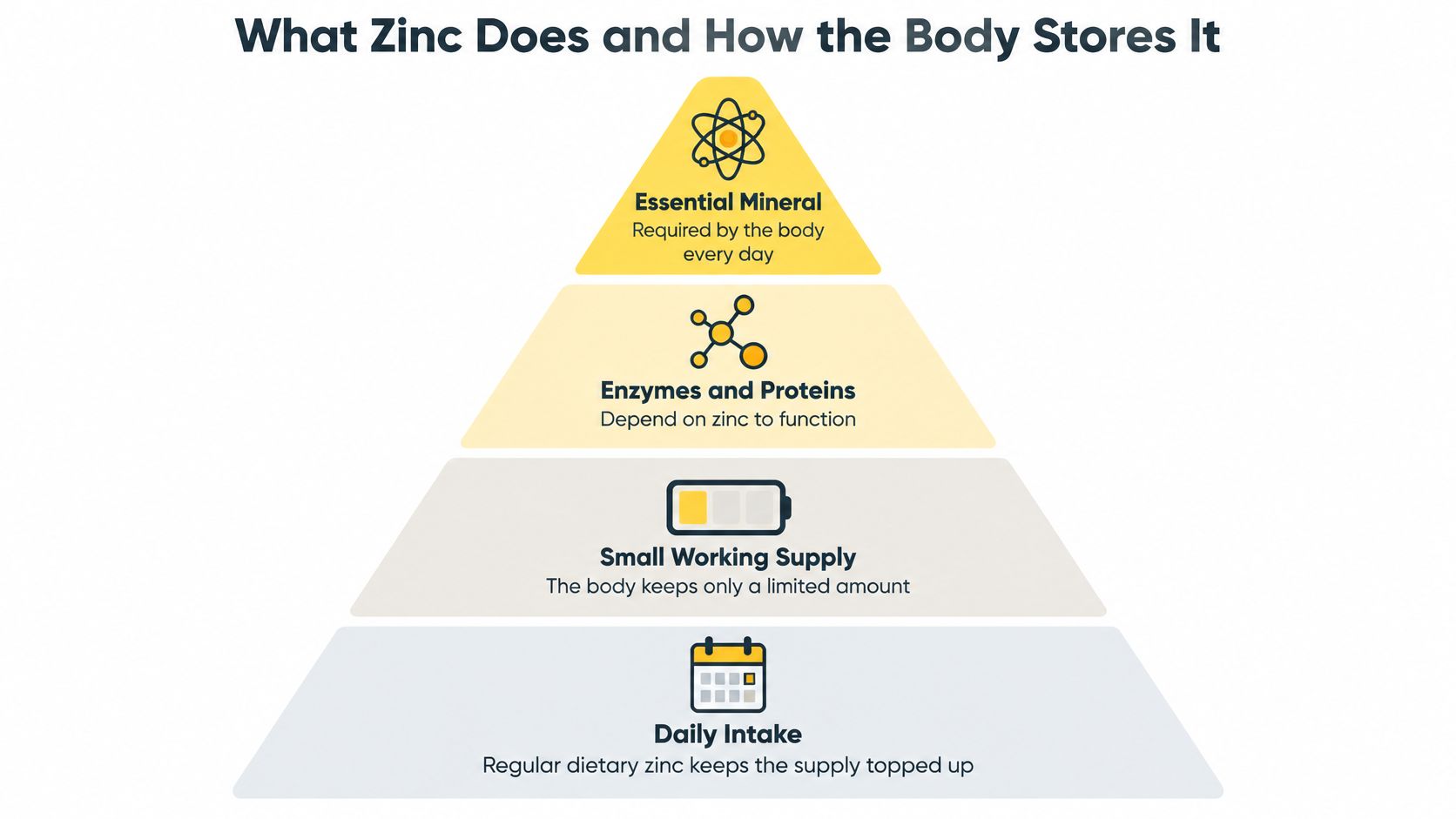
Zinc can help an enzyme complete a chemical reaction or help a protein keep the shape it needs to work. Cells involved in defence, growth and repair share many of the same underlying processes. That explains why a genuine shortage can affect several systems together.
Practical rule: Zinc works best as a steady part of your meals. An occasional large dose cannot compensate for an inconsistent diet.
Zinc circulates through your tissues and does its work there, yet your body keeps no dedicated reserve to draw on later. Past high intake will not cover a weeks-long shortfall. The same logic runs in the other direction, because without a buffer, total exposure counts. A patchy diet can leave you short, while several overlapping supplements can push intake higher than any single label suggests without anyone noticing.
For readers comparing international supplement information, Pumpernickel Health Foods' zinc supplement guidance for UK shoppers offers another consumer resource. Keep the country context in mind, because Australian dietary guidance should remain your reference for local intake decisions.
How much zinc should you aim for each day? The answer depends on age, sex, pregnancy and breastfeeding. Australian nutrient reference values set different targets for these groups, so a single adult figure cannot guide everyone.
A Recommended Dietary Intake (RDI) is the daily amount expected to meet the needs of nearly all healthy people in a group. An Estimated Average Requirement (EAR) is the average amount estimated to meet the needs of half the group. These values help assess intake; they are not a diagnosis based on symptoms.
The figures below are Australian and New Zealand reference values, in milligrams per day. The Upper Level of Intake (UL) is a safety ceiling: treat it as a limit for total intake from food, supplements and fortified products.
| Group | RDI (mg/day) | UL (mg/day) |
|---|---|---|
| Infants, 0–6 months | 2* | 4 |
| Infants, 7–12 months | 3 | 5 |
| Children, 1–3 years | 3 | 7 |
| Children, 4–8 years | 4 | 12 |
| Boys, 9–13 years | 6 | 23 |
| Girls, 9–13 years | 6 | 23 |
| Boys, 14–18 years | 13 | 34 |
| Girls, 14–18 years | 7 | 34 |
| Men, 19 years and over | 14 | 40 |
| Women, 19 years and over | 8 | 40 |
| Pregnancy, 14–18 years | 12 | 34 |
| Pregnancy, 19 years and over | 11 | 40 |
| Breastfeeding, 14–18 years | 13 | 34 |
| Breastfeeding, 19 years and over | 12 | 40 |
*For infants aged 0–6 months, the value is an Adequate Intake rather than an RDI. The Australian Bureau of Statistics explains its use of Australian and New Zealand nutrient reference values, including adequacy measures and upper levels, in its usual-intake methodology.
Use the RDI as a food-planning guide, not as a reason to take a supplement. The UL answers a different question: how much total zinc is considered unlikely to cause adverse effects for almost all healthy people. It is not a target.
Check the amount across all products. A multivitamin, a zinc supplement and a fortified product can each contribute to the daily total, even if no single product seems high.
Life-stage changes can also affect eating patterns. Our guide to perimenopause diet and nutrition looks at how nutrients fit into broader meal planning, without assuming that perimenopause automatically calls for zinc supplements.
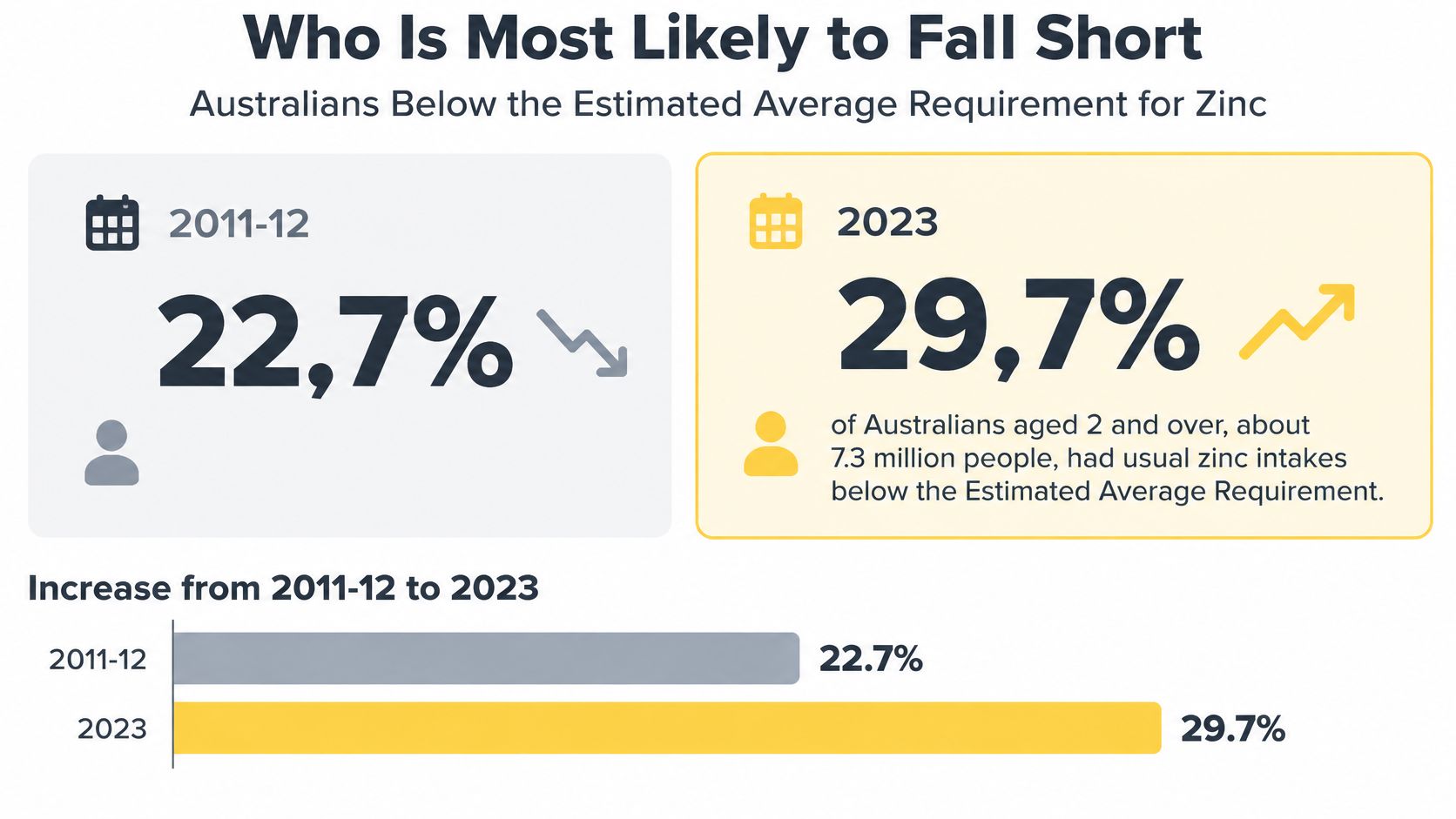
In 2023, 29.7% of Australians aged 2 years and over, approximately 7.3 million people, had usual zinc intakes below their age- and sex-specific EAR, compared with 22.7% in 2011–12, according to the Australian Bureau of Statistics.
That's an important population finding, but it doesn't mean everyone counted had clinically diagnosed zinc deficiency. The estimates describe usual dietary intake, not symptoms, physical examination findings or an individual diagnosis.
The comparison below shows the change in estimated dietary inadequacy.
A vegetarian diet isn't automatically zinc-poor, and eating meat doesn't automatically guarantee adequacy. What matters is the combination of food choices, quantity and absorption.
Dietary review is particularly useful in these situations:
For active adults, training volume alone isn't a reason to assume deficiency. A better starting point is whether meals meet overall nutritional needs and whether recovery products already contain added minerals.
A mild shortfall may not produce an obvious warning sign. More substantial deficiency can affect growth, immune responses, skin, appetite and other functions.
Hair loss, diarrhoea, skin changes and poor healing also have causes unrelated to zinc. Taking a supplement to test a theory can delay assessment of the actual problem.
Persistent symptoms deserve a clinical assessment, not a diagnosis made from a supplement label.
Bring a description of your eating pattern, relevant health conditions and current products to your GP or dietitian. That information is more useful than assuming a national statistic explains your individual symptoms.
Animal foods carry zinc in a form the gut takes up readily, which is why oysters and red meat anchor most zinc-rich eating patterns. Dairy, eggs, legumes, nuts and seeds still contribute, and they give plant-based eaters a workable route to the same target. Regularity matters more than any single food: the body keeps no meaningful zinc store, so zinc works like a daily delivery that has to keep arriving rather than a balance you can bank once.
For adults aged 19–50 years, recommended dietary intake is generally 14 mg/day for men and 8 mg/day for women, while vegetarians may need approximately 50% more zinc than people consuming mixed Western diets, according to the Australian and New Zealand Nutrient Reference Values.
Portion weights and zinc concentrations differ between products, cuts and preparation methods, so record the serve you ate. A reliable Australian food-composition database or a product's declared nutrient information supplies the milligrams. The table below keeps the foods organised by how well their zinc is absorbed.
| Food | Practical serving approach | Absorption note |
|---|---|---|
| Oysters, cooked | Edible portion after cooking | Rich animal source |
| Beef mince, cooked | Weigh the cooked portion | Readily absorbed animal source |
| Lamb, cooked | Edible cooked portion | Readily absorbed animal source |
| Pumpkin seeds | Amount added to the meal | Phytate can reduce uptake |
| Cashews, roasted | Snack portion as eaten | Phytate can reduce uptake |
| Chickpeas, cooked | Cooked, drained quantity | Preparation lowers phytate |
| Cheddar cheese | Slice or grated portion, weighed | Useful dairy source |
| Firm tofu | Drained portion | Plant-food absorption needs consideration |
| Milk | Volume poured | Useful dairy source |
| Egg | Size and edible portion | Contributes alongside other foods |
Zinc from meat, seafood and dairy is generally absorbed more efficiently than zinc from legumes, wholegrains and nuts. The difference comes down to phytate, a naturally occurring compound in plant foods that binds zinc in the intestine and reduces the amount available for uptake. That doesn't make these foods unhealthy or unsuitable, but it does make preparation and variety important.
Soaking, sprouting and fermenting legumes or grains can reduce phytate and improve mineral availability. Use food-safe preparation methods, and cook foods that require cooking rather than treating soaking as a substitute.
A day built around these foods might put pumpkin seeds on breakfast, chickpeas in a lunch salad and tofu, beef or lamb at dinner, with milk, yoghurt or cheese where they suit. Treat that menu as a pattern to repeat across the week: without measured portions and matching food-composition entries, it shouldn't be assigned a precise zinc total.
One distinction matters when shopping for seeds: gardening seeds are not food ingredients. Gift of Seeds Thanks a Bunch is a seed gift meant for planting, so it belongs in the garden rather than in a zinc tally.
More zinc is not automatically more protective. A product marketed for immunity can push total intake higher when it's combined with other supplements. Zinc has no meaningful body store, so regular intake from food and products matters over time.
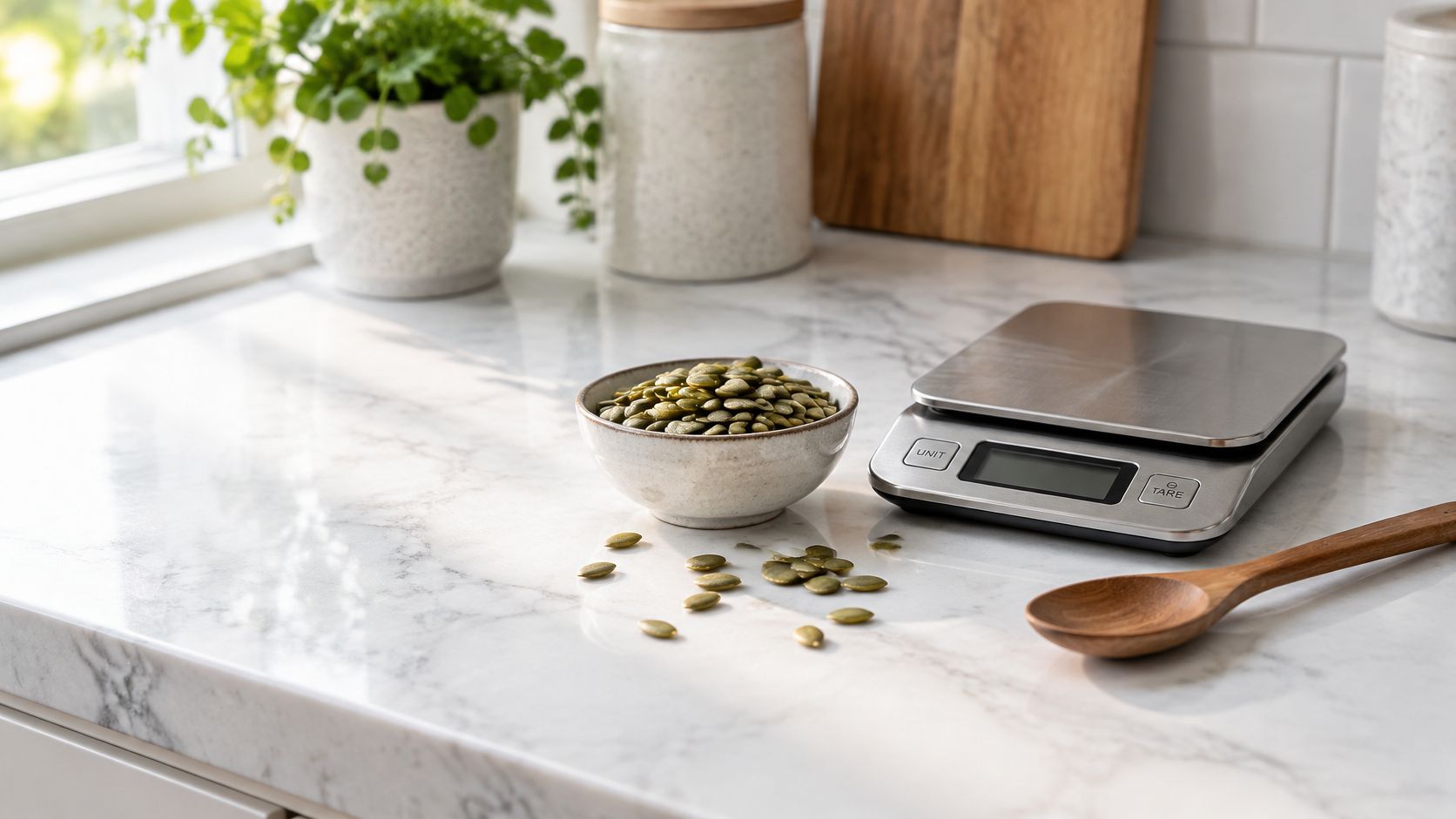
Australian assessment material warns that chronic high supplemental zinc can induce copper deficiency, reduce HDL cholesterol and impair immune function. Intakes around 50 mg/day can compromise copper status, according to the Food Standards Australia New Zealand assessment report.
The report distinguishes zinc naturally present in food, which hasn't been associated with adverse effects, from the risks of sustained high supplemental intake. The practical concern is concentrated zinc taken repeatedly, especially when several products contribute to the daily total.
A multivitamin at breakfast, an immune lozenge during the day and a recovery powder after training can all add zinc. A hair or skin supplement may contribute too, even if zinc isn't what you associate with that product.
Each serving may appear modest. The total across the day, repeated over time, is what matters. Compare ingredient amounts rather than relying on product categories. The same habit helps when comparing minerals, as in this guide to magnesium threonate and glycinate.
The video below offers supplementary education about zinc. Use it alongside the information on product labels and advice suited to your circumstances.
Safety check: Don't add copper yourself to compensate for high zinc intake. Ask a clinician to review the zinc dose and why you're taking it.
Supplement only when you can name the gap it fills. A restricted diet, a diagnosed deficiency and unexplained fatigue call for different decisions, and zinc answers only some of them. Because the body holds no meaningful zinc store, this choice plays out across your daily routine rather than as a one-off course correction.
| Situation | Food-first approach | When to discuss a supplement |
|---|---|---|
| Meat, seafood, dairy or eggs most days | Assess portions and variety before adding anything | Not routinely needed if intake is adequate |
| Vegetarian or vegan diet | Plan legumes, nuts, seeds and appropriately prepared grains | Discuss if intake remains consistently low |
| Pregnancy or breastfeeding | Prioritise zinc-rich foods and prenatal nutrition advice | Discuss individual needs with your doctor |
| Confirmed low intake or diagnosed deficiency | Improve meals, while recognising food changes may not be sufficient | Use a clinician-set dose and review plan |
| Heavy regular sweating or intense training | Check dietary intake and existing recovery products | Discuss rather than stacking several formulas |
| Taking antibiotics or other medicines | Check compatibility before adding zinc | Ask a pharmacist about interactions and timing |
Zinc can interfere with the absorption of some medicines, including some antibiotics. A pharmacist can advise on the specific medicine and zinc product, which is safer than guessing a separation interval or stopping prescribed treatment.
If supplementation is appropriate, look for the declared elemental zinc per serving. The weight of a zinc compound is not necessarily the amount of zinc it provides.
Ask how long to take it and when to reassess. A useful supplement plan has a purpose and a review point, rather than an open-ended instruction to keep purchasing.
For broader consumer reading, you can explore the benefits of zinc capsules from Peak Performance. Treat benefit-focused information as a starting point for questions, not proof that capsules suit your circumstances.
Our discussion of why collagen supplements don't work offers another look at how easily supplement expectations can outrun evidence. For zinc, the deciding question remains whether the product addresses a genuine need.
Frequent colds, slow recovery or skin concerns can justify a closer look at your diet, yet none of them confirms a zinc shortfall on its own. Symptoms overlap with many other causes, and marketing claims are written to sell product, not to assess your intake.
Where your eating pattern shows a consistent gap that better meal planning cannot close, a supplement becomes a reasonable conversation to have with your doctor. Where intake already looks adequate, adding zinc only raises your total exposure without a clear purpose.
At Wallaby Wellness, we offer health foods alongside vitamins and minerals, protein and amino acids, collagen, probiotics, adaptogens, and sleep, stress, weight and metabolism supplements. Visit Wallaby Wellness to compare food and supplement options with your dietary needs and current product labels in hand, and seek professional advice before adding zinc if your intake or safety limits are unclear.