Vitamin D and D3: What the Label Really Means
, 15 min reading time
Vitamin D and D3 explained: how the forms differ, how to convert IU and mcg on labels, and which blood levels and doses matter in Australia.
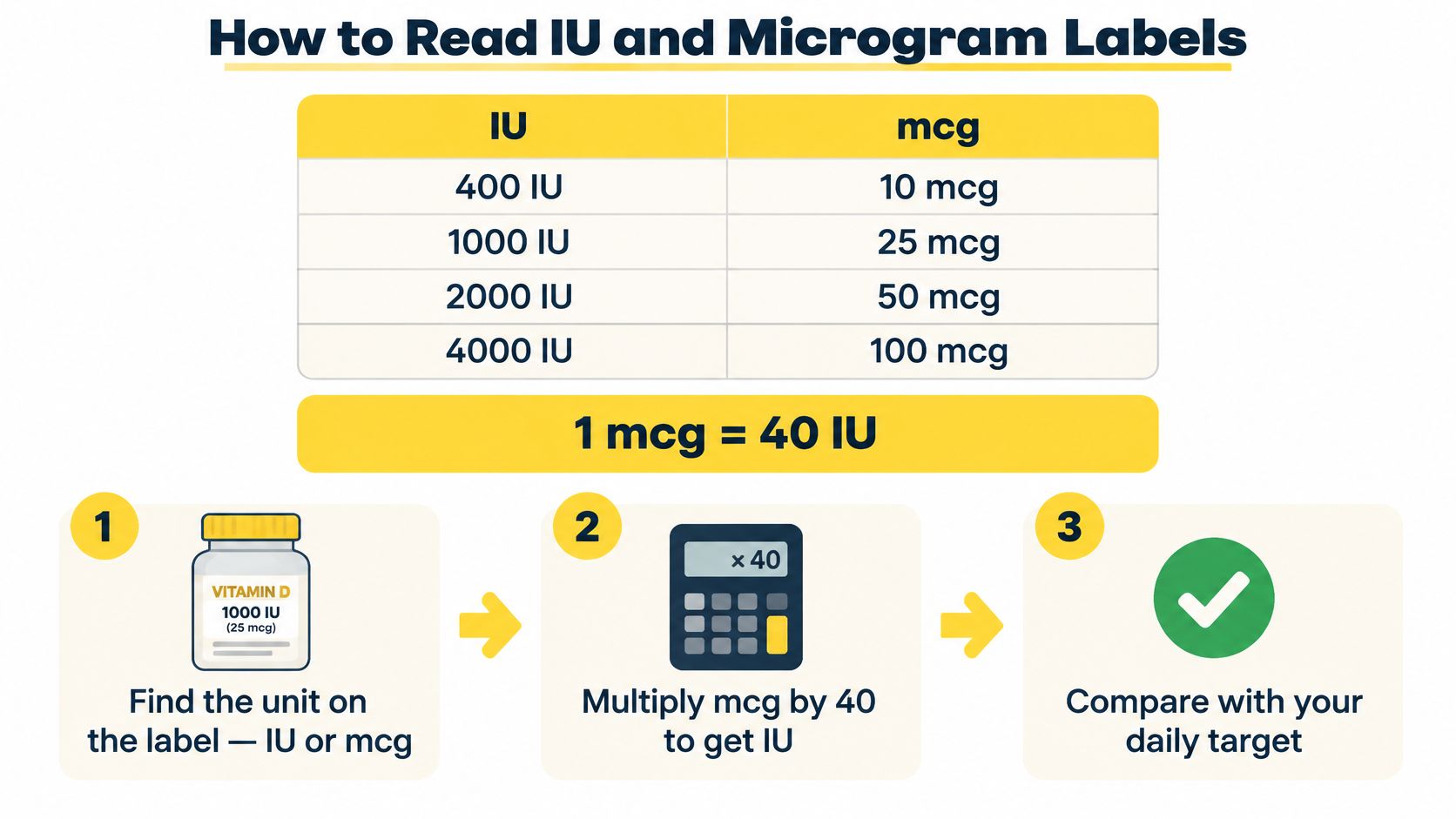
Vitamin D3, or cholecalciferol, is one of the two main forms of vitamin D rather than a nutrient in its own right, and the number that decides whether a product suits you is the dose on the label, not the form name. The units are where confusion often sets in: 1 microgram equals 40 IU, so a 1,000 IU capsule is a 25 microgram dose, and a 50 microgram capsule is 2,000 IU.
So why does a country with this much sunlight produce so many low readings? And why do two bottles on the same shelf, both shouting "vitamin D3" across the front, turn out to be very different products once you do the arithmetic?
The front panel tells you the form. The back panel tells you the dose. Only one of those is a decision you can make without help, and it isn't the one the marketing leans on.
Start with the route, because the names make sense once the route is clear. Vitamin D can arrive from food or a supplement, and vitamin D3 can also start in skin when ultraviolet-B light reaches cholesterol. Either way, the first stop is the liver, which turns D2 or D3 into 25-hydroxyvitamin D, written 25(OH)D. The kidneys then turn that marker into calcitriol, the active hormone that helps manage calcium and phosphate and supports bone mineralisation.
Two inputs feed that same pathway. Vitamin D2 (ergocalciferol) comes mainly from plant and fungal sources, including UV-exposed yeast. Vitamin D3 (cholecalciferol) is usually animal-derived, often lanolin or fish oil, and it is the form made in skin after UVB exposure. Australia's sunshine can start that skin step, but a sunny postcode does not certify the 25(OH)D result; the pathway still has to be fed, processed and measured.
| Form | Also called | Main source | Where it enters the pathway |
|---|---|---|---|
| Vitamin D2 | Ergocalciferol | Plant and fungal sources, including UV-exposed yeast | Diet or supplement, then liver |
| Vitamin D3 | Cholecalciferol | Lanolin or fish oil; also made in skin after UVB | Skin or diet, then liver |
| 25-hydroxyvitamin D | Calcifediol, the blood marker | Made by the liver from D2 or D3 | Liver step; measured in blood |
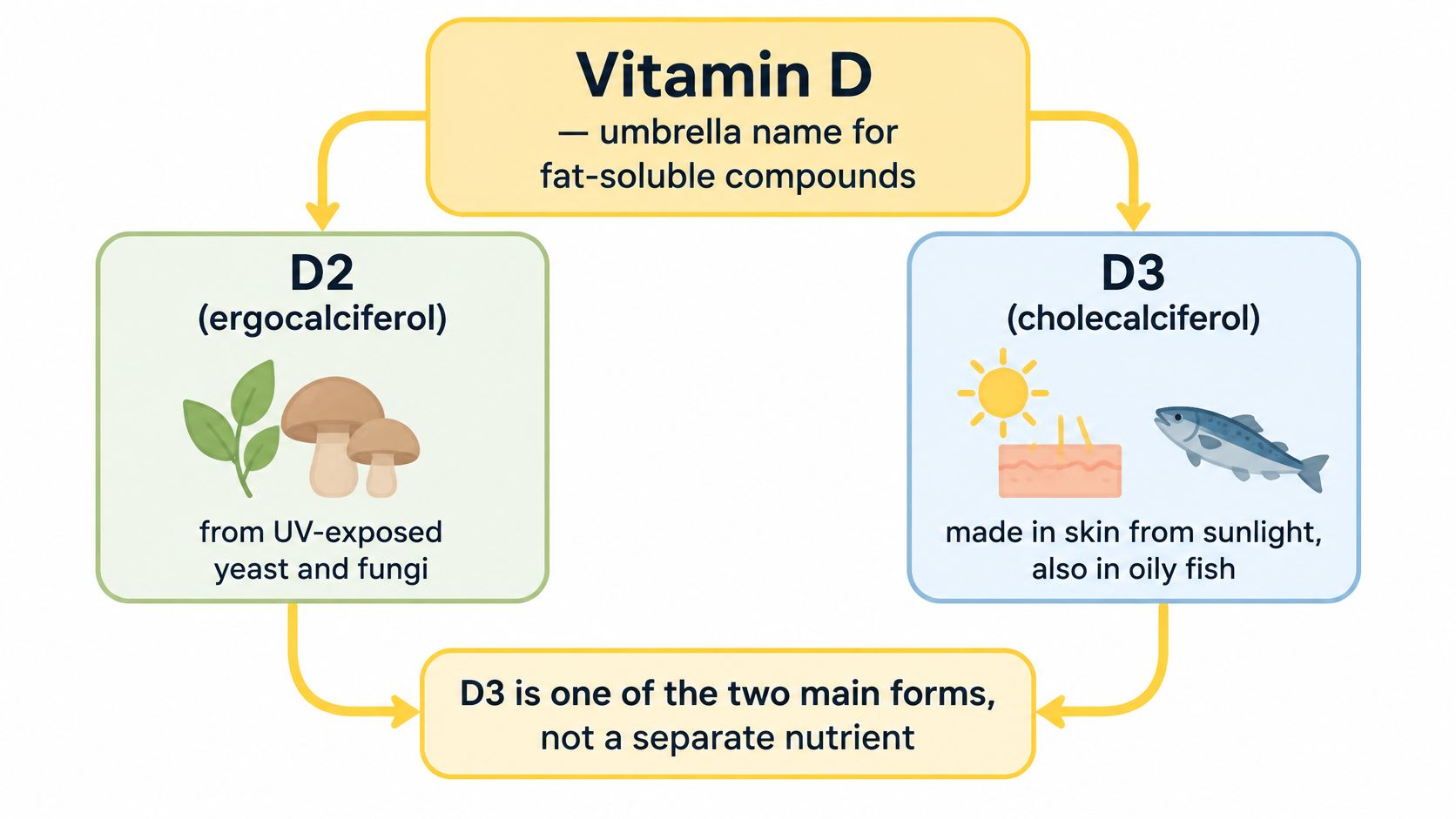
At the shelf, the practical split is simple: the form name tells you which compound is in the capsule, while the amount tells you the dose your body will receive. A bottle marked D3 can hold a small daily amount or a much larger one, so “cholecalciferol” answers the ingredient question and leaves the dose question open. Read the name to know the compound; read the amount to know the decision. For that dose decision, the right target has to come from a person who knows your history, not from the bottle.
Two bottles, same shelf, both saying vitamin D3. One holds 400 IU per capsule and the other 50 mcg. Those are 10 mcg and 2,000 IU respectively, a five-fold gap in dose, and nothing about the form name hints at it. This is the single most common way Australian shoppers accidentally take the wrong amount.
The rule that fixes it: 1 microgram (mcg) equals 40 IU. Divide IU by 40 to get micrograms. Multiply micrograms by 40 to get IU. That's the whole conversion, and it's worth memorising because labels use both units, sometimes on the same panel.
| Label amount (IU) | Equivalent (mcg) | What the reader should note |
|---|---|---|
| 400 IU | 10 mcg | Low dose, below typical treatment amounts |
| 800 IU | 20 mcg | Top of the 700-800 IU a day cited for adults with poor sun exposure |
| 1,000 IU | 25 mcg | Upper end of the 800-1,000 IU range cited for older adults |
One question stays open after all five checks: whether you need vitamin D at all. Older Australian clinical guidance cited in a federal assessment of vitamin D testing recommends approximately 700 to 800 IU a day when sun exposure is inadequate. The slightly higher 800 to 1,000 IU range you'll sometimes see applies to older adults, whose skin produces less vitamin D with age, so the two figures describe different situations rather than disagreeing. Either way, the number that fits you comes from a blood test and a GP or pharmacist who knows your history, not from the shelf. Even in a country with abundant sunshine, a label can't tell you whether your own level is where it should be.
If the arithmetic still feels like guesswork, this short video walkthrough of the IU-to-microgram conversion works through the same steps shown above.
The label-reading habit carries across the supplement aisle. Our guide to choosing a vitamin C supplement in Australia applies the same unit-checking approach, and it's a good test of whether the habit has stuck.
A label describes a capsule. A blood test describes you.
Australia gets plenty of sun, and yet the Australian Bureau of Statistics biomedical results survey found that 23% of adults, approximately 4 million people, had vitamin D deficiency in 2011-12, defined as a serum 25(OH)D below 50 nmol/L. Within that group, 17% sat in the mild band, 6% moderate and less than 1% severe. Sunshine on its own did not settle the question for roughly one adult in four. Most low results land in the mild band, which is reassuring and also a reason not to panic-buy the strongest capsule on the shelf.
A bottle label cannot tell you whether your body is holding enough vitamin D. The same 1,000 IU daily can leave one person comfortably adequate and another still short, depending on starting level, sun exposure, skin, body weight and how well they absorb what they swallow. That is why a number measured in your blood carries more weight than anything printed on the front of the bottle.
| Status | Serum 25(OH)D (nmol/L) | What it means |
|---|---|---|
| Adequate | 50 or above | No deficiency |
| Mild deficiency | 30-49 | Common, usually addressed with a GP review |
| Moderate deficiency | 13-29 | Needs clinical review and a dosing plan |
| Severe deficiency | Below 13 | Needs prompt clinical assessment |
These bands follow the thresholds in the ABS survey, where deficiency begins below 50 nmol/L and severe deficiency sits below 13 nmol/L.
The reference range printed beside your result, because laboratories differ slightly in what they flag. The units, usually nmol/L in Australia, though some reports use ng/mL, where 1 ng/mL equals 2.5 nmol/L. The date the sample was taken, since a winter result and a summer result from the same person can land in different bands.
Say you've been taking 1,000 IU daily through winter and your result comes back at 32 nmol/L. That is mild deficiency. The dose might be too low, it might be fine and the timing wrong, or the issue might be absorption. You cannot tell from the number alone, and doubling the capsules yourself skips the question entirely. A severe result below 13 nmol/L needs prompt clinical assessment rather than self-directed dosing.
Bring three things to a GP or pharmacist: the result with its date, the dose you're taking, and the product itself. Then the plan starts from data instead of a hunch.
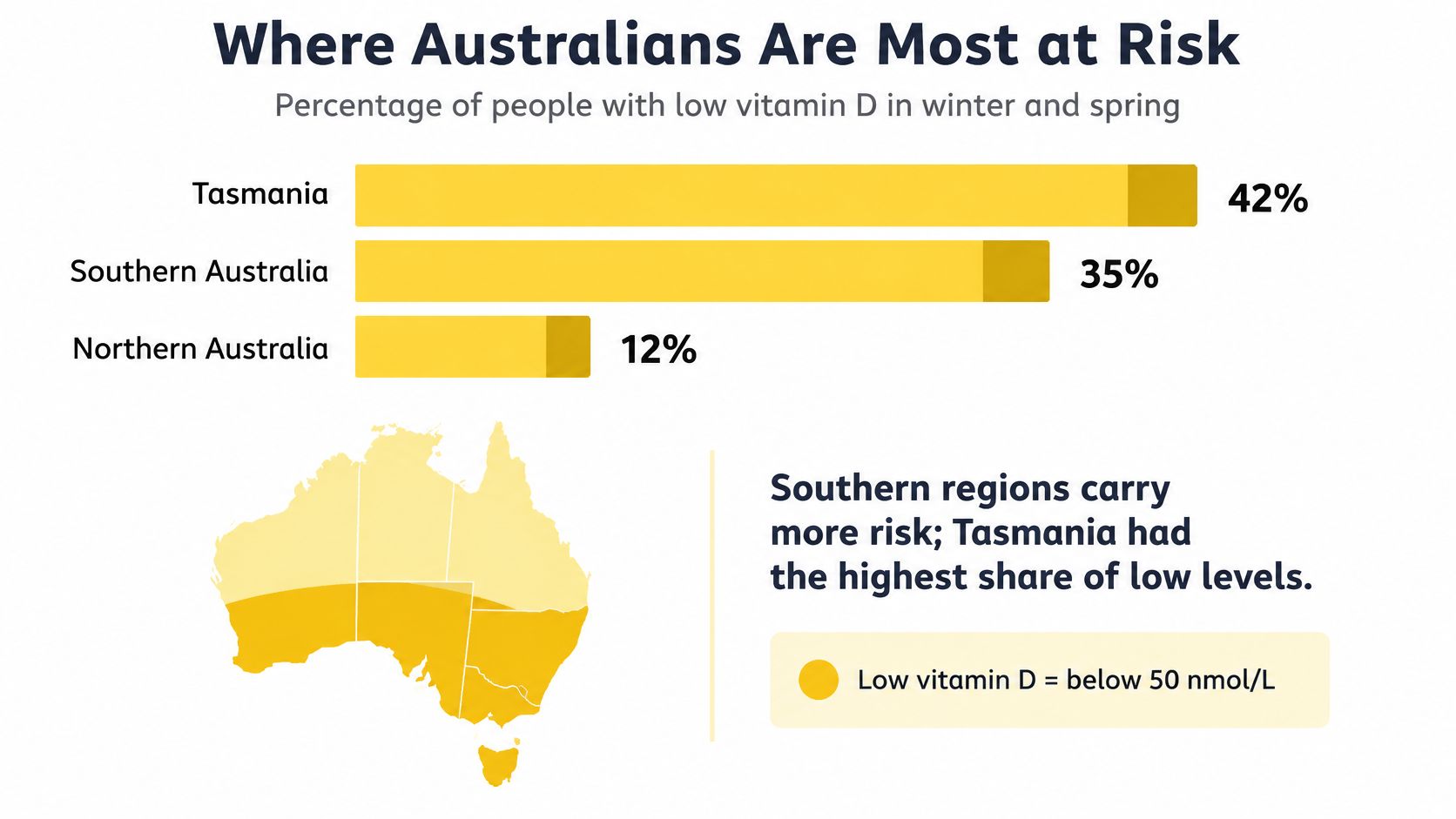
A sunny country can still have people with low vitamin D. In a 2007 multicentre study, researchers measured blood levels in three regions during winter and spring. The proportion of participants at or below 50 nmol/L was 40.5% in southeast Queensland, 37.4% in the Geelong region of Victoria and 67.3% in Tasmania, according to the study published in Environmental Health Perspectives.
| Region | Women below 25 nmol/L, winter and spring |
|---|---|
| Southeast Queensland | 7.1% |
| Geelong, Victoria | 7.9% |
| Tasmania | 13.0% |
Tasmania had the highest share of women below the study's deficiency threshold. Latitude and season help explain the pattern: UVB is weaker in southern winters, so sunshine that supports vitamin D production in January may be less effective in July. Sun exposure also varies with daily routines, clothing and skin pigmentation.
Australian antenatal clinical practice guidance does not support screening every pregnant woman. Testing decisions are risk-based. If several factors apply to you, raise testing with a clinician before choosing a dose.
A 2021 clinical committee report for diagnostic medicine found that vitamin D supplementation has limited clinical benefit for the general population, with support mainly for people at higher risk of deficiency or bone disease. The same report notes blood testing is generally not needed more than once every 12 months, except in circumstances such as chronic kidney disease, osteoporosis, osteopenia or rickets.
That finding works as a triage rule, not a licence to skip testing. Routine re-testing every few months adds little, and a person with no risk factors is not the target audience for a high-strength capsule.
A multivitamin containing vitamin D, a daily glass of fortified milk and a 5,000 IU capsule every morning for a year, chosen because a forum called it the effective dose. Nobody tests. Nobody totals the sources. The number on the label and the number in the bloodstream drift apart.
Excess vitamin D can raise blood calcium, a condition called hypercalcaemia, and severe long-term excess can contribute to abnormal calcification affecting the kidneys and heart. That is why high-strength products belong in a counter conversation rather than a bulk discount.
Each of these lines up with raised blood calcium, the mechanism behind vitamin D excess. Any of them while taking a high dose is a reason to stop and get a blood result, since the symptoms alone cannot confirm the cause.
If you've seen D3 sold alongside another fat-soluble vitamin and wondered why, our explainer on vitamin D and K2 sets out what each one does, because pairing them is a reasonable question rather than a substitute for knowing your own level.
Three habits keep a high dose honest: total every source before you start, put an end date or review date on any amount above maintenance, and never begin one without a blood result in hand. The dose decision itself belongs with a GP or pharmacist.
Six steps, in order, before anything goes in the trolley.
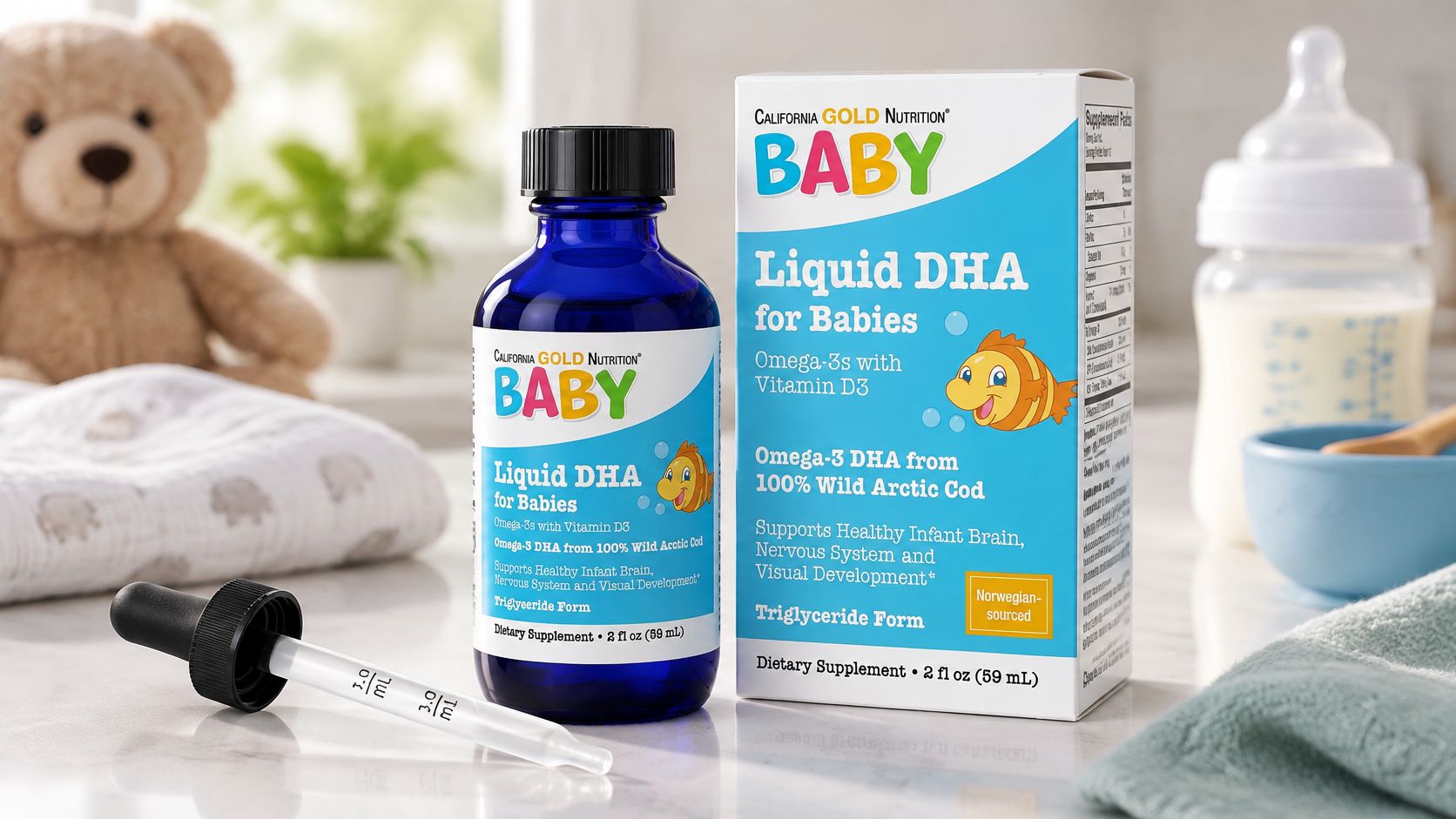
The arithmetic doesn't change when the person is small. If you're working through infant supplementation, California Gold Nutrition Baby's DHA Omega-3 with Vitamin D3 and EPA combines DHA, EPA and vitamin D3 in one product, listed at $24.95 and currently in stock, which means a single bottle to track instead of separate DHA and vitamin D items. Every infant dose still belongs with your paediatrician, GP or maternal health nurse, especially if your baby takes other supplements or has a diagnosed condition.
Once the dose is settled, the shopping part gets simpler. Wallaby Wellness sells vitamin D supplements alongside vitamin C, magnesium, zeolite and colloidal minerals, so you can compare labels by form and unit rather than by price tag. Bring your last blood result and your current bottle, and check the micrograms before you check the shelf appeal. Browse the range at Wallaby Wellness and make the number on the back panel the first thing you read.