Vitamin D and K2: Roles, Evidence and Safety Explained
, 14 min reading time
Vitamin D and K2 explained: what each nutrient does, what the evidence shows for taking them together, and the safety checks to make first.
Is vitamin K2 the missing piece that makes vitamin D work, or only a pairing that looks good on a supplement label?
Low vitamin D is common among Australian adults, and the Australian Bureau of Statistics has documented it in a national health survey. Your own blood level matters more than a label. Vitamin D has established roles, including calcium absorption and bone maintenance. The first step is a blood test and a conversation with a clinician, not a combined capsule.
Could K2 make vitamin D work better, or make a high dose safer? The proposed link between the two nutrients has a biological rationale, but a plausible mechanism does not prove that taking both improves outcomes. Knowing what each nutrient does, who benefits from testing and how to read a label separates established care from claims that remain uncertain.
Is a combined D3 and K2 capsule the smarter buy, or just a busier label? A blood test result and your own circumstances decide far more than whether a bottle lists two nutrients instead of one.
A low reading on a blood test gives a clinician something concrete to act on: whether to supplement, at what dose, and how often to recheck. K2 has a plausible role in calcium-related processes. The guidance reviewed here does not set a K2 dose that everyone should pair with vitamin D, and it does not establish that K2 makes a high dose of vitamin D safer.
The question is common. In 2025, 35% of Australians surveyed reported taking vitamin D supplements, according to Complementary Medicines Australia's annual industry snapshot as reported by NutraIngredients. Taking a supplement, though, tells you nothing about whether you were deficient or whether K2 belongs in the same capsule. For other health figures, health data backed by primary sources can help put claims in context.
The useful order runs in four steps: understand what each nutrient does, weigh whether your risk factors justify testing, ask a clinician to interpret the number, then read the label. If you already take supplements, bring your medication list and your total daily intake to that conversation. Two things are worth confirming before you buy anything: whether there is a documented reason to take vitamin D at all, and whether any medicine you use could interact with vitamin K.
Vitamin D helps the gut absorb calcium; vitamin K activates proteins involved in how the body uses it. They have different roles, and the proposed connection between them shouldn't be mistaken for proof that everyone needs both.
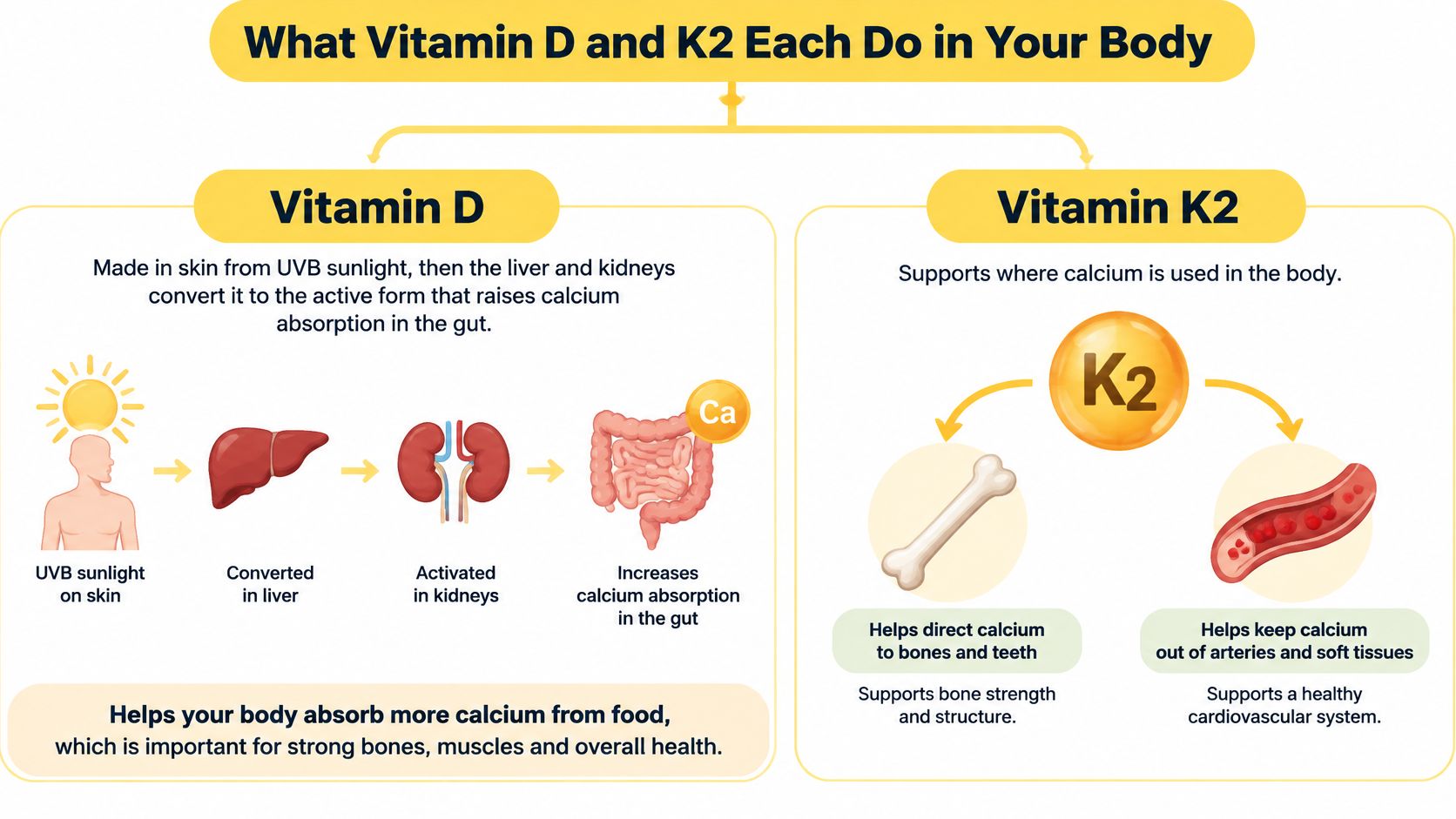
The body can make vitamin D in skin after exposure to ultraviolet-B radiation. The liver and kidneys then convert it into forms the body uses, including the active form involved in raising calcium absorption from the gut. Vitamin D status is assessed with a blood test, not by counting supplement capsules.
Vitamin K comes in several forms. K1, or phylloquinone, is associated with leafy greens and is needed for blood clotting. K2, or menaquinone, includes forms such as MK-4 and MK-7. K2-dependent proteins include osteocalcin in bone and matrix Gla protein in vascular tissue. Activating those proteins provides a plausible mechanism for K2's role, but it doesn't prove a particular supplement prevents bone or heart disease.
| Nutrient | Main role | Where it acts | Evidence strength |
|---|---|---|---|
| Vitamin D3 (cholecalciferol) | Raises intestinal calcium absorption and supports bone mineralisation | Gut, bone, kidney | Well established for correcting deficiency |
| Vitamin K1 (phylloquinone) | Needed for clotting factors; mainly from leafy greens | Liver | Established for clotting; not the basis of K2 claims |
| Vitamin K2 MK-4 (menatetrenone) | Activates osteocalcin and matrix Gla protein | Bone, blood vessel walls | Mechanistic; clinical benefit unproven |
| Vitamin K2 MK-7 (menaquinone-7) | Same activation role, with a longer half-life in blood | Bone, blood vessel walls | Mechanistic; clinical benefit unproven |
One way to picture the proposed partnership is that vitamin D opens the calcium tap, while K2 acts like a traffic controller directing calcium towards bone rather than soft tissue. It's a useful explanation of the mechanism, not a proven account of what a combined supplement will achieve in a person.
That distinction matters when reading labels. MK-4 and MK-7 are different specifications, so a product should name the form rather than just saying “K2.” For a closer look at a different nutrient and its proposed roles, see this guide to the health properties of zinc.
The practical difference is that vitamin D deficiency can be assessed with a blood test. K2's proposed bone and vascular effects remain a clinical question, not a reason to assume that everyone taking D3 needs a K2 supplement.
Vitamin D deficiency isn't rare in Australia, but a population figure can't tell you whether you personally need a supplement. In its analysis of Australian Bureau of Statistics data from the 2011–12 Australian Health Survey, the Australian Institute of Health and Welfare used a blood level of at least 50 nmol/L to define adequate vitamin D. On that basis, 23% of Australian adults, approximately 4 million people, were deficient. That's a historical baseline, not a current estimate.

More recent figures still point to a substantial issue. The Australian Bureau of Statistics reported that 20.6% of adults had vitamin D deficiency in 2025, down from 23.8% in 2011–12, according to its national health statistics. During winter in 2022–2024, deficiency affected 25% of Australians aged 18 and over, based on National Health Measures Survey data reported by SBS News. These figures use different periods and measures, so they're best read as evidence that low levels remain a concern, not as a simple like-for-like trend.
Sunlight enables the skin to make vitamin D, but seeking unrestricted exposure isn't a safe solution. Ultraviolet radiation can also increase skin-cancer risk. Season, latitude, skin pigmentation, clothing, age, time spent indoors and sun-protection habits all affect how much vitamin D a person makes.
Risk can also differ within groups. In the 2012–13 National Aboriginal and Torres Strait Islander Health Measures Survey, the AIHW reported that 27% of Indigenous adults nationally were deficient. The figure was 39% among Indigenous adults in remote areas, compared with 23% in non-remote areas. National averages can obscure these differences, which may reflect a range of environmental and social circumstances.
People who spend little time outdoors, have pigmented skin, wear clothing that covers much of the skin, work indoors, have malabsorption conditions or are older may want to ask a clinician whether testing is appropriate. Osteoporosis risk or a history of falls can also be a reason to discuss vitamin D status. AIHW links low vitamin D with increased osteoporosis risk, partly through effects on falls and musculoskeletal health.
A risk factor is a reason to ask about testing, not a reason to start a high-dose combination product.
Routine vitamin D screening isn't the standard approach for everyone. In Australia, Medicare-supported testing targets people with a clinical indication, rather than the general population. The Australian Government's Medicare guidance describes testing with serum 25-hydroxyvitamin D (25OH-D), not the active hormone 1,25-dihydroxyvitamin D.
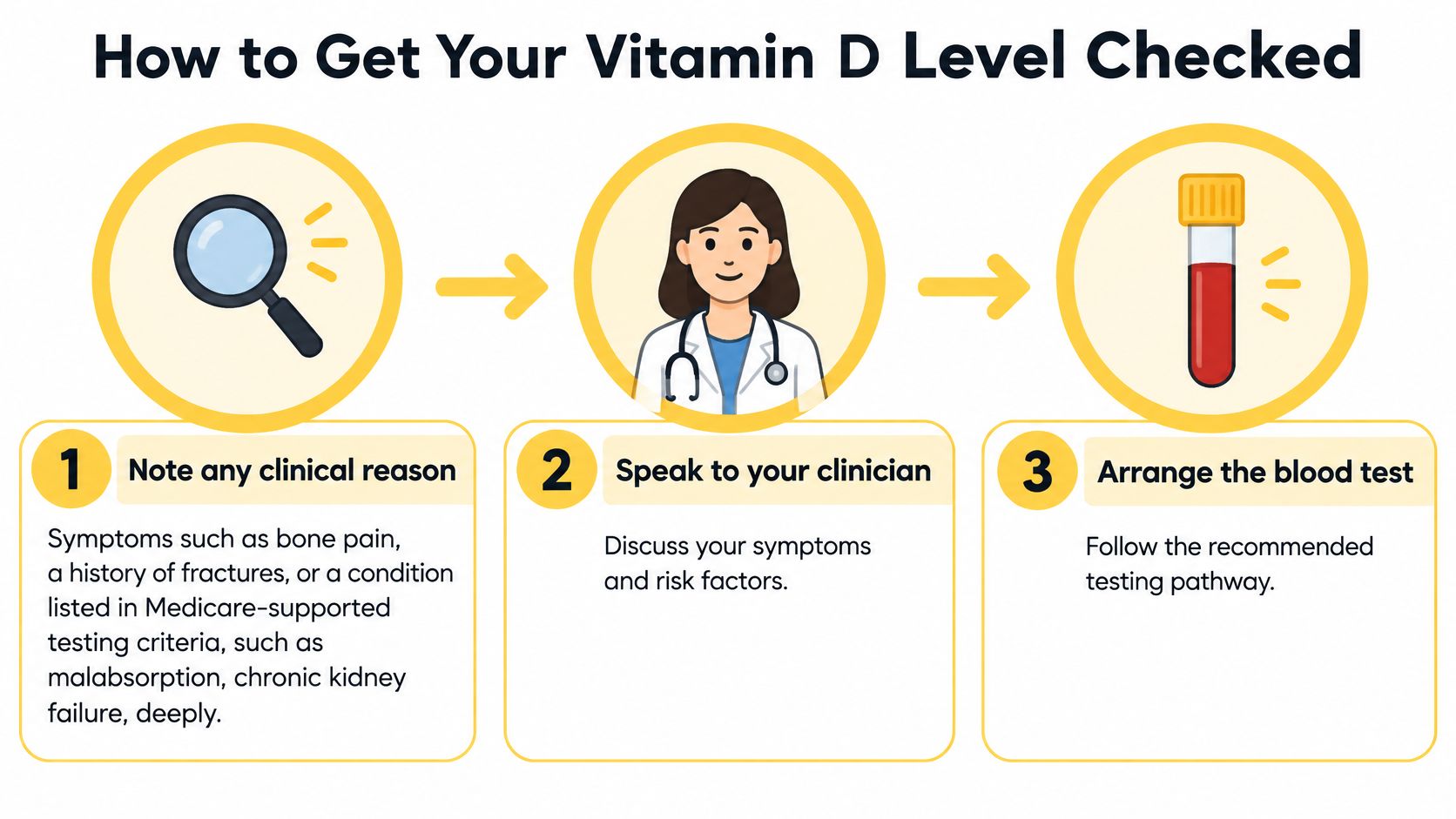
A broader look at how to review health measurements can also help you prepare questions about how to assess a longevity test panel. Bring a list of every product you take, including multivitamins, combined D3 and K2 capsules, calcium products and prescribed vitamin D. For infants, a clinician can advise whether a product such as California Gold Nutrition Baby Vitamin D3 Drops 10 mcg (400 IU) is suitable and how to use it.
Vitamin D deficiency has a clear treatment path: confirm with a 25OH-D test, then replace vitamin D under clinical supervision. Pairing D3 with K2 is a separate claim. The mechanism is plausible, and that is where the certainty ends.
Vitamin D increases calcium absorption in the gut. K2-dependent proteins are involved in calcium handling in bone and vascular tissue. That mechanism does not establish that a combined supplement prevents osteoporosis, arterial calcification or cardiovascular events. The Australian Government's clinical-committee material supports a cautious reading. Benefit depends on baseline deficiency, dose, kidney function, anticoagulant therapy and the outcome being measured. The material sets no universal vitamin D target for supplementation across every population, and no K2 dose to match with vitamin D.
| Claim | Evidence status | Practical reading |
|---|---|---|
| K2 directs calcium into bone and away from arteries | Mechanistic theory; no clear Australian clinical guidance supports it | Treat as a hypothesis, not a reason to buy |
| K2 plus vitamin D reduces arterial calcification | Not established in the material reviewed | Do not rely on it for vascular protection |
| K2 plus vitamin D prevents fractures | Not established in the material reviewed | Fracture prevention still starts with treating confirmed deficiency |
| A specific K2 dose can be matched to a vitamin D dose | No standard matching dose in the guidance reviewed | Ask what the K2 amount is meant to achieve |
| MK-4 and MK-7 are interchangeable | Different forms; the guidance reviewed sets no equivalence | Read the form on the label |
Three things often get mixed together: a biological mechanism, a clinical outcome and a product dose. A mechanism is a plausible route; it is not proof that the clinical destination changes. A dose can appear on a label and still lack evidence that it changes risk.
Once a low result has been confirmed and a clinician has set a dose, the question is narrow: does adding K2 improve an outcome that vitamin D alone would not? The evidence reviewed does not show that it does for the outcomes in the table. That leaves the decision with the clinician managing your deficiency, your kidney and bone health, and any medicines that interact with vitamin K.
A product label can tell you what is in a capsule. It cannot tell you whether you need the combination. The Force Factor MK-7 Vitamin K2 100 mcg 60 Vegetable Capsules listing specifies an MK-7 product; that description alone does not establish that K2 is necessary for you. If a clinician agrees it suits your situation, check the label for the K2 form and the vitamin D amount in micrograms.
Dose stacking is addition. A D3 and K2 capsule, a multivitamin with vitamin D, a calcium tablet with added D and a fortified cereal can each look modest alone, while the combined daily vitamin D is the number that matters. Write down the microgram amount from each label and add them before deciding whether a new product fits.
Vitamin K can affect warfarin, so starting, stopping or changing a K2 supplement belongs with the prescriber. Vitamin D toxicity is uncommon, but excessive supplemental intake can cause hypercalcaemia, or high blood calcium. What matters is whether the label dose matches the amount your prescriber set. Check the microgram figure on every product against the prescribed amount rather than assuming a single capsule is modest.
| Source | What to check | Who to ask |
|---|---|---|
| D3 and K2 capsule | Vitamin D in micrograms and the K2 form (MK-4 or MK-7) | Pharmacist or GP |
| Multivitamin | Vitamin D and vitamin K content per daily serve | Pharmacist |
| Calcium product with vitamin D | Vitamin D per tablet and total daily calcium | GP |
| Fortified foods | Vitamin D per serve, where listed | Dietitian or GP |
| Prescribed vitamin D | Dose and duration set by the prescriber | Prescriber |
| Warfarin or other anticoagulant | Any K2 start, stop or dose change | Prescriber, before any change |
Write down the products, serving amounts and frequency. Use the same unit when comparing labels, and note whether the product contains K2, K1 or both. If you're also considering other products that affect clotting, read about the interaction questions raised by nattokinase and vitamin K2, then discuss your own medication list with a pharmacist or prescriber.
For kidney disease, a parathyroid condition or a calcium disorder, have the prescriber review the full list before you add a combined product. Put the vitamin D micrograms from every supplement and fortified food on one page and compare the total with the dose on your prescription.
Your 25OH-D result and your medication list are the two inputs a clinician needs. The appointment is where the dose, product form and recheck interval get set.
Bring three things: the test result with its date and units, the product list from your label check, and every prescribed medicine you take, including anticoagulants. That record lets the clinician see supplements, fortified foods and prescribed vitamin D together before recommending a change.
Ask direct questions. Is my result low, adequate or high for my circumstances? Do I need vitamin D alone, and at what dose and for how long? If a combined D3 and K2 product is suggested, which K2 form and vitamin D microgram amount should I look for? When should I recheck? These answers turn a general supplement choice into a dose you can follow.
That conversation also separates a proven vitamin D correction from an unproven routine K2 pairing. If you are comparing other nutrients while you wait, our guide to the best vitamin C in Australia covers a separate supplement category.
Wallaby Wellness sells vitamin D supplements, vitamin C, magnesium, and zeolite and colloidal minerals. If your clinician confirms you need a vitamin D product, visit Wallaby Wellness to browse the range. Book the blood test, then take your label list to that appointment.