What Is Sea Moss? Forms, Claims and Safety Explained
, 14 min reading time
Wondering what is sea moss? Learn where it comes from, the common forms sold in Australia, what nutrition claims hold up and the iodine checks to make.
If two jars both say sea moss, are you getting the same ingredient and the same iodine dose? Not necessarily. The name tells you less than you might expect about what's inside, which makes species identification and label checks more useful than a list of promised benefits.
Understanding what sea moss is starts with treating it as a seaweed food, not a uniform superfood. Its form, origin and measured composition matter, especially if you're considering regular use.
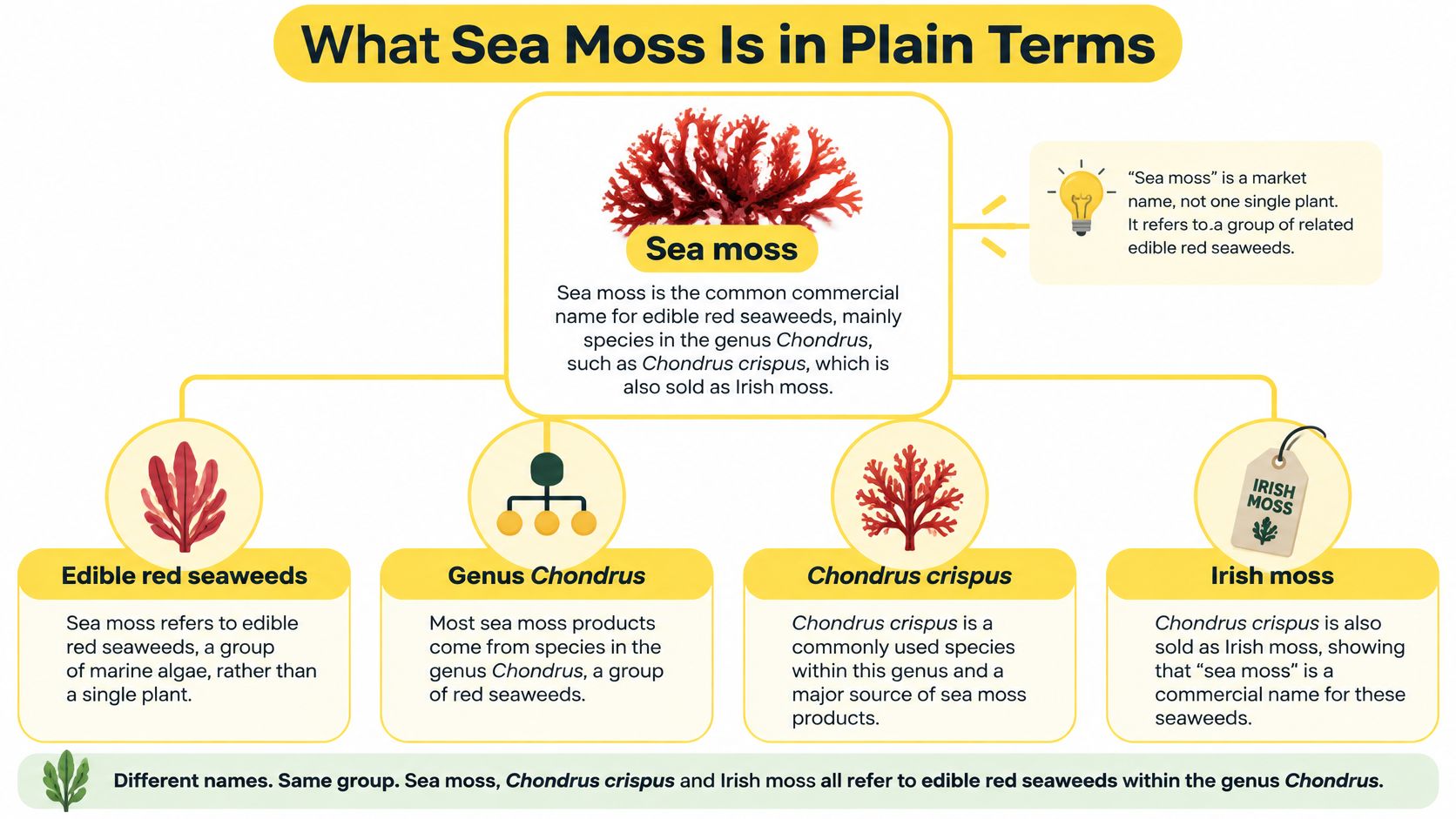
Sea moss is a common commercial name for edible red seaweeds, mainly species in the genus Chondrus, including Chondrus crispus, also sold as Irish moss. It's a market name rather than a guarantee that every product contains the same botanical ingredient.
Think of the word greens on a supermarket shelf. A bag might contain spinach, rocket or a mixture, and you wouldn't assume they all have identical nutritional profiles. Sea moss works similarly: the front label names a broad category, while the ingredient list should identify the actual seaweed.
Say you buy dried whole sea moss to prepare at home. The branching pieces, called fronds, soften when soaked and can be blended with water into a thick mixture for drinks or cooking. Its structural carbohydrates, including sulfated polysaccharides, help bind water and form gels.
The relationship between the market name and the species is easier to follow visually.
Seaweeds are marine algae harvested or cultivated for food, extracts and supplements. They also accumulate elements from their surroundings: the Food Standards Australia New Zealand seaweed survey describes naturally occurring minerals including sodium, potassium, magnesium, calcium, iron, zinc, selenium and iodine.
That doesn't make sea moss a predictable multivitamin. Species, growing location, season and processing can change what ends up in the finished product, and an extract isn't necessarily equivalent to whole seaweed.
Start with identity: Before judging a sea moss product's benefits, find its species and country of origin.
A useful mental shift is to treat sea moss like another food ingredient with a particular composition, rather than a complete nutritional package. The name tells you where to start asking questions, not what the answers will be.
Common sea moss forms and what to check
| Form | What it is | Common use | What to check on the label |
|---|---|---|---|
| Raw fronds | Freshly harvested seaweed | Soaked and blended at home | Species and harvest area |
| Dried whole pieces | Dried seaweed | Soaked, then made into gel | Origin and drying method |
| Gel | Soaked and blended seaweed | Smoothies, soups and cooking | Ingredients and water content |
| Powder | Dried, milled seaweed | Stirred into drinks and food | Serving size in grams and declared iodine |
| Capsules | Powdered seaweed in a capsule | Fixed daily dose | Dose per capsule and batch testing |
The main difference you'll notice is preparation. Whole pieces let you control how much water you add, but they require handling and preparation according to the product's food-safety instructions. Gel is ready to spoon into food, while powders and capsules remove the need to soak or blend anything.
Convenience doesn't establish nutritional equivalence. A spoonful of gel includes added water, whereas a capsule contains a measured amount of dry material or extract. You can't compare them meaningfully unless the labels disclose the amount of seaweed, preferably on a dry-weight basis.
Australia's seaweed sector shouldn't be mistaken for an established domestic sea-moss farming industry. The Australian university and industry report hosted by the University of Tasmania describes a small sector with historical activity centred on beach-cast brown algae for extracts and agricultural products.
The scale of imports provides useful context: in 2024, the NSW Government reported that Australia imports approximately AUD $40 million of seaweed products annually. That figure covers seaweed products broadly, not sea moss alone.
For shoppers, the practical distinction is between where a product was packed and where its seaweed grew. An Australian retailer or brand name doesn't answer the second question.
Choose the form you can measure and understand. A convenient format is useful only if you can also establish what it contains.
What does a sea moss nutrition claim tell you about the serving in the jar? Often, less than the label suggests. Seaweeds vary by species and sample, so research on one group of seaweeds cannot provide a nutrition profile for every sea moss gel or capsule.
A 2019 Deakin University study analysed 13 seaweeds, including nine wild-harvested Australian species and four commercially available species, according to the published nutritional and sensorial study. Most tested species contained meaningful protein and crude fibre; nine had an omega-6-to-omega-3 ratio of approximately one or lower. The researchers suggested that 10 grams dry weight of a mixture of the tested seaweeds could contribute fibre, protein and beneficial fatty acids.
These findings show potential as food ingredients, while leaving the composition of any particular sea moss product unknown.
Sea moss nutrition claims against the Deakin evidence
| Claim on pack | What the Deakin study shows | What it does not show |
|---|---|---|
| Mineral-rich superfood | Seaweed composition needs species-specific assessment; mineral uptake alone does not establish nutritional completeness | Measured mineral values for a shopper's sea moss gel or capsules |
| Source of protein and fibre | Most tested species contained meaningful protein and crude fibre | Per-serving amounts for gel or capsule forms |
| Source of omega-3 fats | The Deakin study found EPA in every tested species, with a favourable fatty-acid ratio in many samples | A guaranteed EPA amount in a commercial sea moss product |
| Daily serve of dried seaweed | A mixture of the tested seaweeds could contribute fibre, protein and beneficial fatty acids | A universal sea moss dose or demonstrated health outcome |
The fatty-acid results also varied between samples. The researchers found eicosapentaenoic acid, or EPA, in every species tested, with nori substantially higher than the other samples. A favourable ratio between fatty acids describes their balance, not the amount in a serving.
Fibre or minerals in a food do not, by themselves, show that a serving will change someone's overall intake or correct a deficiency. Nutritional analysis also does not demonstrate improved immunity, clearer skin or other therapeutic effects.
The study assessed seaweeds, not every gel, powder or capsule sold as sea moss. Species, harvest conditions and processing can all affect how closely a product resembles a tested sample. The researchers noted that vegetarians and vegans relying on seaweed for more of these nutrients would need higher amounts. That observation concerns nutrient contributions, which must be weighed alongside iodine exposure.
How much iodine does a serving of sea moss provide? The most important missing detail on a sea moss label is iodine per serving. Seaweed absorbs iodine unevenly, so a product's name alone cannot tell you the dose.
The FSANZ Australian iodine survey measured concentrations from 9.4 mg/kg in dried nori to 4,300 mg/kg in dried kombu. These figures describe the particular seaweeds tested, not every sea moss product.
Iodine reference values for seaweed and adults
| Reference point | Value | What it shows |
|---|---|---|
| Adult daily iodine need | About 150 micrograms, according to FSANZ iodine-sensitivity guidance | A baseline for total daily intake, not a sea moss dose |
| Maximum iodine in imported brown seaweed in Australia | 1,000 mg/kg dry weight, according to FSANZ's seaweed iodine survey | The import threshold applies to brown seaweed |
| Dried nori in the FSANZ survey | 9.4 mg/kg, according to the FSANZ survey | The lowest survey concentration |
| Dried kombu in the FSANZ survey | 4,300 mg/kg, according to the FSANZ survey | The highest survey concentration, above the brown-seaweed import threshold |
The units describe different things. Micrograms per day measure intake; milligrams per kilogram measure concentration in a product. To estimate intake, you need both the concentration and the amount consumed.
The FSANZ guidance on iodine sensitivities gives the adult intake reference. Australia's brown-seaweed controls set the import threshold. Neither figure is a recommended sea moss serving size or a measure of iodine in an untested jar.
A measured amount of seaweed is not necessarily a measured amount of iodine.
FSANZ identifies brown seaweed as a medium-to-high public-health risk for iodine because uptake varies with environmental conditions, including temperature and season. Red seaweed products also vary, so their colour or category alone cannot establish their iodine content.
Drying removes water, while serving size determines how much material you consume. A small amount of dried seaweed and a larger serving of diluted gel can't be compared reliably without knowing their iodine concentrations.
The same distinction matters when considering nutrients such as zinc. Read about the health properties of zinc, then separate what a nutrient does from how much a particular food provides. A nutrient's role in the body does not reveal the dose in a serving.
For sea moss, look for iodine per serving, then consider other dietary sources of iodine. If the label does not state the amount, you cannot treat the product as a predictable iodine supplement.
Pregnant or breastfeeding people, children, and anyone with a thyroid condition should get individual advice before using sea moss regularly. The question is whether an additional, variable iodine source suits that person's needs.
The FSANZ guidance on iodine sensitivities explains that most adults require about 150 micrograms daily, links concerns about high-iodine seaweed to thyroid dysfunction, and advises against overconsuming brown seaweeds during pregnancy and breastfeeding. Australian guidance recommends that pregnant or breastfeeding women and children limit brown seaweed to no more than one serve per week, according to FSANZ's iodine-sensitivity guidance. Pregnancy guidance also recommends 150 micrograms of iodine supplementation under professional advice.
The brown-seaweed recommendation does not set a serving allowance for red sea moss or concentrated supplements. Check mixed products carefully, since they may contain brown seaweeds.
Before an appointment, note the foods and supplements you usually consume over a week. Include iodised bread, seafood, dairy, other seaweeds, prenatal products, and any kelp or iodine supplements.
Bring photographs of the ingredient list, serving directions and any batch test results. Your GP or dietitian can assess the specific product alongside your diet and medical history, rather than judging sea moss by name alone.
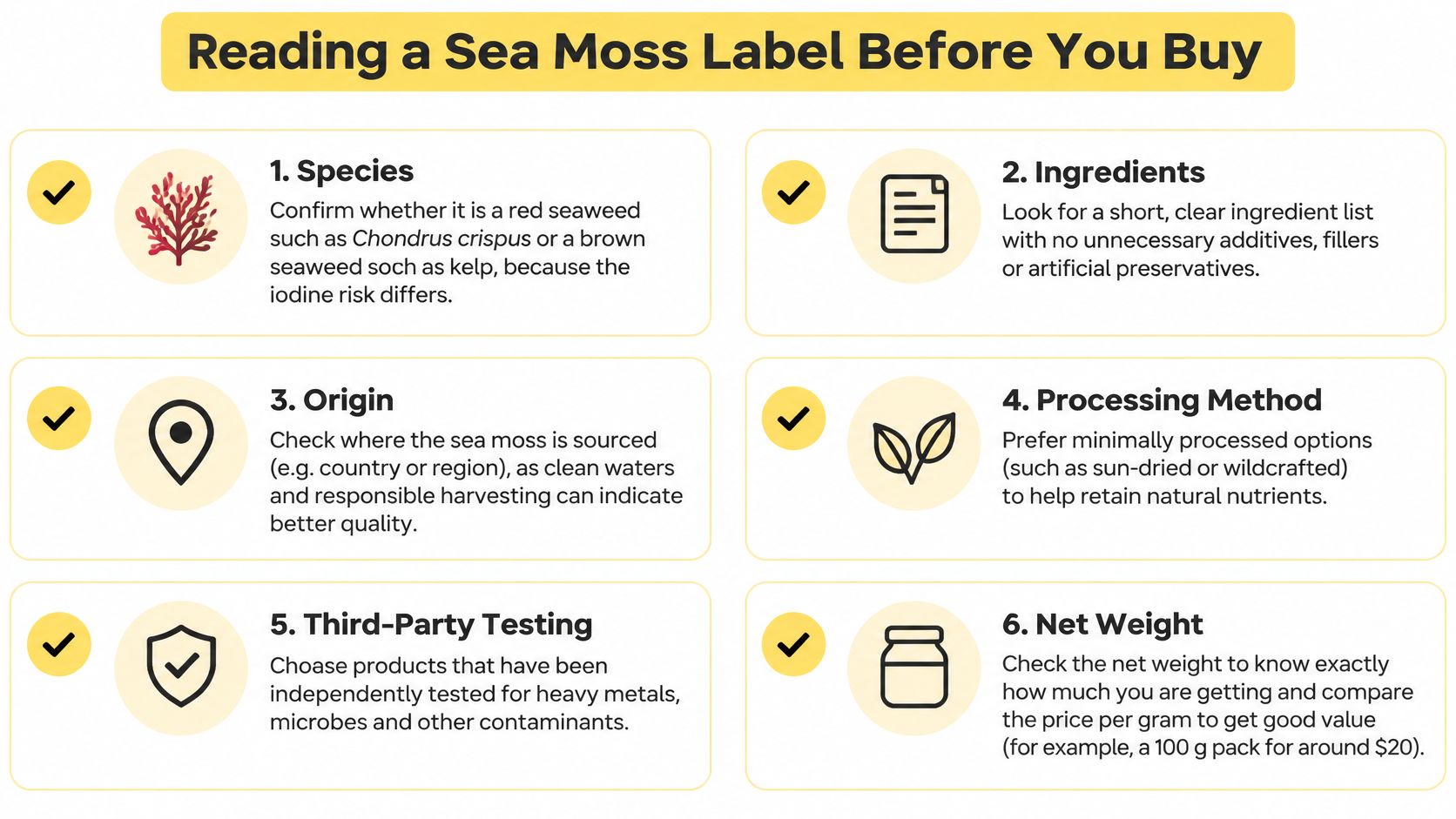
What can a sea moss label tell you about the product's contents and serving? Start with details that help identify the seaweed and assess its composition. Words such as “natural,” “organic” or “wild-harvested” describe other aspects of a product, not its iodine amount.
FSANZ's overview of iodine levels in seaweed explains that iodine levels vary across seaweed products. Australian controls on imported brown seaweed provide context, but they do not establish the iodine content of a particular product or serving.
Buying rule: An unknown iodine amount is an information gap, not evidence that the amount is negligible.
Compare ingredient panels against the checklist. Prioritise clear species, serving and test information over broad product claims, and pay particular attention to whether iodine is disclosed.
For more shopping context, see our guide to buying sea moss in Australia. It can help you compare product information with the label and any batch results.
The video below provides additional product-label context.
Sea moss is easier to assess when its role in your diet is clear. Use the earlier guidance on iodine, personal circumstances and label details to decide whether a product is suitable for you, rather than repeating those checks here.
If you choose to use sea moss, follow the product's stated serving instructions and avoid increasing the amount to pursue a particular effect. New or concerning symptoms warrant medical advice; do not treat them as evidence that the supplement is working.
Sea moss can be one part of a varied diet, but it does not replace balanced eating or medical care.
Wallaby Wellness sells sea moss supplements, colostrum supplements, black seed oil and diatomaceous earth. Visit Wallaby Wellness to review the sea moss range and compare products with the guidance above.