Buy Sea Moss Australia: A 2026 Buying Guide
, 17 min reading time
Buy sea moss Australia shoppers can compare gel, powder, capsules and liquid, then check species, iodine and lab results before ordering.
You can buy sea moss in Australia online from specialist retailers such as Wallaby Wellness without a prescription. Choose a format that suits your routine, then check the named species and iodine information rather than relying on the words sea moss.
The popular advice is to buy the product with the longest mineral list. That's the wrong starting point. More minerals aren't automatically better, and unusually high iodine is a purchasing risk, not a reason to choose a stronger product.
A useful buying specification is simpler: an identified seaweed, a measurable serving and credible evidence about the batch you're ordering.
Sea moss is sold in food and supplement formats, so the first decision is how you want to use it. We sell sea moss supplements online; health-food stores may also stock dried moss or ready-made gel. Supermarket and pharmacy ranges change, so check the store's current listing before making a trip.
Sea moss formats compared for Australian shoppers
| Format | How you take it | Keeping | Main label trap |
|---|---|---|---|
| Dried whole sea moss | Soak and blend into gel at home | Long while kept dry | Species and iodine per dried gram |
| Ready-made gel | Spoon from the jar | Usually refrigerate, short life | Serving mass, species and added sweeteners |
| Powder | Stir a weighed amount into food or drink | Long if sealed and dry | Grams per serve versus a mineral marketing list |
| Capsules | Swallow a set number | Long if stored as directed | Capsule count versus milligrams of actual moss |
| Liposomal or herbal liquid | Take a spoonful or mix into a drink | Follow the bottle date | Moss may be a small part of a wider blend |
Dried whole moss suits someone who wants to prepare their own gel and control the other ingredients. The trade-off is preparation: you need clean utensils, a suitable container and a clear storage routine once you've added water. Don't assume homemade gel has the same keeping instructions as a commercially prepared product.
Ready-made gel saves preparation and mixes easily into food. You're buying convenience and texture, but also taking on fridge space and an opened-jar deadline. Check storage requirements before ordering, including whether you'll be home to receive the parcel.
Powder is easier to keep in the cupboard and measure with a kitchen scale. Capsules avoid the taste and preparation, but you need to read the amount of actual moss in the labelled serving, not just compare capsule counts.
Format rule: Choose gel for a food-like routine, powder for weighed mixing, and capsules for convenience. None gets a free pass on testing.
A liposomal or herbal liquid can suit someone who prefers a flavoured spoonful to a capsule. However, the sea moss may sit alongside herbs, vitamins, oils and sweeteners. Compare the declared moss content, not the bottle volume.
Don't treat a spoonful of gel, a scoop of powder and a capsule as interchangeable. Their water content, ingredient mix and concentration can be quite different.
If you're shopping because of unexplained tiredness or a general feeling that you need more nutrients, separate that concern from the format decision. Vital iQ Health's guide to full body checkup costs in Australia can help you plan the cost side of seeking a health assessment; a supplement purchase isn't a substitute for finding out what's causing symptoms.
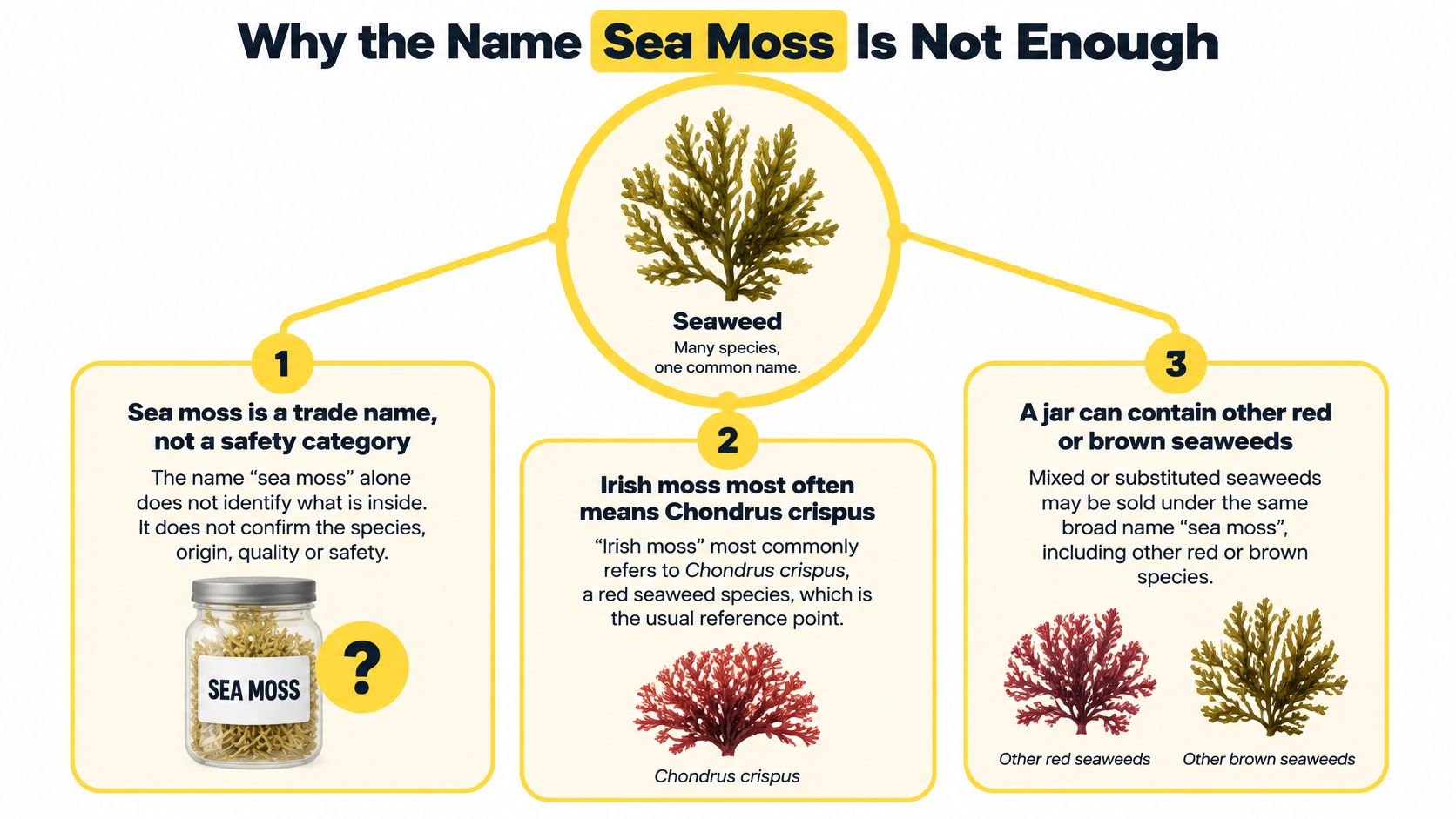
Ordering sea moss without checking the species is like ordering fish without asking which fish. The broad category tells you something about the food, but it doesn't tell you everything you need to choose a portion or compare products.
Irish moss most often refers to the red seaweed Chondrus crispus. Other red seaweeds, or products containing brown seaweeds, can appear under broad sea-moss branding, so a familiar front label never establishes that different jars hold the same ingredient.
The distinction is easier to see when the trade name and actual species are separated.
After thyroid dysfunction was associated with excessive iodine intake, FSANZ and Australian states and territories surveyed seaweed products in 2010; the FSANZ seaweed iodine survey found substantial differences by type, with wakame, nori and products containing them generally low, while some dried seaweeds, particularly brown seaweeds such as kombu, contained potentially unsafe concentrations.
That history is why unusually high iodine belongs on the risk side of the ledger here rather than the benefit side. A product made from a named red species and a mixed-seaweed powder can sit in the same shopping category without being interchangeable.
Australian border rules now cover iodine levels in imported brown seaweed. That control targets a defined category of imported food; it isn't a blanket approval of every sea-moss supplement sold by an Australian website.
Say you're comparing a plain moss powder with a jar described as a marine mineral blend. The powder identifies Chondrus crispus, while the blend lists sea moss alongside kelp without clearly separating the amounts.
Those are different formulations, and each needs its own questions.
Use the ingredient panel to establish:
A species name tells you what the supplier says is inside. A batch test helps establish what's been measured in it.
The same discipline applies across a crowded supplement shelf. Our guide to what black seed oil is is useful if you're comparing unfamiliar ingredient categories, but each ingredient needs its own specification. Similar wellness language doesn't make different products equivalent.
I would favour a plainly identified product over an impressive mineral story. More minerals is not automatically better, and if the retailer can't establish which seaweed you're buying, there's little value in debating flavours or capsule convenience yet.
A stronger product page lets you connect the ingredient, serving and laboratory result to the jar being sold. A weaker page gives you attractive harvesting language and a general assurance that the product is tested.
Batch-specific evidence is the difference. A certificate for an unidentified sample, an old supplier brochure or a report for a different formulation doesn't establish the quality of your purchase.
The Australian seaweed food-safety program report identifies relevant hazards including inorganic arsenic, cadmium, iodine and Salmonella, and reports a Food Standards Code maximum of 1 mg/kg for inorganic arsenic in seaweed, with limits of 0.1 mg/kg for cadmium and 0.1 mg/kg for lead under the applicable contaminant provisions.
Those reference limits don't establish that every retail jar has been tested. They also shouldn't be applied indiscriminately across product categories without checking which provisions apply.
Read the report heading, sample description, batch identifier, test date and laboratory details before looking at the results. Check whether the tested material was dried seaweed, finished gel or another preparation. A result for the raw ingredient doesn't automatically describe everything added during manufacture.
What to verify on a sea moss product page
| Check | Evidence that passes | Why it matters |
|---|---|---|
| Species | Latin or clear common name such as Chondrus crispus, not only sea moss | Iodine differs sharply by seaweed type |
| Origin | Country of origin and whether it's imported or Australian-grown | Supply chain and border controls differ |
| Form and serve | Dried, gel, powder or liquid, with grams or millilitres per serve | The swallowed amount determines exposure |
| Iodine | Recent batch result from an independent laboratory | High iodine is a central purchasing risk |
| Inorganic arsenic | A measured result assessed against the seaweed maximum | Total arsenic alone doesn't identify the inorganic fraction |
| Cadmium and lead | Separate results assessed against applicable limits | Seaweed can accumulate metals |
| Microbial quality | Batch results covering Salmonella and general microbial quality | Hygiene matters alongside mineral content |
| Traceability | Importer, lot or batch, date and storage instructions | Wildcrafted or organic isn't a test result |
Use this checklist while the product page and certificate are open together.
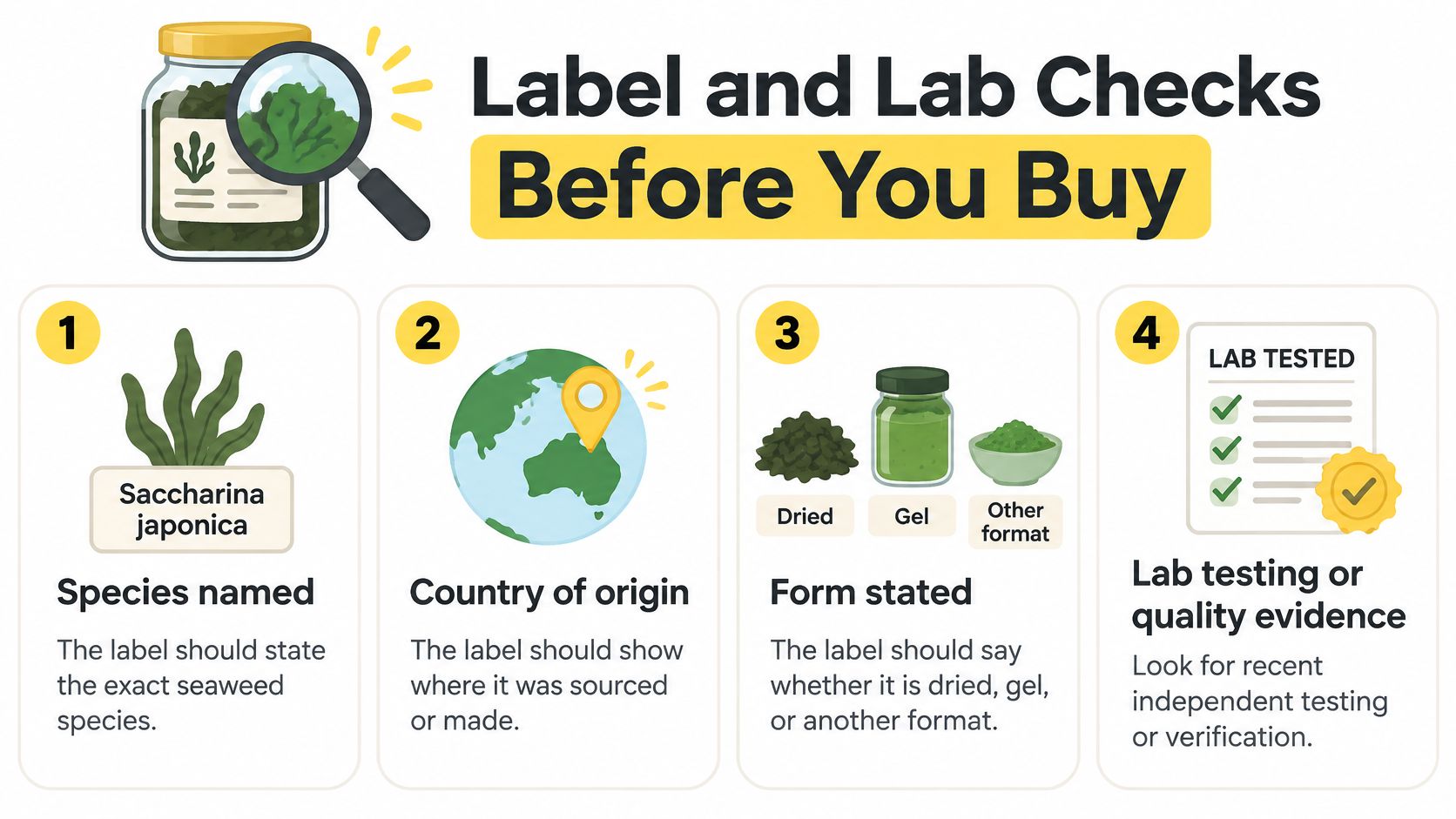
Organic describes a production claim. Wildcrafted describes a harvesting claim. Neither tells you the iodine concentration or whether the finished batch passed microbial testing.
Ask for arsenic speciation rather than accepting total arsenic as the complete answer. Look for separate metal results, iodine measurements and microbial findings, plus information about foreign-matter inspection. Contaminants can change with harvest location, growing conditions and processing.
The documentation habit is useful outside supplements too. Momotaro Apotheca's page for testing documentation for intimate care products offers a cross-category example of making certificates accessible, although intimate-care testing doesn't establish food safety or sea-moss compliance.
Likewise, the distinction between an ingredient name and its declared amount matters when you buy magnesium glycinate in Australia. Read what was measured and what you'll consume, rather than allowing the headline ingredient to answer every question.
The practical test is straightforward: can you match the species, preparation and batch on the page to the evidence? If not, keep the purchase on hold.
A blend can be a reasonable format choice, but it needs to be read as a blend. The ingredient featured on the front isn't necessarily the largest active ingredient inside.
The product panel below is a useful example of where to look for the serving instructions and ingredient breakdown.
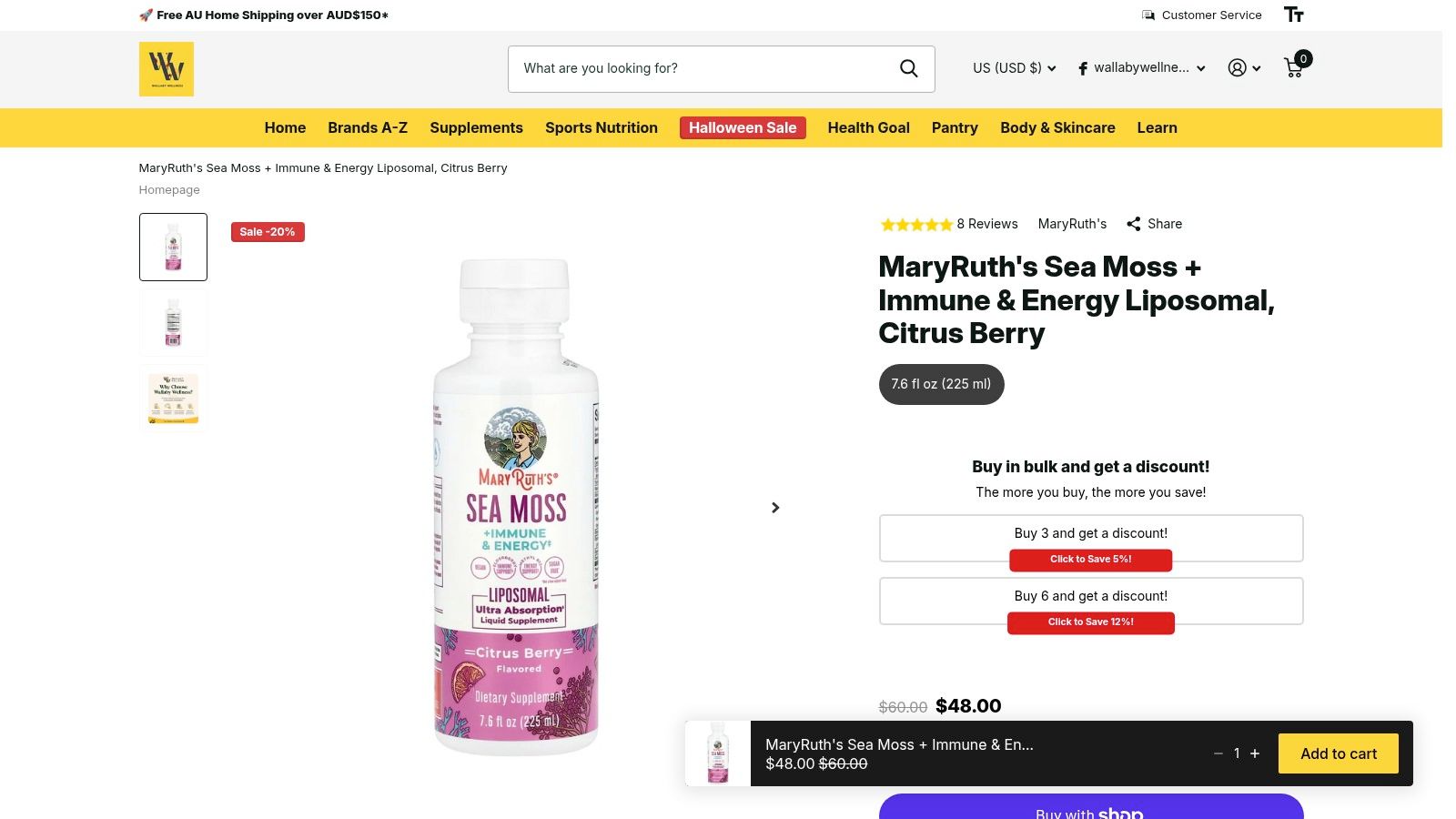
The label for MaryRuth's Sea Moss + Immune & Energy Liposomal, Citrus Berry describes a vegan, sugar-free liquid with an adult serving of up to 1 tablespoon (15 mL) daily, about 15 servings per bottle, and 140 mg of organic Irish moss (Chondrus crispus) powder per serving, alongside 600 mg organic European elderberry extract, 100 mg organic rose hips extract, 25 mg orange oil, 7.5 mg vitamin E and 0.38 mcg methylcobalamin vitamin B12.
The useful interpretation isn't that the whole spoonful is sea moss. It's a flavoured formulation containing moss, elderberry, rose hips, vitamins and an oil-based liposomal blend.
That makes it a different purchase from plain dried moss or a concentrated powder. Compare it with other blended liquids on composition and suitability, not with a gel jar on spoon size.
Liposomal describes the formulation, not the amount of sea moss. It doesn't turn a mixed product into pure moss, and it doesn't replace batch-specific iodine information.
The product name includes immune and energy language. Read those words alongside the ingredients responsible for the positioning rather than assuming every claimed purpose comes from the seaweed.
For another way to review the product presentation, this video can sit alongside your label check.
The label advises consulting a physician or healthcare professional before starting a supplement, especially during pregnancy or breastfeeding, when taking medication or with a medical diagnosis. It also says to keep the product out of children's reach.
We dispatch from our Queensland warehouse, ship Australia-wide and offer pickup in Brisbane. Those fulfilment options help you arrange the purchase, but they don't determine whether this formulation suits you.
Apply the same reading method to your preferred format: identify the labelled serving, find the amount of actual moss, then check what else accompanies it. Don't substitute the size of the jar, capsule or spoon for that information.
Seaweed can concentrate iodine up to 30,000-fold relative to seawater, with brown seaweeds generally containing more iodine than red or green varieties, according to the FSANZ report on iodine in seaweed. That concentration range is why a marine ingredient deserves the same caution as any potent supplement. This is shopping guidance, not personal medical clearance.
For a shopper, iodine functions as a technical specification. You need information a doctor or pharmacist can use to assess your intended serving.
Pause before starting if any of these apply:
Bring a photograph of the ingredient panel, the directions and any iodine result. A product name alone may not give the clinician enough information, particularly when several seaweeds or an extract are involved.
Don't increase the serving because you haven't noticed a benefit. Lack of a noticeable effect doesn't establish that the dose is too small or that taking more is safe.
Pause point: If you can't establish iodine exposure, don't solve the uncertainty by guessing a smaller spoonful.
Making gel changes the texture and spreads dried material through a larger volume. Unless the processing removes iodine, the water carries the same mineral load the dried moss brought in.
Soaking, draining and blending change how the product feels and pours; the iodine stays with the material. Treat home preparation as a texture step, not a reliable way to lower exposure.
Separate a wellness goal from the decision to buy sea moss. If you're comparing gut health supplements in Australia, start with the symptom or dietary need you want to address rather than assuming a mineral-rich ingredient is the right tool.
For someone without those cautions, the practical boundary is still the labelled serving of the identified product. Use the appropriate measuring tool, don't stack similar products casually, and seek professional advice if suitability is unclear.
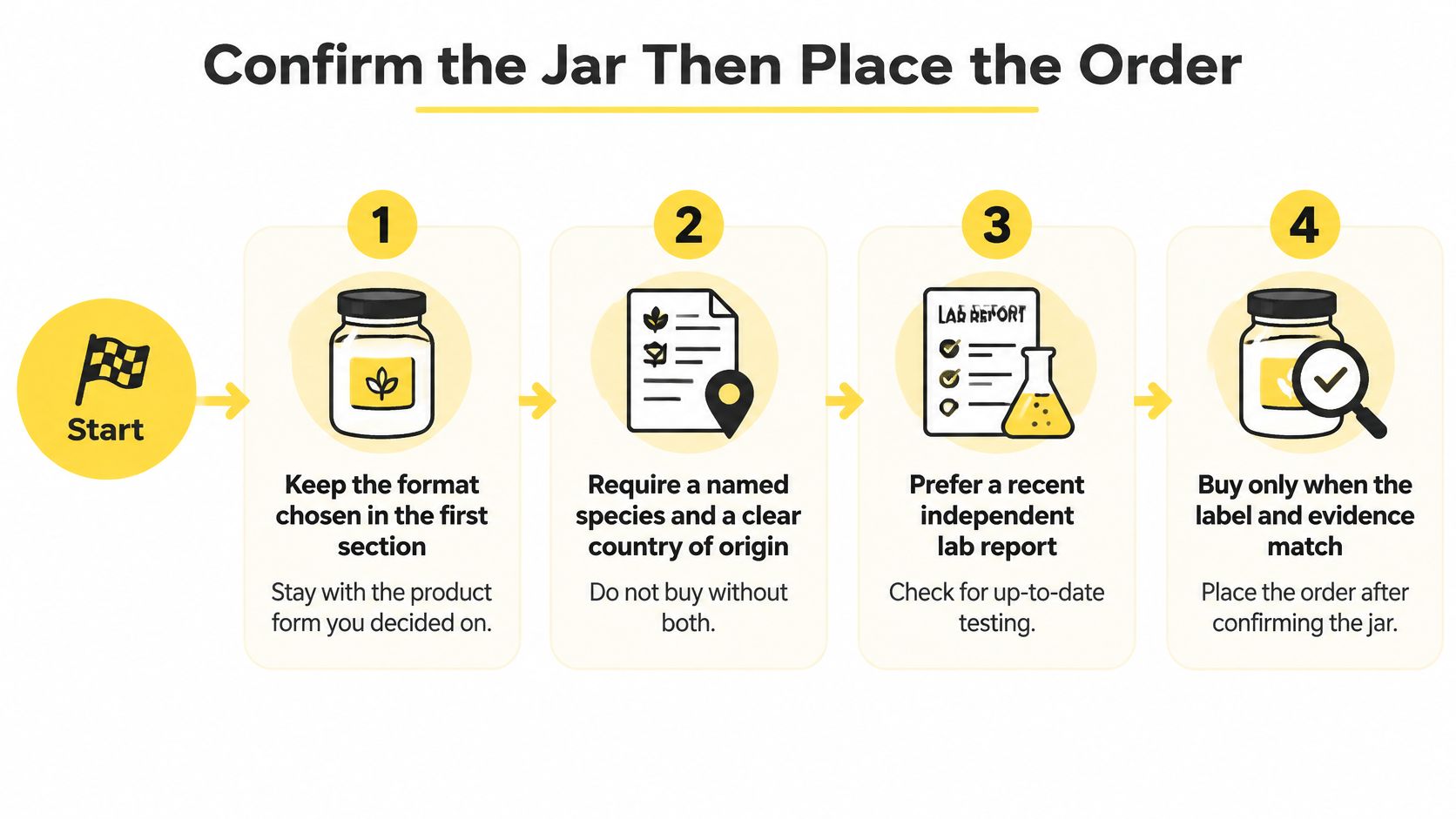
A purchase is ready when the product description and supporting evidence agree. Use these confirmations before checkout rather than adding a jar because the front label sounds mineral-rich.
This final visual is a reminder to confirm the jar before committing to the order.
For a powder-format comparison, Switch Nutrition Sea Moss 100% Pure Golden Irish Sea Moss is described as a Chondrus crispus extract. That identifies the advertised ingredient, but you should still assess the origin, directions and batch evidence rather than treating concentration as a benefit by itself.
Once those checks pass, browse our sea moss options against your chosen specification. We offer free shipping within Australia on orders over AUD $150 using FREE150, year-round and subject to the stated conditions.
You can combine two or three wellness items in a basket, but check the actual total. Don't assume a particular sea-moss product qualifies by itself, and don't add an unsuitable supplement just to reach a shipping threshold.
Wallaby Wellness offers sea moss supplements alongside vitamins, minerals, health foods and other wellness essentials, with Australia-wide shipping and Brisbane pickup. Visit Wallaby Wellness to compare the available formats, and contact our Australian support team about product details before choosing your jar.