Magnesium Oxide Benefits: What Works and What Doesn't
, 15 min reading time
Magnesium oxide benefits explained: where it helps, how absorption and dose limits affect results, and side effects to know. Australian guide.
A bigger milligram figure looks like a better magnesium product. Often it only means a heavier salt.
Popular pages bundle magnesium oxide in with promises of deeper sleep, a calmer mood and stronger lifts. That advice blurs three different things: the elemental magnesium printed on the label, the share your gut absorbs, and the dose your bowels tolerate before stools loosen. Oxide is a compact, lower-cost salt. It can close a dietary gap or act as a laxative. Its evidence for sleep, mood and athletic performance is limited, and stacking it with a multivitamin can push total supplemental magnesium past the adult limit without you noticing. That limit is set mainly around loose stools; serious poisoning is the exception.
A pharmacist reading the label with you would start with one question. What job do you want this product to do?
A tablet's magnesium oxide weight is not the same as the amount of magnesium it provides. Magnesium oxide is a compound of magnesium and oxygen, one of several forms used in supplements. To read its label accurately, separate the compound's total weight from its elemental magnesium content.
Your body cannot make magnesium, so it must come from food or supplements. Australian nutrient-reference materials place adult requirements broadly around 310–420 mg per day, varying by age and sex. Magnesium contributes to normal muscle and nerve function, energy metabolism and bone maintenance, according to the Australian Bureau of Statistics nutrition tables.
Elemental magnesium is the portion of a compound's weight that is magnesium itself. For example, a tablet containing 500 mg of magnesium oxide supplies roughly 300 mg of elemental magnesium, because magnesium makes up about 60 per cent of the compound's weight. The rest is oxygen bound to it. A supplement panel that lists elemental magnesium makes that amount easier to compare across products.
Oxide appears in standalone tablets and capsules, some multivitamins, and some laxative and antacid products. Under the Therapeutic Goods Administration's Australian Regulatory Guidelines for Listed Medicines, a product making a nutrient-content claim must provide at least 25% of the relevant Recommended Dietary Intake or Adequate Intake. That threshold concerns the amount in the product. It does not, by itself, show how much your body absorbs or whether a particular benefit will follow.

Read magnesium oxide benefits by how well each one is supported, not by how often it appears on a bottle.
| Benefit | What it rests on | Evidence strength |
|---|---|---|
| Correcting low dietary magnesium | Magnesium's role in muscle, nerve, energy and bone function | Well established when intake is low |
| Relief of constipation | Osmotic laxative action of unabsorbed magnesium | Well established, dose-dependent |
| Heartburn and indigestion | Traditional antacid use | Common use, limited modern trials |
| Muscle cramps | Magnesium's role in muscle contraction | Limited, no benefit shown with chronic use |
| Athletic performance | Acute and chronic supplementation studies | Mixed: acute gain in one lift, no chronic effect |
| Sleep and mood | Magnesium's role in the nervous system | Not established for magnesium oxide |
Correcting a low intake is the strongest nutritional use. Magnesium is required for muscle and nerve function, energy metabolism and bone maintenance. If food isn't covering that, a supplement is a reasonable way to add elemental magnesium. It doesn't upgrade a diet that's already adequate.
Constipation relief is the strongest physical effect of the salt itself. Magnesium that stays in the gut draws water into the bowel and stimulates motility. The effect grows as the dose grows, which is why the same compound can be sold as a nutrient in one product and as a laxative in another. Match the dose to the job.
Heartburn and indigestion sit in a middle band. Oxide has a long history as an antacid, and many people still use it that way for occasional discomfort. Modern trial evidence for that use is thin, so treat it as a traditional option rather than a proven therapy.
Cramps and training are where packaging runs ahead of the evidence. A 2024 Bond University systematic review found that acute magnesium supplementation increased bench-press one-repetition maximum, while chronic supplementation showed no effect on athletic performance, recovery or muscle cramps, and the supporting evidence was limited. One lift moving after a single dose isn't a reason to expect fewer cramps or faster recovery from weeks of use.
Sleep and mood rest on magnesium's role in the nervous system, not on trials of oxide. There isn't enough evidence specific to this salt to treat those claims as established. If that's your reason for shopping, a closer look at magnesium supplementation is a better next read than a bottle that lists every possible benefit on the front.
If you want a reliable effect, match the product to a well-supported use rather than a broad wellness claim.
A national intake shortfall points to a population pattern, not a personal diagnosis. In 2023, 31.3% of Australians aged 2 years and over, about 7.7 million people, had magnesium intakes from food and beverages below the Estimated Average Requirement, according to the Australian Bureau of Statistics' usual nutrient intakes release. The comparable figure for 2011–12 was 34.9%.
The Australian Health Survey 2011–12 found that teenage intake was often below age-specific requirements: 61.3% of males aged 14–18 and 71.6% of females in that age group consumed less magnesium than required. Among adults aged 19–30, the figures were 33.5% for males and 37.2% for females.
These figures describe estimated dietary intake. They do not establish that a person needs a supplement, or that magnesium oxide is the right form.
A diet with few wholegrains, nuts, seeds, legumes and leafy vegetables may leave less room to meet magnesium needs through food. Pepitas, almonds, cashews, wholegrain bread, brown rice, lentils, chickpeas, spinach and silverbeet are examples to consider. The guide to foods high in magnesium has more meal options.
For children, questions about behaviour or sleep call for separate consideration. The evidence on magnesium for autistic children addresses that topic; dietary shortfalls alone do not show that an oxide supplement is appropriate.
Two capsules can print the same elemental figure and still put very different amounts of magnesium into your bloodstream. Absorption is where the gap opens.

Your gut takes up only part of any dose, and that share shifts with the form of the salt, the size of the dose, how well your digestion is working and what sits in your stomach beside the capsule. A dose taken with a meal moves through the stomach more slowly than one taken fasted, which changes how much is absorbed before the remainder passes through. A single large dose also leaves a bigger unabsorbed fraction than the same amount split across the day. Oxide carries a relatively high proportion of elemental magnesium, so a small tablet can print a large number while still delivering a modest absorbed amount. An Australian health comparison finds that inorganic oxide is absorbed less effectively than organic forms such as citrate: at equivalent doses, citrate produced greater rises in blood magnesium and in 24-hour urinary magnesium excretion than oxide, as summarised by Blackmores.
The largest elemental figure on a shelf can still deliver the smaller absorbed dose. Digestive function, dose size and the meal beside the capsule all influence the result, so a claim that one form is "best" does not hold.
Oxide can still be a sensible pick. It suits someone who wants a compact, lower-cost product, or whose goal is occasional laxative or antacid action rather than a reliable rise in magnesium status. If the goal is status, a form with stronger absorption evidence is the better match, and our comparison of magnesium threonate vs glycinate shows how those organic salts are usually positioned.
The short video below shows how different magnesium salts behave once they reach the gut.
Check any product against the right figure. Mixing up a daily requirement with a supplement limit is how people overshoot.
| Figure | Value | What it applies to |
|---|---|---|
| Adult men, reference intake | 400–420 mg per day | Total magnesium from food and supplements |
| Adult women, reference intake | 310–320 mg per day | Total magnesium from food and supplements |
| Supplement ceiling, adults | 350 mg per day | Magnesium from supplements only, based mainly on mild diarrhoea |
| TGA warning threshold | 350 mg or more elemental magnesium per day | Inorganic salts such as oxide in listed oral medicines |
The NHMRC nutrient reference intakes, about 400–420 mg a day for men and 310–320 mg a day for women depending on age, describe total magnesium from food and supplements together. They aren't a target dose of magnesium oxide.
Australian consultation material cites a tolerable upper level of 350 mg per day for magnesium from adult supplements, based primarily on mild diarrhoea rather than systemic toxicity, and the same material notes that unabsorbed salts, including oxide, draw water into the intestine, as set out in the TGA permissible-ingredients consultation. Listed oral medicines that provide 350 mg or more of elemental magnesium a day from inorganic salts, including heavy or light magnesium oxide, carry a warning for that reason. Food magnesium isn't counted in that ceiling. Recent TGA records also show oxide products remain listed in Australia, which confirms they're sold, not that a given bottle suits you.
People with kidney impairment, and anyone taking medicines that can interact with magnesium, should get advice before adding a dose. Clearance and interactions change the maths.
Practical rule: A multivitamin often hides a second magnesium dose. Add it before you decide the standalone tablet is "only" a modest amount.
Diarrhoea is the main side effect of magnesium oxide, and it is dose-related. Oxide is an inorganic salt, so only part of each dose crosses the gut wall. The unabsorbed portion stays behind and holds water in the bowel, the same osmotic action that makes larger doses work as a laxative. As a result, the label number and the absorbed number part company: a tablet can deliver a modest amount of elemental magnesium and still leave enough unabsorbed salt in the intestine to loosen stools.
The Therapeutic Goods Administration identifies diarrhoea as the principal tolerability concern and requires a warning on listed oral medicines supplying high elemental doses from inorganic salts, including heavy or light magnesium oxide. Diarrhoea was infrequent at doses of 365 mg/day or less and generally mild and reversible, with risk rising at higher exposure, according to Healthdirect. That figure sits just above the 350 mg supplement ceiling covered earlier: the ceiling is a cautious limit set before symptoms typically begin, while 365 mg marks the level where loose stools started appearing often enough to be measured. Read together, they say the same thing. Stay under the ceiling and side effects are unlikely; climb past it and the odds rise with the dose.
| Symptom or situation | Likely cause | What to do |
|---|---|---|
| Loose or watery stools | Dose exceeds what the gut absorbs | Reduce the dose or split it across the day, then reassess |
| Diarrhoea that persists or is severe | High total exposure, often from stacked products | Stop and seek professional advice |
| Stomach cramping or nausea | Osmotic effect in the bowel | Lower the dose and check with a pharmacist if it continues |
| Reduced kidney function | Slower clearance can raise magnesium levels | Get medical advice before starting |
| Taking other medicines | Possible interactions with magnesium | Ask a pharmacist before combining |
Loose stools are a signal to reassess the dose. They are not proof the product is "working", unless a laxative effect was the goal you chose.
A single loose bowel motion after a dose increase usually settles once you drop back or split the serving. Diarrhoea that continues after you lower the dose, or that is severe or lasts more than a few days, is different: stop taking it and get professional advice.
The kidney-function and medicine-interaction rows in the table follow the same logic as the ceiling checks from the previous section, so apply that advice before you start rather than after symptoms appear. Any side effect also counts against your combined intake, not just the oxide tablet, which is why the totalling exercise done earlier has to come first.
The right product is the one whose job matches yours. Magnesium oxide earns its place when the goal is occasional constipation or short-term antacid use; for correcting low intake, absorption and tolerance matter more than the biggest number on the front label.
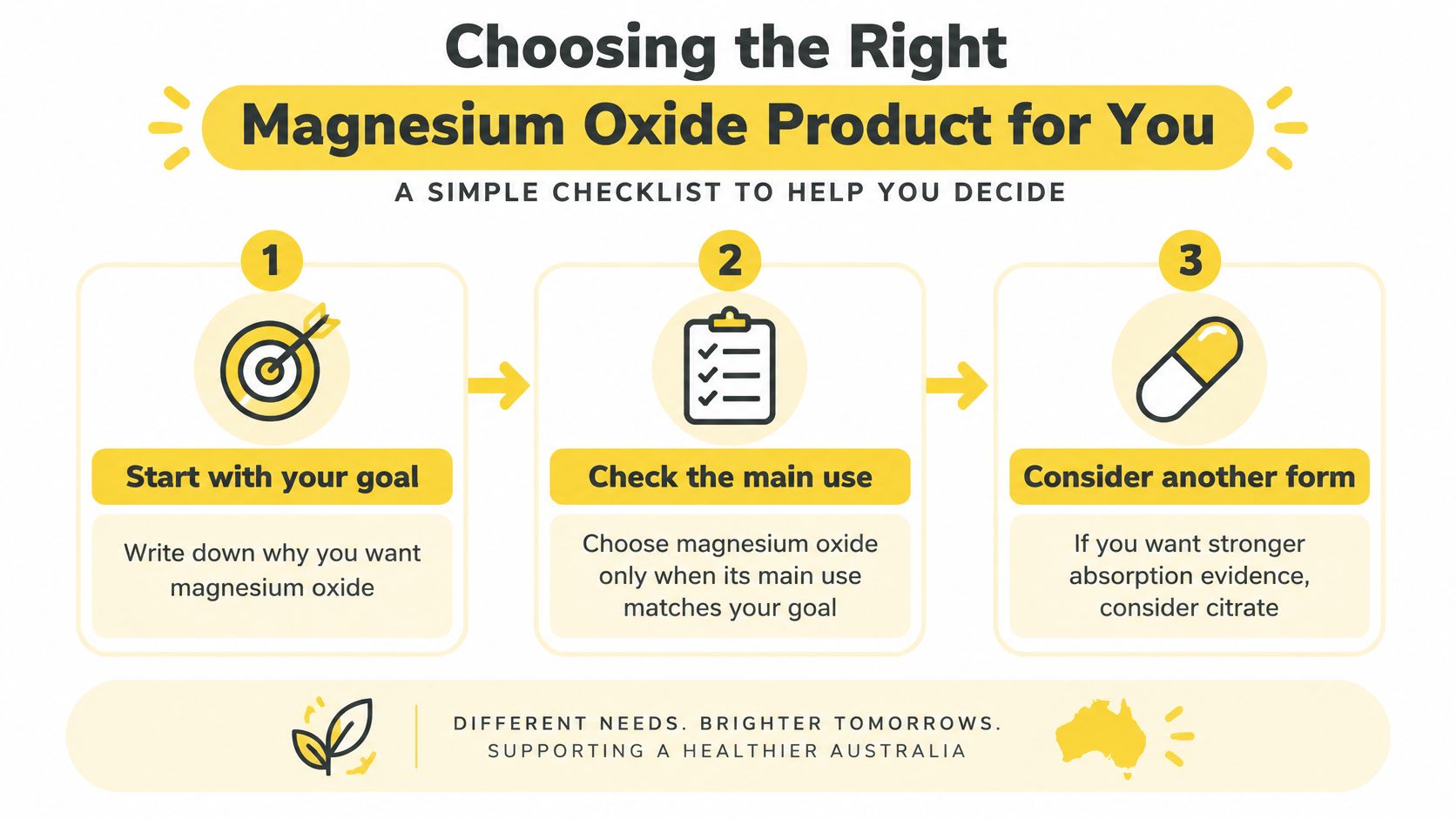
Write the goal down before comparing prices. Three jobs are commonly handed to oxide: correcting low dietary magnesium, easing occasional constipation, and settling occasional heartburn. The first is where buyers most often overpay for the wrong thing, because a cheap oxide can show a high compound weight while little elemental magnesium is absorbed.
If correcting intake is the goal, compare forms rather than cost per bottle. A blended product such as Nutri Triple Magnesium + L Theanine, 120 Vegan Capsules still needs the same label checks below: confirm the named forms, find elemental magnesium per serving, then count it toward your daily total. For a closer look at a glycinate option, see buying magnesium glycinate in Australia. Shoppers comparing similar salts across the Tasman can also read magnesium supplement advice from NZ Supps.
If the goal is occasional constipation or antacid use, a compact oxide product can suit, provided the supplemental total stays inside the ceiling in the reference table.
Speak with a GP, pharmacist or dietitian before choosing if you have a kidney condition, take regular medicines, or have diarrhoea that will not settle. Wallaby Wellness sells magnesium supplements alongside vitamin C, vitamin D, and zeolite and colloidal minerals, so the bottle in your basket may not be the only source of magnesium in the order. Browse the range at Wallaby Wellness and match the serving on the panel to the goal you wrote down.