What Is NAC Supplement and How It Works
, 16 min reading time
What is NAC supplement? See how this cysteine ingredient is used, how Australian doses differ from hospital care, and which safety checks matter.
The word antioxidant makes NAC sound gentler than it is. NAC, or N-acetylcysteine, is a cysteine-derived ingredient Australian shoppers meet in three different ways: as a glutathione precursor, as a supervised paracetamol overdose antidote in hospital, and as lower-dose retail capsules with unevenly proven everyday claims.
Treat “detox” slogans as marketing; hospital evidence is a different standard. The practical check is the label: serving size, daily directions and stated purpose. A capsule sold for general antioxidant support should not be used to copy clinical dosing or manage poisoning.
NAC, also called acetylcysteine, is a cysteine-derived ingredient with three roles Australian shoppers regularly mix up: a glutathione precursor, a supervised paracetamol antidote, and a lower-dose retail capsule.
A bottle sold for antioxidant support belongs in a different category from a clinician's treatment protocol or an investigator's trial. When someone asks what an NAC supplement is, the useful answer starts with which of these roles the claim refers to.
Three roles of NAC and what each dose means
| Role | Where it is used | Dose context | What it is not |
|---|---|---|---|
| Retail NAC supplement | Australian shop or online listing | The product's labelled oral serving and daily directions | Not a hospital antidote or a reason to raise the dose |
| Paracetamol overdose antidote | Hospital and poisons care in Australia | Clinician-directed dosing, adjusted to the poisoning circumstances | Not something to self-treat with a retail bottle |
| Research protocol | Clinical trials, including runner and Melbourne pilot studies | A study-specific single dose or supervised daily regimen | Not a standard supplement serving to copy |
The ingredient name can stay the same while the purpose, formulation, monitoring and evidence change substantially. Describing NAC as medically established doesn't validate every claim on a supplement listing.
An observational Australian Paracetamol Project study found that, in patients with massive overdose and high paracetamol concentrations, an increased NAC dose within 21 hours was associated with a lower risk of hepatotoxicity, with an odds ratio of 0.27 and a 95% confidence interval of 0.08–0.94. Hepatotoxicity means liver injury caused by a substance.
That result comes from supervised emergency treatment of poisoning patients. Because the study was observational, its association also shouldn't be presented as a guaranteed outcome for an individual patient.
Emergency rule: If you suspect someone has taken too much paracetamol, contact emergency services or the Poisons Information Centre. Don't attempt treatment with a retail NAC supplement.
For everyday shopping, keep the question narrower: what does this particular product claim, what amount does its label recommend, and is there evidence relevant to that use? Those questions prevent a hospital medicine's reputation from becoming an all-purpose endorsement of a pantry capsule.
NAC has one job in this story: it delivers cysteine, the raw material your cells use to manufacture glutathione. Every health claim built on NAC starts from that supply relationship.
Chemically, NAC is the amino acid L-cysteine with an acetyl group attached. Acetylated describes that structural modification, which changes how the molecule is absorbed and handled by the body.
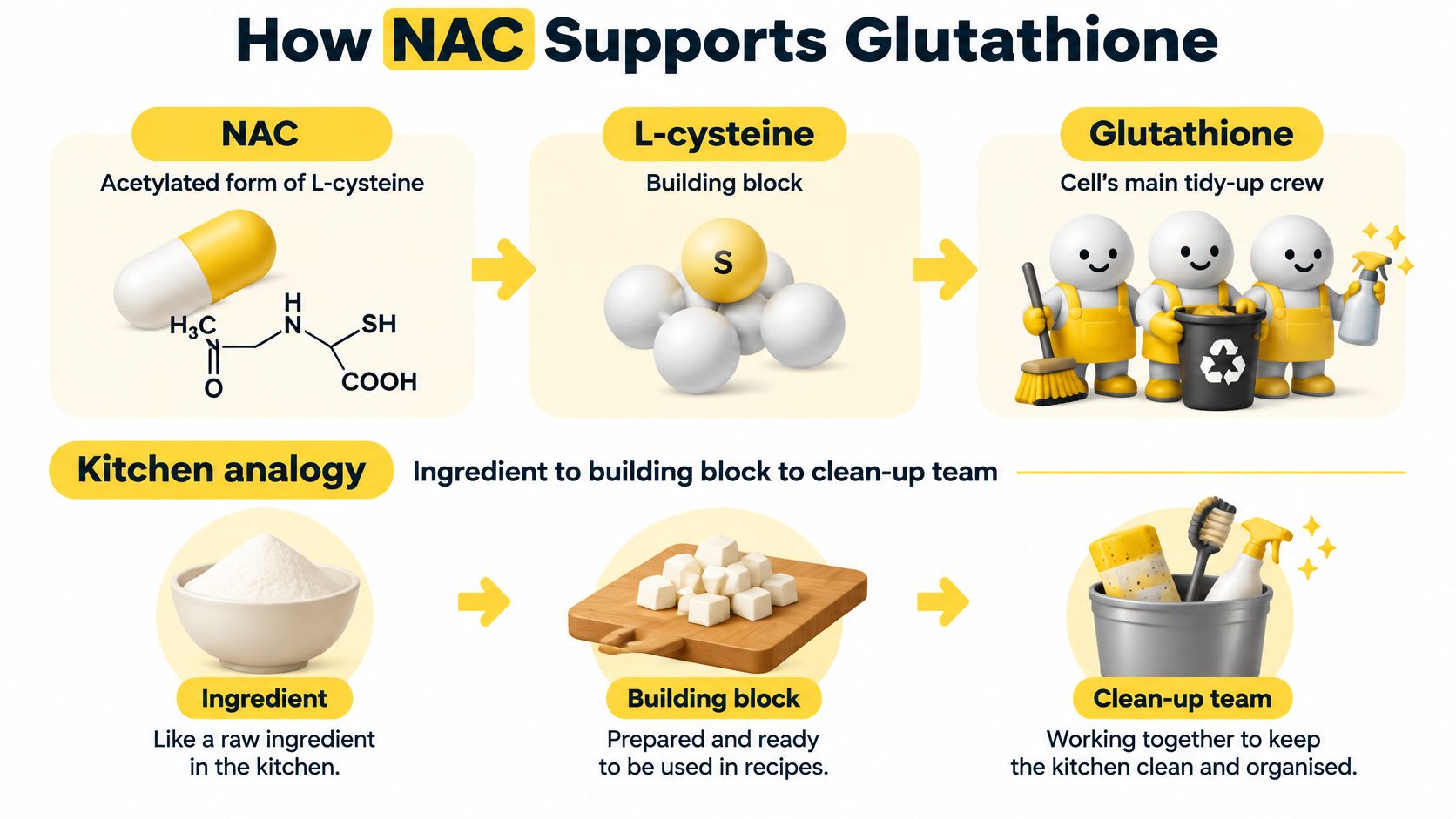
NAC supplies cysteine; glutathione is the molecule your cells assemble from it. In chemistry terms, NAC is a precursor: a starting material the body converts into something else.
Glutathione is a major intracellular antioxidant and redox regulator. Intracellular means inside cells, and redox regulation describes the control of chemical reactions involving oxidation and reduction. Within that environment, glutathione helps keep oxidation in check.
NAC also carries a free sulfhydryl group, a chemical feature that can directly reduce some oxidised molecules. Between that direct action and its role as a cysteine donor, researchers have a plausible reason to study NAC in conditions involving oxidative stress.
Supplying a building block doesn't prove that every oral capsule produces a clinically meaningful increase in tissue glutathione.
Delivering an ingredient shows what could be made. It says nothing about how much finished product results, where it ends up in the body, or whether anyone feels a difference afterwards.
The missing step for a shopper is usually the clinical outcome. Showing that NAC can support glutathione production still leaves open whether the studied formulation improved breathing, mood, exercise recovery or any other result a label might imply.
Three questions separate a mechanism from a benefit worth paying for:
A claim can answer the first question convincingly and still have nothing to say on the third. Hospital use sits in a different category entirely, involving medical dosing, oral or intravenous protocols and laboratory monitoring, so a consumer capsule or powder gains no credibility from that setting.
A mechanism explains what might happen. An outcome shows what did happen. For an everyday supplement, the second is the evidence that counts.
Australian status starts with the label, then the daily directions. A bottle can say NAC prominently while its lawful pathway still depends on dose, formulation, claims and presentation.
The TGA's regulatory-impact material identifies acetylcysteine as Schedule 2 in oral preparations unless the label recommends a daily dose of 1 gram or less, with other scheduling circumstances, including Schedule 4 provisions and specified exceptions. Treat that threshold as a classification line drawn from the recommended daily amount, separate from any personal target dose.
How Australian NAC products are treated
| What you see | Regulatory signal | What to verify |
|---|---|---|
| Oral product within the lower labelled daily-dose exception | A dose-based exception may apply to the oral scheduling provision | Total labelled daily amount, beyond the amount per capsule |
| Oral product above that exception | Scheduling controls apply according to the preparation and relevant provisions | Exact schedule, formulation and lawful supply pathway |
| Listed medicine | Sponsor self-certification generally focuses on safety and quality rather than full pre-market efficacy assessment | ARTG listing and the specific claim |
| Registered complementary medicine | AUST R identification and pre-market evaluation of safety, quality and efficacy | Registration details match the pack |
| Imported or unapproved therapeutic good | Overseas availability leaves Australian evaluation unresolved; an unapproved good has not undergone that evaluation | Australian status ahead of a foreign website's assurances |
A prominent amount on the front may describe what sits in a capsule or serving. The directions field is the part that adds each recommended dose across the day, so count every directed serving before judging where the product sits.
Marketing words such as detox, lung support and glutathione support describe positioning. They sit outside the scheduling and listing checks, so read them as claims to weigh against the actual directions, formulation and ARTG details.
Listed, assessed listed and registered medicines follow distinct pathways. A listed medicine relies on sponsor self-certification centred on safety and quality. Assessed listing adds evaluation of evidence for particular claims. Registered complementary medicines undergo evaluation of safety, quality and efficacy before supply and carry AUST R identification on the label and packaging.
That hierarchy explains why two NAC bottles can share an ingredient name yet sit in different regulatory lanes. For shoppers comparing categories, our guide to gut health supplements in Australia provides a separate category reference, while each NAC product still needs its own label, dose and status check.
An overseas checkout page can show a familiar ingredient and a lower price while leaving Australian evaluation unresolved. Confirm the formulation, daily directions and regulatory details before buying.
A Melbourne pilot published in 2025 gave 36 adults with loss-of-control eating 2,400 mg of NAC a day for 12 weeks, and participants reported improvements in cravings and eating-related measures. That result sounds stronger than it is: the study was open-label, single-site and preliminary, so it does not establish a generally effective treatment or justify copying the regimen at home.
Open-label means participants knew what they were taking. Without a blinded comparison, it is harder to separate an ingredient's effects from expectations, changes in behaviour and other influences.
An Australian New Zealand Clinical Trials Registry entry registered in 2024 specified a single 600 mg dose for a controlled trial involving physically active amateur long-distance runners. A registry entry records a study plan; it is not a published finding that NAC improves performance or recovery.
Part of the confusion is that NAC's antioxidant reputation covers three different things shoppers often merge into one: a glutathione precursor, a supervised hospital antidote for paracetamol overdose, and lower-dose retail capsules whose popular claims are unevenly proven. The comparison below separates them.
NAC uses and how strong the evidence is
| Use people ask about | What exists | Shopper takeaway |
|---|---|---|
| Paracetamol overdose | Established hospital antidote with supervised dosing and monitoring | Don't self-treat with a supplement |
| Loss-of-control eating | A small, open-label Melbourne pilot | Preliminary findings, not a retail dosing instruction |
| Exercise in amateur runners | A registered controlled-trial protocol | A trial plan, not a proven recovery benefit |
| Respiratory or sinus comfort | Consumer claims with evidence that differs by condition and dose | A lung-support label isn't proof of relief |
| Liver detox, immunity or mood | Popular wellness claims with uneven evidence | Judge the specific claim, not the slogan |
Antioxidant activity describes chemistry. A meaningful health claim needs a defined outcome, so ask what the product is meant to improve and whether evidence addresses that outcome in people like you.
Study doses belong to their protocols. Investigators choose amounts for a particular question, participant group and protocol. Moving an amount from a study into your daily routine removes that context without proving greater benefit.
A polished product page cannot establish Australian regulatory status. Overseas popularity or repeated recommendations are reasons to examine a claim more closely, not evidence that it has been independently confirmed.
A useful claim names an outcome. Better cravings, fewer symptoms and a laboratory marker are different results, even when they appear under the same antioxidant headline.
Fertility is another area where shoppers may encounter NAC discussions. The Axelrad Clinic's discussion of NAC in fertility supplements offers context for that conversation, but an individual fertility decision belongs with a treating clinician rather than a general supplement recommendation.
If you're comparing unfamiliar ingredients more broadly, our explanation of what black seed oil is covers a different ingredient with its own evidence base. Don't transfer the evidence or proposed uses of one supplement to another just because both appear in antioxidant discussions.
Before accepting a headline, match the studied purpose, formulation, daily amount and participants to the product you're considering. Where the match is unclear, the honest conclusion is uncertainty rather than an assumption that the benefit will carry across.
Mr Supplement's NAC overview describes Australian retail amounts around 500–600 mg per serve and notes that NAC can potentiate the effects of nitroglycerin and related medicines. A familiar serving size doesn't remove medication-related risks.
If you're treated for cardiovascular disease, start with a pharmacist or doctor's review rather than a trial purchase. A supplement's antioxidant reputation doesn't tell you how it fits your prescriptions. The three-way mix-up matters most: a supervised hospital antidote, a glutathione precursor and a retail capsule sit under the same acronym, and the label alone can't tell you which safety assumptions apply.
Use this checklist to prepare that conversation.
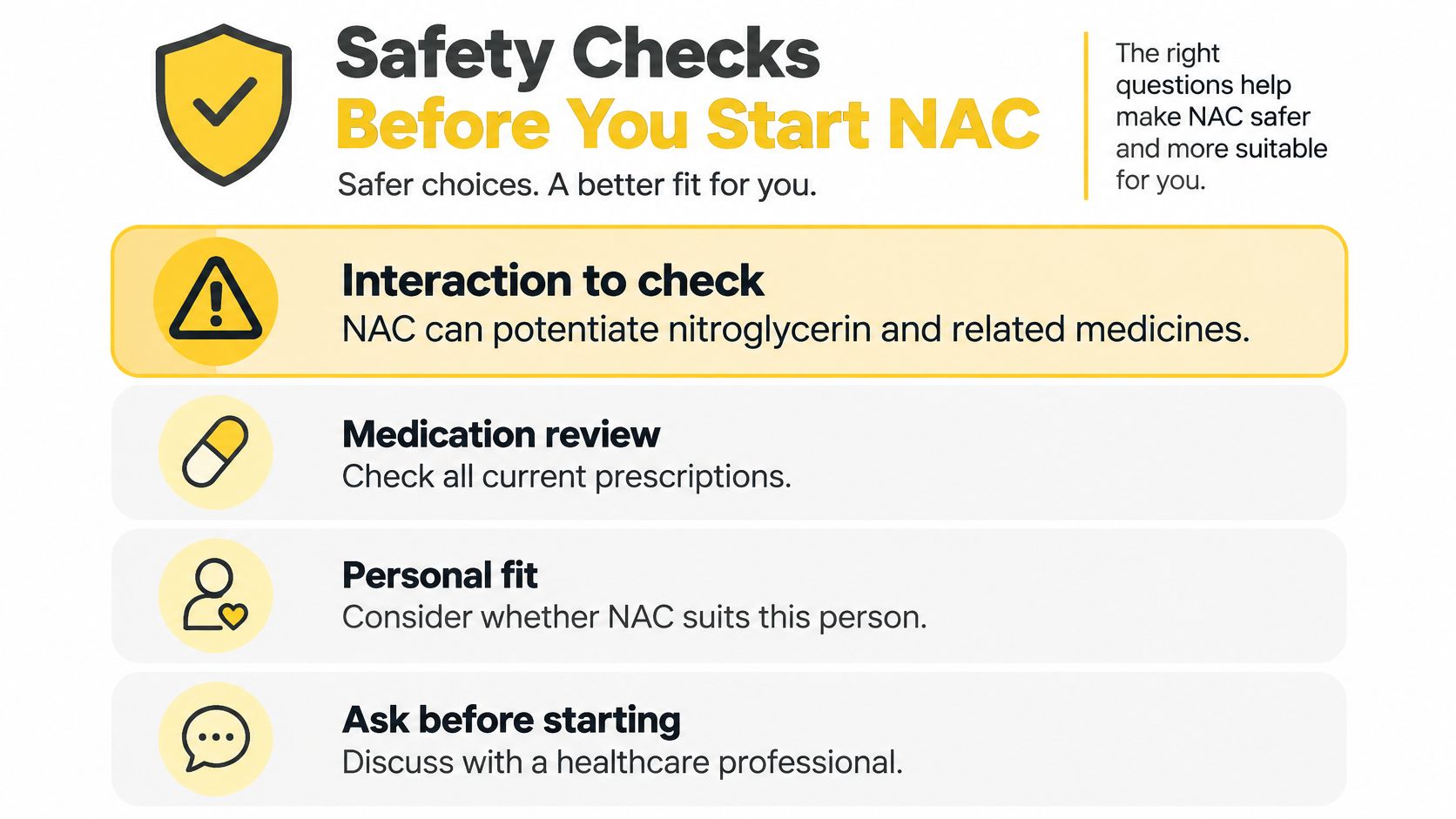
This is a discussion checklist, not clearance to start. Your pharmacist or doctor may need to consider the formulation, other ingredients and the reason you want to take it.
NAC can cause gastrointestinal symptoms, including nausea and stomach upset. If symptoms persist or an unexpected reaction occurs, stop taking it and speak with a health professional rather than increasing the amount or trying to tolerate it.
Don't escalate your serving because a study used a higher daily amount. Research supervision and a defined protocol aren't reproduced by taking extra capsules.
For broader supplement reading, our guide to the health properties of zinc discusses another ingredient separately. It shouldn't be interpreted as advice to combine zinc with NAC.
The video below talks through similar precautions in spoken form. Keep your product label and medicine list in hand while you watch, and treat it as background for the pharmacist conversation above rather than a substitute for it.
Stop self-treatment and seek advice for a new rash, breathing symptoms or persistent stomach upset. Breathing difficulty calls for urgent medical assessment.
Any plan to replace prescribed treatment with NAC also needs a clinician's review before you make the change. The important question isn't whether NAC is safe in the abstract, but whether this product is appropriate for you.
The retail version of NAC stands or falls on its label. Regulatory status is more useful than a reassuring slogan. The TGA's assessed listed medicines guidance distinguishes ordinary listing from the pathway in which evidence for particular health claims is evaluated.
Choose by what the pack declares rather than the strongest promise on the front. Three checks do most of the work.
Pregnancy, breastfeeding, asthma, current medicines and chronic conditions belong to the safety checks covered earlier, and daily amounts belong to the Australian dose rules. Resolve those questions with a pharmacist or doctor before the product reaches your cart.
Two NAC products can sit side by side and still differ in declared daily amount, excipients and regulatory details, so compare labels rather than packaging or storefront imagery.
An ARTG entry is a regulatory signal. Proven benefit and personal suitability are separate questions, so keep the pack details, your intended use and your health history together when making the decision.
Wallaby Wellness lists NAC alongside probiotics, gut health supplements, nattokinase and TUDCA, so you can compare targeted supplement categories within the one Australian catalogue once those checks are done. Retail browsing helps you compare products; a health professional determines medical suitability.
Suspected paracetamol overdose still calls for emergency or poisons care. It is never a shopping decision.
Wallaby Wellness offers NAC supplements alongside gut health products and other targeted supplement categories. Visit Wallaby Wellness to compare labelled options after checking the daily directions and Australian regulatory details, and take any medication or suitability questions to your pharmacist or doctor before starting.